

A dedicated debt-snowball tracker can make it easier to record balances, minimum payments, and each small win while you follow the plan.
As an Amazon Associate, we may earn from qualifying purchases.
The debt snowball method is a repayment strategy that helps you clear what you owe by targeting your smallest balance first while paying the minimum on everything else. If large debts and maxed-out credit cards feel impossible to escape, the debt snowball method gives you a clear order of attack and a series of quick wins that keep you moving forward. This article explains exactly how the system works, why it succeeds where willpower alone fails, and how to build a plan you can start this week.
Most people do not abandon debt repayment because the math is too hard. They quit because progress feels invisible — payments disappear into interest, balances barely move, and motivation drains away. The snowball approach solves the motivation problem by engineering small victories early, so you stay committed long enough to reach the larger balances.
By the end of this article, you will know how to list and rank your debts, how to free up extra cash to accelerate payoff, how the snowball compares with the avalanche method, and which tools make tracking effortless. You will also learn the common mistakes that stall progress, and how to protect your momentum until the final balance hits zero. The goal is simple: a repeatable system that turns an overwhelming pile of debt into a sequence of manageable, motivating steps.
1. What the Debt Snowball Method Is
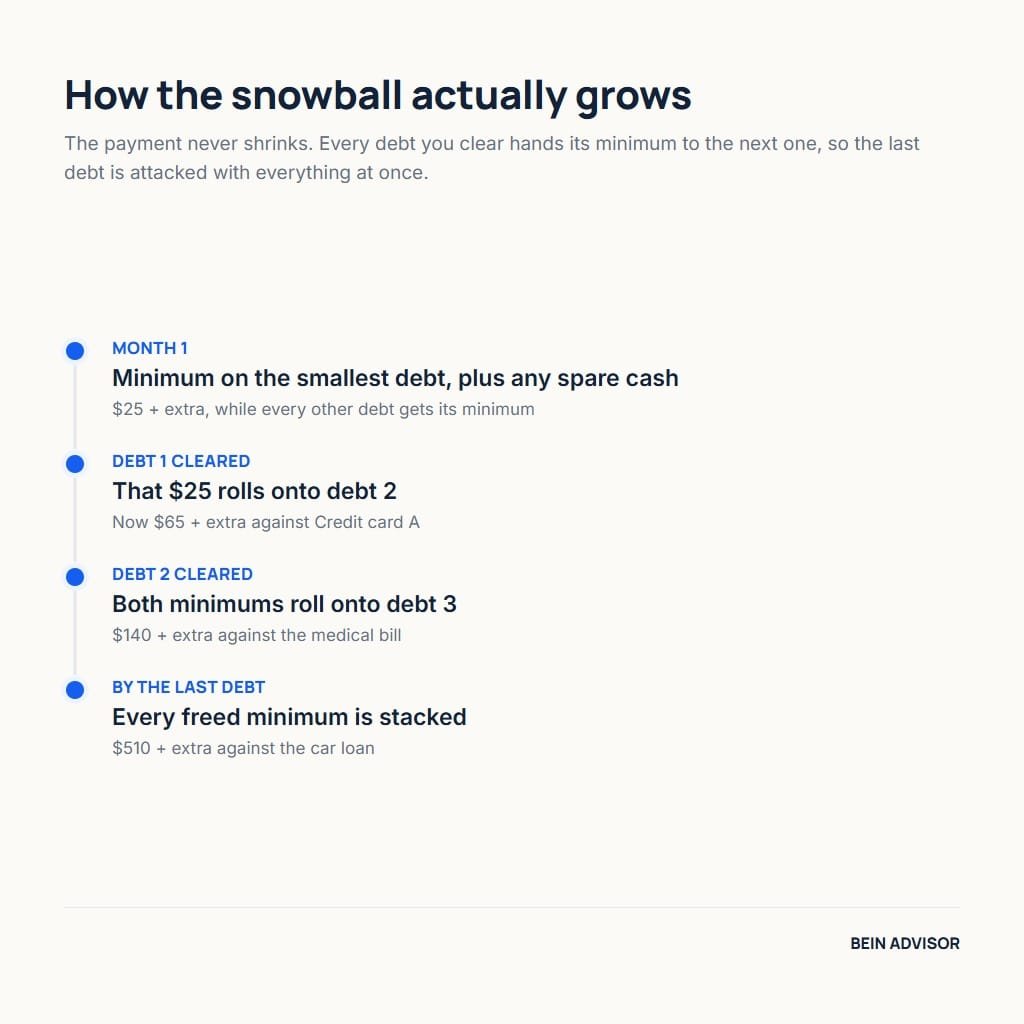
The debt snowball method is built on a single, powerful idea: momentum matters more than math when you are trying to escape debt. Instead of ranking your balances by interest rate, you rank them by size and attack the smallest one first. Every other debt receives only its minimum payment until that smallest balance is gone. Then the money you were sending to it rolls onto the next-smallest debt, creating a payment that grows larger with each victory — much like a snowball gathering size as it rolls downhill.
1.1 The Core Principle Behind the Method
The principle at the heart of the debt snowball method is behavioral, not financial. Clearing debt is a long project that can take months or years, and the biggest risk is not a high interest rate — it is giving up. By paying off a complete balance quickly, you receive proof that the plan works. That proof releases a sense of accomplishment that fuels the next payment. Each closed account is a finished task, and finished tasks build the confidence needed to keep sacrificing until every balance reaches zero.
1.2 Why the Snowball Targets the Smallest Balance First
Targeting the smallest balance first feels counterintuitive, because a larger debt with a high rate costs you more over time. Yet the smallest balance is the one you can eliminate fastest, often within a few weeks or months. That speed is the point. When an entire account disappears from your list, the psychological lift is immediate and concrete. The debt snowball method trades a small amount of interest for a large amount of motivation, and for most people that trade is what finally carries them across the finish line.
2. How the Debt Snowball Method Works Step by Step
Putting the debt snowball method into action takes four repeatable moves. First, you list every debt except your mortgage. Second, you order those debts from the smallest balance to the largest, ignoring interest rates. Third, you pay the minimum on all of them while throwing every spare dollar at the smallest. Fourth, when that debt is gone, you roll its entire payment onto the next one. Repeat the cycle and the payment grows steadily until the last and largest balance falls.
2.1 Listing Every Debt You Owe
Start by gathering every balance you carry: store cards, credit cards, personal loans, medical bills, car loans, and money borrowed from family. Write down the total balance and the minimum monthly payment for each. Seeing the full picture in one place can be uncomfortable, but clarity is the foundation of the debt snowball method. You cannot build momentum against a target you have not measured, and a complete list prevents forgotten balances from surprising you later and breaking your stride.
2.2 Building the Snowball Payment
The snowball payment is the engine of the whole system. It begins as the minimum payment on your smallest debt plus any extra cash you can spare that month. Once that debt is cleared, you do not absorb the freed-up money back into spending. Instead, you add it to the minimum of the next debt. A sixty-dollar minimum joined by a ninety-dollar freed payment becomes a one-hundred-and-fifty-dollar attack on the following balance, and the snowball keeps compounding in your favor with every account you close.
3. Debt Snowball vs. Debt Avalanche
The most common alternative to the snowball is the debt avalanche, which orders debts by interest rate and targets the highest rate first. Both methods ask you to pay minimums on everything else and funnel extra money toward one focus debt. The difference is the ranking, and that single difference produces very different experiences. Understanding the trade-off helps you choose the approach you will actually finish.
3.1 The Math Behind Snowball vs. Avalanche
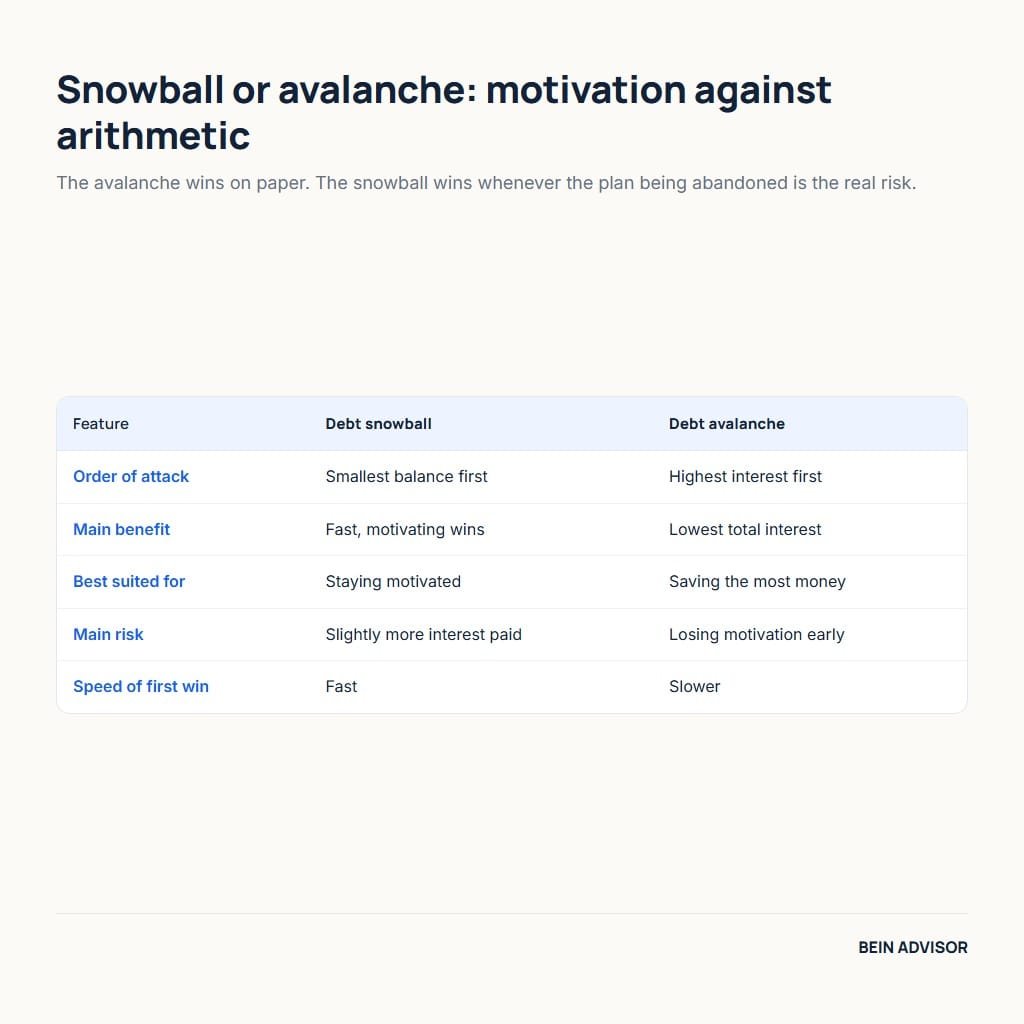
On paper, the avalanche wins. By eliminating the highest interest rate first, it reduces the total interest you pay and can shorten the timeline slightly. For someone with a large, high-rate balance, the savings can be meaningful. The table below shows how the two methods treat the same set of debts, so you can see where the avalanche saves money and where the snowball delivers its first win sooner.
| Feature | Debt Snowball | Debt Avalanche |
|---|---|---|
| Order of attack | Smallest balance first | Highest interest first |
| Main benefit | Fast, motivating wins | Lowest total interest |
| Best suited for | Staying motivated | Saving the most money |
| Main risk | Slightly more interest paid | Losing motivation early |
| Speed of first win | Fast | Slower |
3.2 Why Behavior Often Beats Math
Research into personal finance behavior has repeatedly found that people who use the debt snowball method are more likely to stay the course and become debt-free. The reason is engagement: early wins keep you involved, and an involved person keeps paying. A mathematically perfect plan that you abandon halfway saves nothing. The debt snowball method accepts a small interest cost in exchange for a far higher chance of completion, which is why so many advisors recommend it to anyone who has struggled to stay motivated.
4. Setting Up Your Debt Snowball Plan
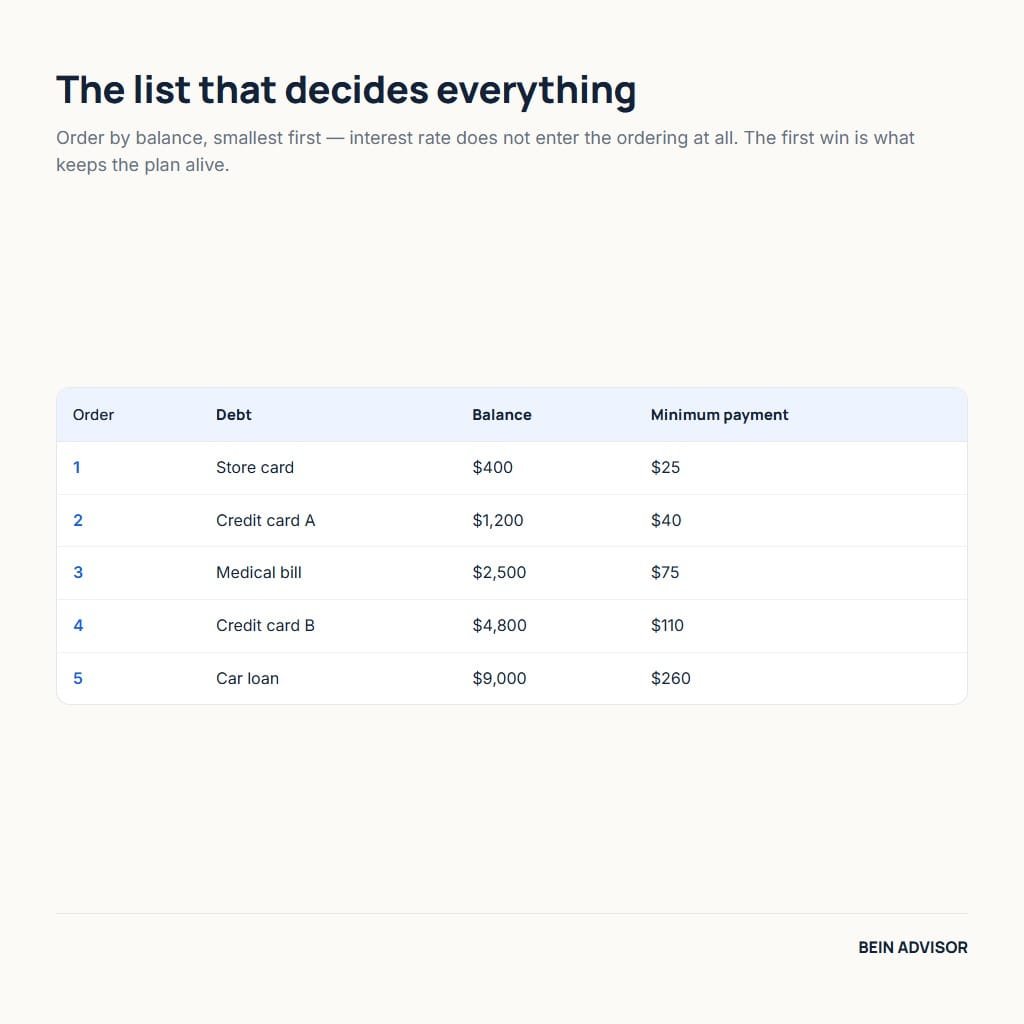
A plan only works once it lives on paper or a screen where you can see it every week. Setting up the debt snowball method means turning your list of balances into an ordered schedule, confirming the minimums, and deciding how much extra you can commit. The example below walks through a realistic set of debts so you can model your own numbers against it and see the order of attack at a glance.
4.1 Calculating Your Minimum Payments
Your minimum payments form the baseline of the entire plan, because you must keep every account current to protect your credit and avoid penalty fees. Add up all the minimums to find the floor of your monthly debt budget. Anything you pay above that floor is your snowball fuel. Knowing the exact total also reveals how much breathing room you have, and whether you need to trim expenses or raise income before the debt snowball method can pick up real speed.
| Order | Debt | Balance | Minimum payment |
|---|---|---|---|
| 1 | Store card | $400 | $25 |
| 2 | Credit card A | $1,200 | $40 |
| 3 | Medical bill | $2,500 | $75 |
| 4 | Credit card B | $4,800 | $110 |
| 5 | Car loan | $9,000 | $260 |
4.2 Finding Extra Money to Accelerate
The faster you want the snowball to roll, the more extra money it needs each month. Review your spending for subscriptions you do not use, dining costs you can cut, and services you can pause. On the income side, a side job, overtime, or selling unused items can add meaningful fuel. Even an extra one hundred dollars a month dramatically shortens the timeline of the debt snowball method, because that amount compounds onto every balance as you progress down the list.
5. Tackling Credit Cards With the Snowball
Credit cards are where the debt snowball method proves its worth, because card balances are often small enough to clear quickly yet painful enough to feel like real victories. Most households carry several cards with different limits and rates, and the snowball gives you a clear order for clearing them without agonizing over which to choose first or second.
5.1 Handling High-Interest Cards in the Snowball
High-interest cards are expensive, and the snowball does not ignore them — it simply does not always attack them first. If a high-rate card also happens to carry your smallest balance, it becomes your first target naturally. If it is a larger balance, it waits its turn while the snowball grows strong enough to crush it. You can also call your issuer to request a lower rate, which reduces the interest drag without changing your snowball order at all.
5.2 Avoiding New Card Debt
The debt snowball method only works if the balances move in one direction. Adding new charges to a card you are trying to pay off is like bailing a boat while leaving the hole open. While you follow the plan, switch to cash or debit for everyday spending, keep one card for genuine emergencies, and pause the habits that created the balances. Protecting your progress is as important as making the payments, because a single relapse can erase months of effort.
6. Tools and Apps to Track Your Snowball
The debt snowball method is simple enough to run on paper, but the right tools make it easier to stay consistent and see how far you have come. A good tracker shows your ordered list, updates balances as you pay, and projects your debt-free date. Below are categories of resources that pair well with the method and help you keep the plan visible.
6.1 Budgeting Apps
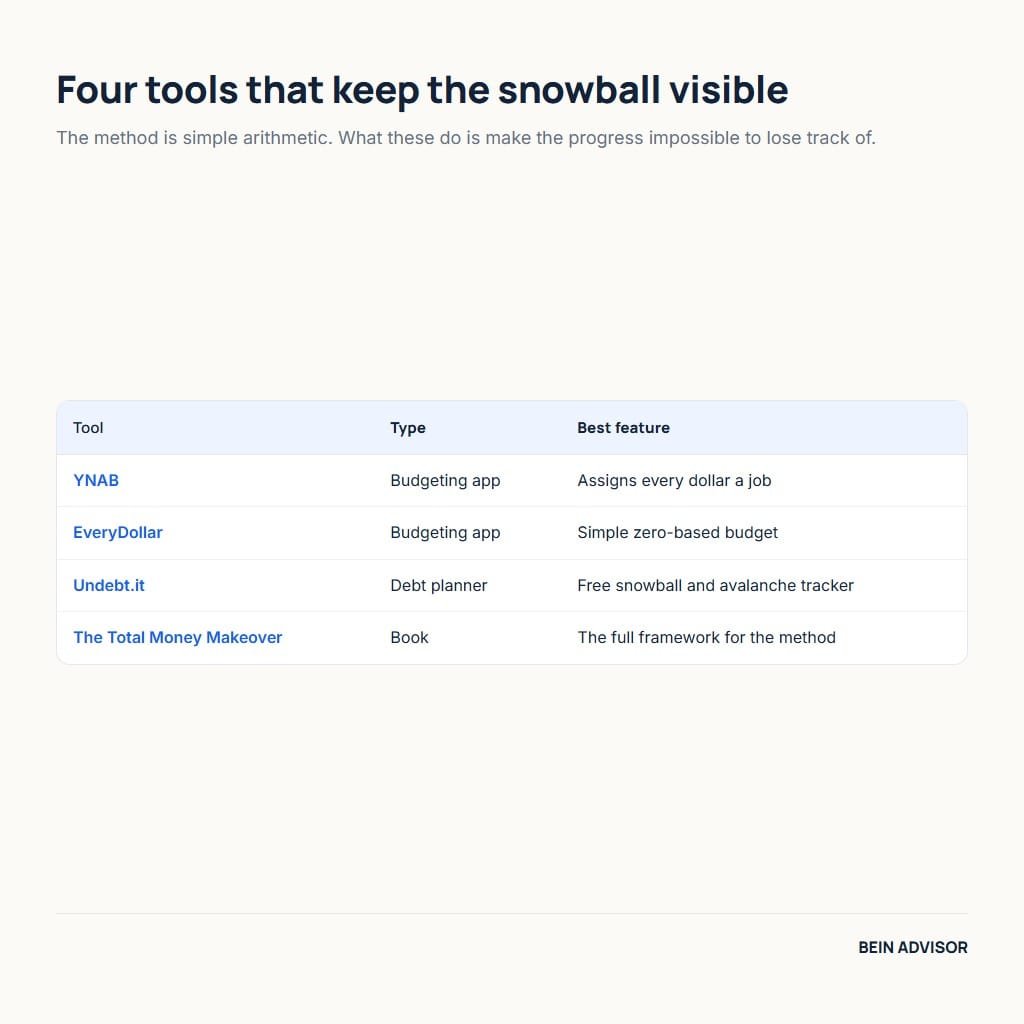
A dedicated budgeting app keeps your plan visible and automatic. You Need A Budget (YNAB): helps you assign every dollar a job, which makes finding snowball fuel far easier. EveryDollar: built around the same philosophy, offers a simple zero-based budget and a debt-tracking view that complements the method. Undebt.it: is a free planner designed specifically for the snowball and avalanche, letting you compare timelines and check off each balance as it falls.
6.2 Books and Courses
If you want the full framework behind the method, The Total Money Makeover: by Dave Ramsey lays out the snowball within a complete plan for building financial stability. Financial Peace University: and similar structured courses add community and accountability, which many people find essential for sticking with the debt snowball method over the long haul. A single well-chosen book or course can replace dozens of scattered videos and give you one consistent system to follow.
| Tool | Type | Best feature |
|---|---|---|
| YNAB | Budgeting app | Assigns every dollar a job |
| EveryDollar | Budgeting app | Simple zero-based budget |
| Undebt.it | Debt planner | Free snowball and avalanche tracker |
| The Total Money Makeover | Book | Full framework for the method |
7. Common Debt Snowball Mistakes to Avoid
Even a system as straightforward as the debt snowball method can be undermined by a few avoidable errors. Knowing them in advance protects your momentum and keeps your debt-free date from slipping. The mistakes below are the ones that most often derail otherwise committed people, so guard against them from the very first month.
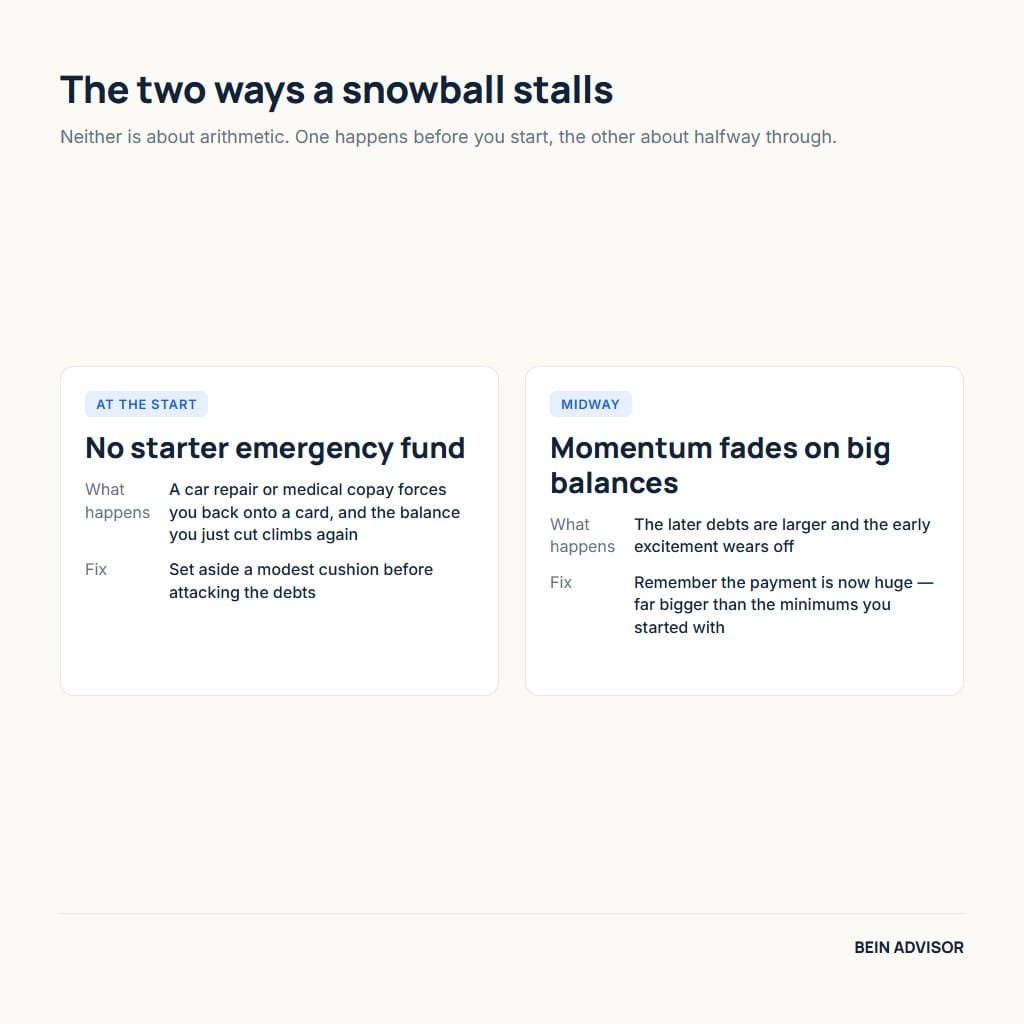
7.1 Skipping a Starter Emergency Fund
Beginning the snowball with no cash cushion is a common trap. When an unexpected bill arrives — a car repair, a medical copay — you are forced back onto a credit card, and the balance you just reduced climbs again. Setting aside a small starter emergency fund before you attack your debts gives you a buffer that keeps life’s surprises from breaking your plan. The debt snowball method works best when a modest safety net stands between you and the next emergency.
7.2 Losing Momentum on Larger Balances
The later debts in your list are bigger, and the excitement of early wins can fade as you face them. This is where many people stall. The cure is to remember that your snowball payment is now large — far bigger than the minimums you started with — so even a sizable balance falls faster than it would have at the beginning. Tracking your progress visually and revisiting how far you have come keeps the debt snowball method from losing steam during its final, most important stretch.
8. Staying Motivated Until Debt Freedom
Motivation is the fuel the debt snowball method is designed to protect, and a few simple habits keep that fuel topped up. The plan rewards you with regular wins, but you can amplify those rewards and make the long journey feel shorter and more satisfying with a little deliberate effort.
8.1 Celebrating Small Wins
Every time you close an account, mark the moment. Cross the balance off your list, tell someone who supports your goal, or enjoy a small, inexpensive reward. These celebrations are not frivolous — they are the psychological payoff that the debt snowball method is built around. Acknowledging each victory reinforces the behavior and makes the next sacrifice feel worthwhile, turning a long grind into a series of achievements you can be proud of.
8.2 Tracking Your Snowball Progress Visually
A visual tracker turns abstract numbers into something you can feel. A debt thermometer you color in, a chart that shrinks, or an app that counts down your debt-free date all make progress tangible. Seeing the line move keeps the goal in front of you on the hard days. Many people find that a visible chart is the single most powerful motivator in the entire debt snowball method, because it converts months of effort into a picture of steady, undeniable progress.
Conclusion: Your Path to Debt Freedom
The debt snowball method succeeds because it works with human nature instead of against it. By clearing your smallest balances first, you generate the early wins that keep you committed, and by rolling each freed payment forward, you build an unstoppable force that eventually levels even your largest debts. The strategy costs a little extra interest, but it buys something more valuable: the motivation to actually finish.
Start today by listing every balance, ordering them from smallest to largest, and deciding how much extra you can commit this month. Pick your tools, set up a visual tracker, and protect your momentum with a small emergency fund. Follow the steps with patience and consistency, and the debt snowball method will carry you from a stack of overwhelming bills to the day you make your final payment and step into a debt-free life.