
A flashcard business lets you turn simple educational cards into a product that parents and teachers buy again and again, in both digital and printed form. Because a flashcard business sells learning rather than a passing trend, demand stays steady: every year a new wave of toddlers and young students needs help with letters, numbers, words, and concepts. This article walks through six ultimate steps to design, produce, sell, price, and scale a profitable line of educational flashcards for children.
The appeal of this niche is its rare mix of low cost and high repeatability. A single well-designed set can be sold as an instant digital download with almost no marginal cost, or printed and shipped for a healthy margin. You design once and sell endlessly, which makes flashcards one of the friendliest products for a first-time creator. Parents value anything that helps their child learn, and that emotional motivation makes them eager, repeat buyers.
By the end of this article, you will know how to pick a profitable niche, design cards that genuinely teach, build both digital and printable versions, choose where to sell, price for profit, and market to parents and teachers. You do not need to be a professional illustrator or own a print shop — modern design tools and print-on-demand services remove almost every barrier. What you need is a clear plan, and the steps below give you exactly that.
1. Step 1 — Choose Your Flashcard Niche and Audience
The niche you choose shapes everything that follows, from design to marketing, so it deserves real thought. A flashcard business that tries to teach everything to everyone competes with thousands of generic sets, while a focused line — phonics for preschoolers, sight words for early readers, or first words in two languages — speaks directly to a specific need. Choosing a clear topic and age range makes your cards easier to design, easier to find, and far easier for a parent to recognize as exactly what their child needs.
1.1 Picking a Profitable Learning Topic
Start by finding the overlap between what children need to learn and what parents actively search for. Foundational skills — the alphabet, numbers, colors, shapes, phonics, and early vocabulary — sell steadily because every child passes through them. Search marketplaces and note which flashcard sets have many reviews, since reviews are proof that people are buying. A flashcard business built on a proven, in-demand topic starts with a market that already exists, which is far safer than betting on a clever idea no one is looking for.
Within a proven topic, look for an angle that sets your set apart from the crowd. You might focus on a specific teaching method, a distinctive art style, bilingual cards, inclusive imagery, or a theme children love such as animals or space. Early learning is widely recognized as critical by organizations like UNICEF, which means thoughtful, genuinely educational cards stand out. A clear angle gives your flashcard business a reason to be chosen over a cheaper, generic alternative sitting right beside it.
1.2 Knowing Your Buyers: Parents and Teachers
Your two main audiences want slightly different things, and serving both deliberately widens your market. Parents buy for one or two children and care about ease of use, durability, and whether the cards make learning feel fun at home. They often buy on impulse when a set promises to help their child reach a milestone. Designing a flashcard business around the home market means clear instructions, appealing visuals, and sets small enough to feel manageable for a busy family.
Teachers and homeschoolers, by contrast, buy in larger quantities and value alignment with curricula, reusability, and printable formats they can run off repeatedly. They are willing to pay for comprehensive, well-organized sets that save them planning time. Serving educators can turn a flashcard business into a steadier operation, because a teacher who loves your cards may buy your whole catalog and recommend it to colleagues. Understanding both buyers lets you package the same content in ways that appeal to each.
2. Step 2 — Design Flashcards That Teach and Sell
Great flashcards balance two jobs: they must teach effectively and look appealing enough to buy. Design is where many beginners stumble, either by overcrowding cards with detail or by making them pretty but pedagogically weak. The goal is clean, clear cards a child can understand at a glance and a parent is proud to use. Strong design is the single biggest factor that separates a flashcard business people trust from one that looks homemade and cheap.
2.1 Educational Design Principles
Effective learning cards follow simple, child-friendly rules. Use one clear concept per card, large readable fonts, high-contrast colors, and a single strong image so a young child is not overwhelmed. Keep backgrounds clean and consistent across the set so the focus stays on what is being taught. For a flashcard business, this clarity is not just aesthetic — it is what makes the cards actually work, and cards that visibly help a child learn earn the glowing reviews that drive future sales.
Think about how the cards will be used, not just how they look on screen. Add helpful touches such as the word spelled clearly, a simple pronunciation cue, or a matching activity on the back, and keep a consistent layout so the set feels professional. Parents and educators notice when cards are designed by someone who understands how children learn — an insight reinforced by resources on positive parenting. That thoughtfulness gives a flashcard business credibility that thin, decorative sets can never match.
2.2 Visuals, Tools, and Print Quality
You do not need expensive software or drawing skills to create polished cards. Tools like Canva offer child-friendly templates, fonts, and licensed illustrations that let beginners produce professional results quickly, while licensed image libraries provide art you can legally use commercially. Always confirm you have commercial rights to every image and font, because selling work you do not own can end a flashcard business overnight. Clean, consistent, legally safe visuals are the foundation of a product you can sell with confidence.
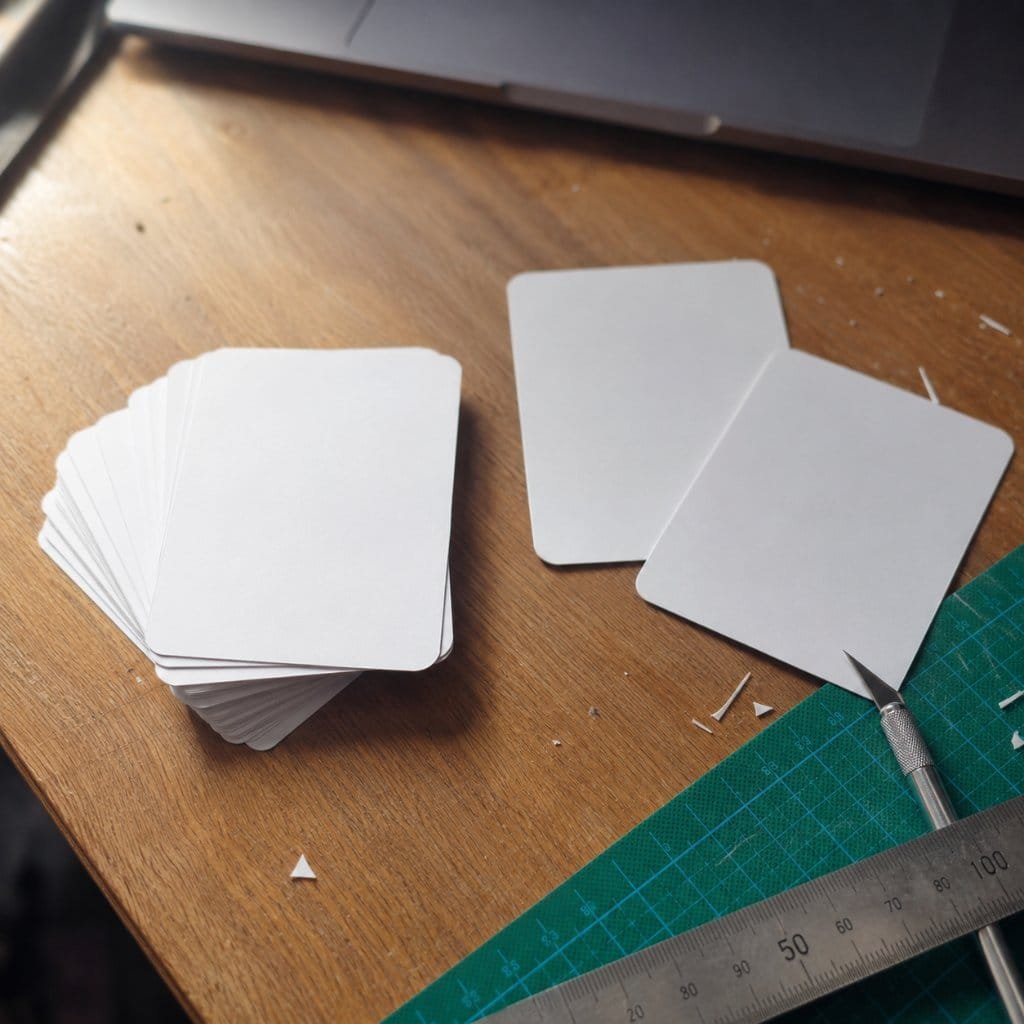
Print quality matters as much as the design itself, especially for physical sets. Design at a high resolution of at least 300 DPI, use a standard card size, and include safe margins so nothing important is trimmed off. Consider durability too, since children handle cards roughly — thicker stock, rounded corners, and a protective coating make printed cards last. Building these print specifications into your files from the start lets a flashcard business move smoothly from a digital design to a physical product without costly redesigns later.
3. Step 3 — Build Digital and Printable Versions
Offering both digital and printed versions lets one design serve several products and price points. A printable PDF download earns money instantly with no shipping, while a professionally printed set commands a higher price and suits buyers who want a ready-made product. Building both from the same artwork doubles your offering with little extra work. This flexibility is a major reason a flashcard business can be so profitable, because the hardest part — the design — is done only once.
3.1 Creating Print-Ready and Digital Files
Export your designs in formats that work cleanly for buyers and printers. A high-resolution, print-ready PDF is the standard for printable downloads, ideally laid out so customers can print several cards per page to save paper. Test-print your files yourself to confirm sizes, colors, and margins behave as expected before any customer sees them. For a flashcard business, files that print perfectly on a home printer prevent the refund requests and poor reviews that follow confusing or broken downloads.
Make the digital product effortless for a non-technical parent to use. Include a short instruction page explaining how to print, cut, and use the cards, and bundle the set as a single clearly named file or folder. Consider offering both a color version and an ink-saving version, since printing costs matter to families. These small courtesies make a flashcard business feel professional and caring, turning a simple PDF into a product buyers happily recommend rather than a confusing file they struggle to open.
3.2 Print-on-Demand vs. Self-Printing
For physical cards, you can either print and ship yourself or use a print-on-demand partner that prints each order for you. Self-printing gives you full control over quality and higher margins, but it means buying stock, managing inventory, and packing every order. Print-on-demand services such as Printify or Printful handle production and shipping automatically, trading some margin for huge convenience. The right choice depends on your volume, budget, and how hands-on you want a flashcard business to be.
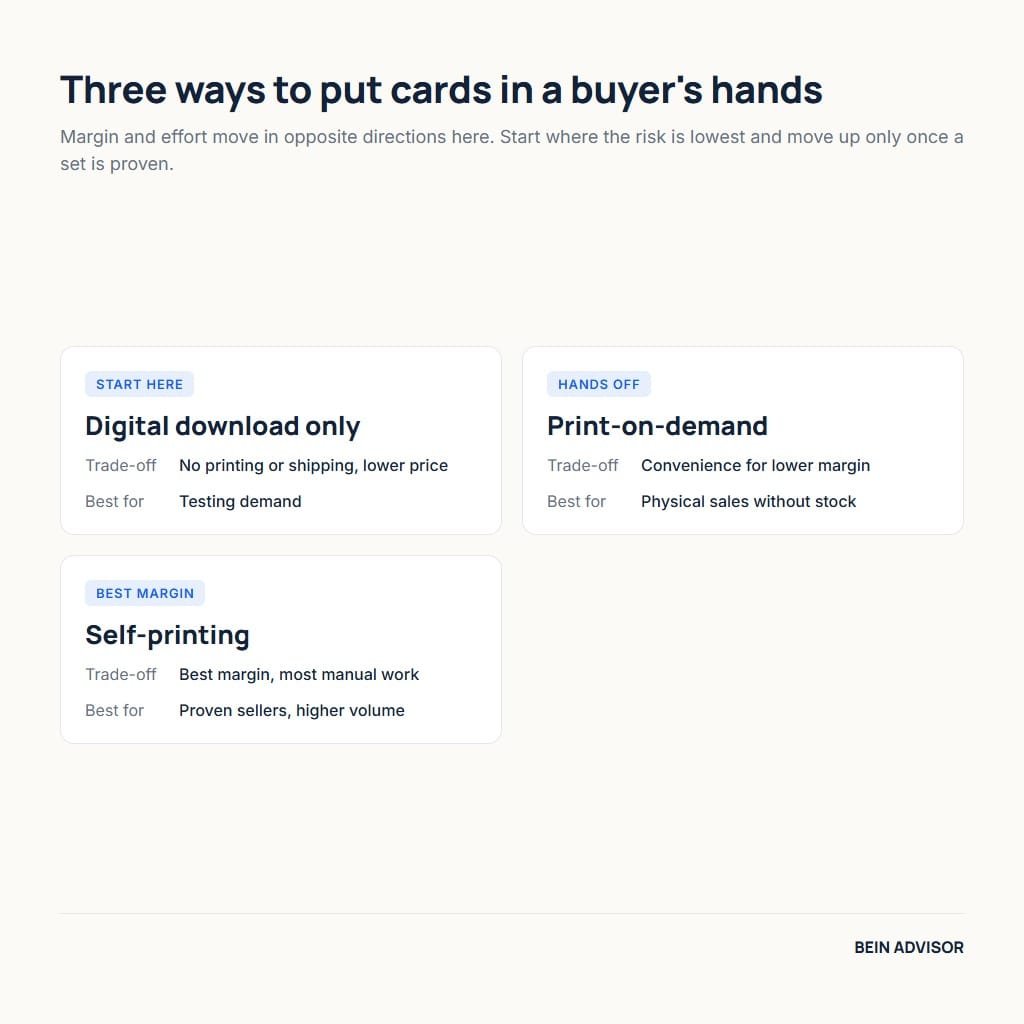
Most founders are wise to start lean and scale into fulfillment as demand proves itself. Selling digital downloads first costs almost nothing and validates which sets people actually want, after which you can add print-on-demand and finally self-printing once volume justifies the effort. The table below compares the production routes so you can match one to your stage and let a flashcard business grow its operations only when real orders require it.
| Method | Trade-off | Best for |
|---|---|---|
| Digital download only | No printing or shipping, lower price | Starting out and testing demand |
| Print-on-demand | Convenience for lower margin | Hands-off physical sales |
| Self-printing | Best margin, most manual work | Proven sellers, higher volume |
4. Step 4 — Set Up Your Sales Channels
Where you sell shapes how customers find you and how much you keep from each sale. The two broad routes are established marketplaces that bring built-in shoppers and your own store that gives you control and better margins. Many sellers use both, starting on a marketplace for traffic and adding their own store as their brand grows. Choosing the right channel lets a flashcard business reach buyers quickly while building toward long-term independence.
4.1 Marketplaces vs. Your Own Store
Marketplaces like Etsy and education-specific platforms put your cards in front of millions of shoppers already searching for learning materials, which is powerful for early sales. The trade-off is fees and competition, plus limited control over branding and customer relationships. Still, the built-in traffic makes a marketplace the fastest way for a flashcard business to make its first sales and learn which designs resonate before investing in anything more complex.
Your own store — built on a platform such as Shopify or a simple site with a tool like Gumroad for digital files — gives you control over pricing, branding, and customer data. You handle your own marketing, but you keep more of every sale and own the relationship with buyers. The smartest path is often to use a marketplace for discovery and your own store for loyal repeat customers, letting a flashcard business capture both new shoppers and the higher margins of direct sales.
4.2 Listings That Convert Browsers to Buyers
However you sell, your listing is your salesperson, so make it work hard. Use bright, clear photos or mockups that show the cards in use, write titles and descriptions with the words parents actually search, and explain exactly what the buyer receives. Highlight the learning benefit and the age range up front. For a flashcard business, a strong listing turns a casual browser into a confident buyer, because online shoppers decide in seconds based on images and the promise your words make.
Reviews and trust signals close the sale once attention is won. Encourage happy customers to leave reviews, respond politely to questions, and show that a real, caring person stands behind the product. A few genuine five-star reviews reassure new buyers far more than any claim you make about yourself. Building this social proof early gives a flashcard business momentum, because each satisfied parent who reviews your set makes the next purchase feel safer for everyone who follows.

5. Step 5 — Price and Bundle Your Flashcards
Pricing turns your designs into income, and packaging decides how much each customer spends. Because digital and printed versions have very different costs, they deserve different prices and positioning. The goal is to charge fairly for the value your cards deliver while using bundles to raise the average order. Thoughtful pricing and packaging are what let a flashcard business earn a real return on a design you only had to create once.
5.1 Pricing Digital and Printed Sets
Digital downloads cost almost nothing to deliver, so price them on the value and convenience they offer rather than on cost. A useful, well-designed printable set can be priced affordably yet remain pure profit on every sale, which is the magic of digital products. For a flashcard business, the key is to avoid pricing so low that your work looks cheap; a fair price signals quality and still feels like a bargain to a parent who values their child’s learning.
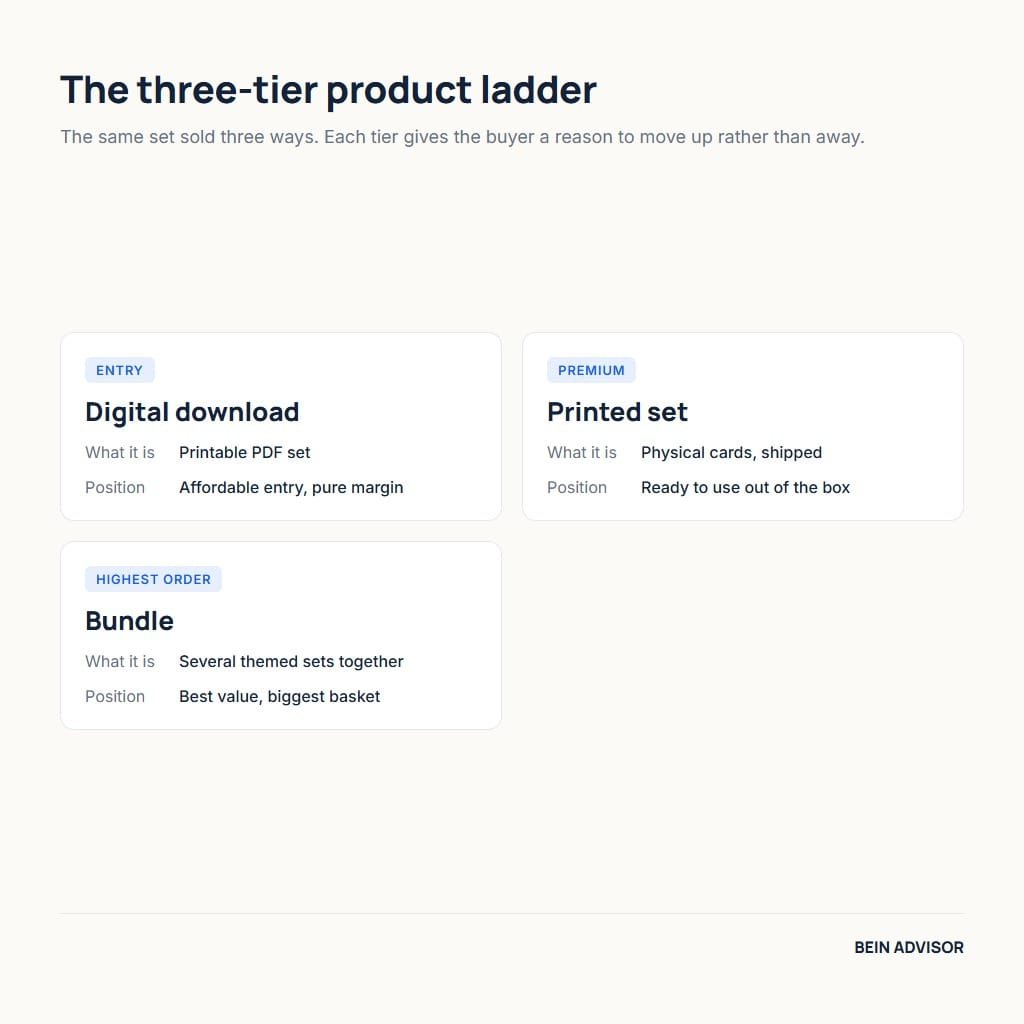
Printed sets must cover materials, printing, packaging, and shipping, plus a healthy margin on top. Calculate your true cost per set before setting a price, and remember that buyers expect to pay more for a physical, ready-to-use product. Position printed cards as the premium option and digital as the budget-friendly choice, giving shoppers a clear ladder. The table below shows an example structure a flashcard business can adapt to its own costs and market.
| Product | What it is | Position |
|---|---|---|
| Digital download | Printable PDF set | Affordable entry, pure margin |
| Printed set | Physical cards, shipped | Premium, ready-to-use |
| Bundle | Several themed sets together | Best value, highest order |
5.2 Bundles, Upsells, and Repeat Sales
Bundling is the easiest way to raise revenue without finding new customers. Group related sets — for example, letters, numbers, and shapes — into a discounted bundle that offers clear value while increasing the total sale. A parent who came for one set will often buy three when the package feels like a deal. For a flashcard business, bundles turn a single interested buyer into a much larger order, which is one of the simplest ways to grow income from the audience you already have.
Repeat sales come from giving existing customers more to love. As children grow, parents need the next level of learning material, so a clear catalog that moves from toddler basics to early-reader sets keeps buyers coming back. Collect emails so you can tell past customers about new releases, much like a digital creator running an online course business nurtures its audience. A flashcard business that plans for repeat buyers turns one-time shoppers into a loyal, recurring source of revenue.
6. Step 6 — Market and Scale Your Flashcard Business
A wonderful set still needs to be seen, and marketing in this niche rewards genuine helpfulness. Parents and teachers gather online to share resources, so meeting them with useful content is the most natural way to attract buyers. Once sales are steady, scaling means adding products and automating sales so income grows without a matching rise in effort. This final step turns a single successful set into a true flashcard business with a future.
6.1 Reaching Parents and Teachers Online
Content that helps parents teach is the best advertisement for cards that help children learn. Share quick learning tips, printable freebies, and short videos of the cards in action on the platforms where parents and educators spend time. A free sample set is especially powerful, because it lets people experience your quality before buying and builds an email list at the same time. For a flashcard business, this generous, helpful approach earns trust and attention far more effectively than pushy promotion ever could.
Partnerships extend your reach to audiences that already trust someone else. Parenting bloggers, teacher communities, and family-focused social accounts can introduce your cards to thousands of ideal buyers in a single post. Offering a free set to a respected reviewer, or collaborating with a teacher who shares classroom resources, plugs a flashcard business into established communities. These warm introductions carry credibility that cold advertising cannot buy, and they often spark the word-of-mouth growth that this niche rewards so generously.
6.2 Scaling With New Sets and Passive Sales
Growth in this business comes mainly from expanding your catalog. Each new themed set gives existing customers another reason to buy and attracts new shoppers searching for that specific topic, so a steady release schedule compounds your sales over time. Reusing your established style and templates makes each new set faster to create than the last. A flashcard business with a growing, coherent catalog becomes more valuable and more discoverable with every set you add.
Automation turns growth into largely passive income. Digital downloads deliver themselves, print-on-demand fulfills orders without your involvement, and an email sequence can introduce new buyers to your best sets automatically. Once these systems run smoothly, you can focus on creating new designs while existing products sell around the clock. This is the long-term promise of a flashcard business: work that you do once continues to earn, letting a small catalog quietly generate income long after the design work is finished.
FAQ
Do I need design skills to start a flashcard business? No. Beginner-friendly tools like Canva offer templates, fonts, and licensed images that let anyone create professional-looking cards. Focus on clear, child-friendly design principles, and always confirm you hold commercial rights to every image and font you use.
Should I sell digital, printed, or both? Both, ideally. Digital downloads cost nothing to deliver and are pure margin, making them perfect for starting and testing demand, while printed sets command higher prices. Building both from one design maximizes income with little extra work.
Where is the best place to sell flashcards? Start on a marketplace such as Etsy or a teacher-resource platform for built-in traffic, then add your own store for better margins and repeat customers once your brand grows.
Conclusion: Turn Learning Cards Into Income
A flashcard business is one of the most accessible products a creator can build: low cost, evergreen demand, and the ability to sell the same design as both a digital download and a printed set. By choosing a focused niche, designing cards that truly teach, building digital and printable versions, selling through the right channels, pricing with bundles, and marketing with genuine help, you create a product that earns long after the work is done. Each of the six steps builds on the last, turning a simple idea into a real income stream.
Start with one strong set in a topic parents already search for, then list it, gather reviews, and let those early sales guide your next design. Add formats, bundles, and channels as you grow, and keep quality at the center of everything you make. The need to help children learn never fades, which means a flashcard business that designs with care has a future limited only by how many thoughtful sets you choose to create.