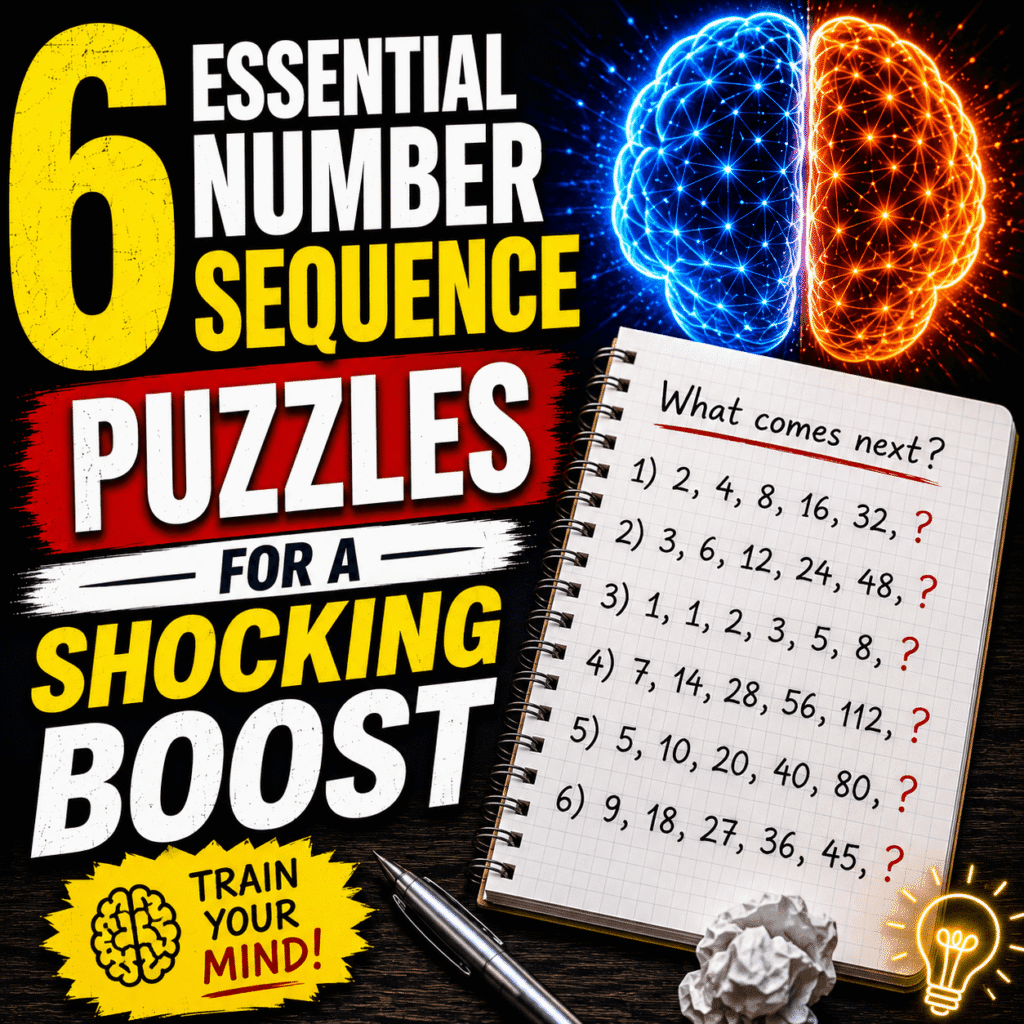
Number sequence puzzles ask a simple question with a surprisingly deep payoff: what comes next? Anyone who has stared at a string of numbers and felt the small jolt of satisfaction when the hidden rule finally clicks has experienced why these puzzles remain a staple of IQ tests and brain training programs alike. This article explains what makes number sequence puzzles effective for building reasoning skill, walks through a clear step-by-step method for solving them, and shows how to practice in a way that produces real, lasting gains rather than a few minutes of distraction.
Readers will find a breakdown of the cognitive skill these puzzles actually train, the main pattern types to recognize, and a practical method for approaching an unfamiliar sequence without guessing blindly. The discussion builds on the rotation-and-progression principles already covered for brain training and memory retention elsewhere in this series, applying them specifically to one of the most common and most useful puzzle formats available.
1. What Are Number Sequence Puzzles and Why They Matter
Number sequence puzzles present a list of numbers that follow a hidden rule and ask the solver to identify that rule well enough to predict the next term, or sometimes a missing term in the middle. They matter because identifying a pattern from limited examples is one of the clearest, most measurable forms of abstract reasoning, which is exactly why this puzzle format appears so consistently on IQ tests and cognitive assessments rather than being a niche brain-training gimmick.
1.1 Defining Number Sequence Puzzles
At its simplest, a number sequence puzzle gives a short list, such as 2, 5, 8, 11, and asks for the next value. The defining feature is that the rule connecting the numbers is never stated outright; it must be inferred purely from the pattern of differences, ratios, or more complex relationships between consecutive terms. This is what separates a sequence puzzle from simple arithmetic, since the solver is not applying a known formula but discovering an unknown one from evidence alone.
This inference requirement is precisely why the format scales so well across difficulty levels. A beginner sequence might rely on a constant difference between terms, something most people spot within seconds, while an advanced sequence might combine two interleaved patterns or a rule that changes after a certain term. The puzzle format stays identical at every level; only the complexity of the underlying rule changes, which makes it ideal for a graded practice routine that raises difficulty without switching formats entirely.
1.2 Why Pattern Recognition Matters
Pattern recognition, the skill these puzzles target most directly, underlies far more daily tasks than solving a quiz question. Spotting a recurring trend in monthly expenses, noticing that a particular type of error keeps showing up in a report, or recognizing that a colleague’s pushback follows a predictable shape are all instances of the same underlying skill: inferring a rule from a limited set of examples. Strengthening this skill through deliberate practice transfers more broadly than many people expect from what looks like a simple math puzzle.
This is also why number sequence puzzles are valued well beyond classroom math. Analysts, programmers, and researchers all rely heavily on the ability to spot a pattern in noisy data before a clear explanation is available, and regular practice with number sequences builds exactly that muscle in a low-stakes, low-cost format. A short daily puzzle session functions as a kind of warm-up for the same reasoning that shows up later in far more consequential decisions.
2. How Number Sequence Puzzles Train the Brain
Solving a number sequence puzzle recruits working memory, since several candidate rules must be held in mind and tested simultaneously, and recruits flexible reasoning, since a rule that fails must be abandoned in favor of a new hypothesis without frustration derailing the process. These two systems working together are what make the format genuinely useful for cognitive training rather than just a quick distraction.
2.1 Working Memory and Sequential Reasoning
Testing a candidate rule against a sequence requires holding both the proposed rule and the original numbers in mind at the same time, then checking each term against the prediction before moving to the next. This juggling act is a direct working-memory exercise, and longer sequences with five or six terms place noticeably more demand on this system than a short three-term puzzle, which is one reason sequence length is a simple, reliable way to scale difficulty.
As working memory improves through repeated practice, solvers typically notice they can track more complex rules without losing their place partway through, such as a sequence where the difference itself increases by a fixed amount each step. This capacity increase is a concrete, observable sign of progress, distinct from simply memorizing that a particular puzzle’s answer was a specific number, which is why tracking solve time alongside accuracy gives a fuller picture of improvement than accuracy alone.
2.2 Transfer to Everyday Problem-Solving
The habit of generating a hypothesis, testing it against evidence, and revising it when it fails transfers directly to problem-solving situations far removed from puzzle books. Troubleshooting why a process keeps producing the same error, or figuring out why a budget consistently overshoots in one particular month, both follow the same hypothesize-test-revise structure that number sequence puzzles train in miniature, just with messier and less clean-cut data than a puzzle page provides.
This transfer is strongest when practice includes deliberately wrong first guesses rather than only easy puzzles solved correctly on the first attempt. Working through a sequence that requires two or three failed hypotheses before the correct rule emerges builds tolerance for being wrong along the way, which is often the actual skill missing when someone gives up on a real-world problem too early simply because their first theory did not pan out.
3. Types of Number Sequence Puzzles by Difficulty
Number sequence puzzles scale across a wide difficulty range using a small set of underlying pattern families. Recognizing which family a puzzle belongs to is often the fastest route to a solution, since each family responds to a slightly different first move. The table below summarizes the main pattern types from beginner to advanced, along with a short example of each.
| Pattern Type | Example | Difficulty |
|---|---|---|
| Constant difference | 3, 7, 11, 15, ? | Beginner |
| Constant ratio | 2, 6, 18, 54, ? | Beginner |
| Increasing difference | 1, 2, 4, 7, 11, ? | Intermediate |
| Two interleaved patterns | 1, 10, 2, 20, 3, ? | Advanced |
3.1 Beginner Number Sequence Puzzles
Beginner-level sequences almost always rely on a single, constant operation applied repeatedly, such as adding the same amount each step or multiplying by the same factor. These puzzles exist mainly to establish the habit of checking the simplest possible explanation first, since jumping straight to a complicated theory on an easy puzzle wastes time and builds a bad habit that slows down harder puzzles later. Spotting a constant difference or ratio within the first few seconds is the expected, achievable benchmark at this level.
Even at this easy level, writing out the differences between consecutive terms explicitly, rather than trying to spot the pattern purely in the head, builds a habit that pays off enormously once sequences grow more complex. A beginner who skips this step on easy puzzles because it feels unnecessary often struggles unnecessarily later, simply because the habit of externalizing the pattern-search process was never built in the first place.
3.2 Advanced Number Sequence Patterns
Advanced sequences typically combine two ideas: either the rule itself changes partway through the sequence, or two separate patterns are interleaved within a single list, such as alternating odd-position and even-position terms that each follow their own independent rule. Recognizing an interleaved pattern usually requires separating the sequence into two shorter sub-sequences first, a step that is easy to overlook but immediately simplifies what looked like an impossibly irregular list.
A second advanced category involves a difference that itself follows a pattern, sometimes called a second-order sequence, where the differences between terms form their own simple sequence rather than staying constant. Practicing this category specifically builds comfort with thinking one level of abstraction higher than the original numbers, a skill that proves useful well beyond puzzle books whenever a problem requires noticing a pattern in how something is changing, not just in the values themselves.
4. The Science Behind Number Sequence Puzzles and IQ
Number sequence tasks appear on IQ tests because they measure fluid reasoning, the capacity to solve novel problems without relying on previously learned facts or formulas, which researchers distinguish from crystallized knowledge built up through education and experience. Understanding this distinction clarifies what practicing these puzzles can and cannot realistically achieve.
4.1 Pattern Recognition and Number Sequence Puzzles
Each successful pattern identification reinforces the same neural pathways involved in abstract reasoning more broadly, an application of the same plasticity principles already discussed for general brain training and neuroplasticity. Repeated practice with number sequence puzzles strengthens this reasoning circuitry specifically, even though the practical test scores most people care about, such as a timed IQ assessment, reflect a snapshot built from many different reasoning tasks rather than sequence puzzles alone.
This means regular practice with number sequence puzzles realistically builds the underlying reasoning skill and speed that contributes to fluid intelligence tasks, rather than guaranteeing a specific point increase on a formal IQ test. Framing the goal as “becoming faster and more flexible at spotting patterns” rather than “raising my IQ score by a fixed number” sets expectations that match what the puzzles can actually deliver, and keeps the practice motivating rather than disappointing.
4.2 IQ Tests and Fluid Reasoning
The Harvard Health overview of cognitive exercise notes that effective brain training requires challenge, complexity, and repeated practice over time, three criteria that number sequence puzzles satisfy cleanly when difficulty rises gradually rather than staying fixed at one comfortable level. Fluid reasoning specifically benefits from this kind of structured, escalating challenge far more than from occasional exposure to puzzles at a single static difficulty.
This is why a graded sequence of puzzles, moving deliberately from constant-difference patterns through interleaved and second-order patterns over weeks, produces a more meaningful training effect than working through a single difficulty level indefinitely. The progression itself, not any single puzzle, is what builds the broader reasoning flexibility that fluid intelligence tasks require.
5. How to Solve Number Sequence Puzzles Step by Step
A consistent method beats relying on intuition alone, especially once puzzles move past the easiest beginner level. The same four-step process applies regardless of difficulty, and following it in order prevents the common trap of jumping to a complicated theory before ruling out simpler explanations first.
5.1 A Step-by-Step Method for Number Sequence Puzzles
Start by writing out the differences between each consecutive pair of numbers, since a constant or simply patterned difference resolves a large share of puzzles immediately. If the differences themselves are not constant, check whether those differences form their own simple pattern, which catches most second-order sequences. If neither approach works, test a constant ratio instead of a difference, since multiplicative patterns are the next most common family after additive ones.
If none of these checks reveal a pattern, split the sequence into odd-position and even-position terms and examine each sub-sequence separately, since this step reveals interleaved patterns that look completely irregular when read as a single list. Working through these four checks in order, rather than randomly, turns an intimidating puzzle into a short, methodical process that rarely takes more than a minute or two once it becomes a habit.
5.2 Common Solving Strategies
Beyond the core four-step check, writing the candidate rule down in plain words, not just as a calculation, helps catch errors before committing to a final answer. A rule stated as “each term is the previous term plus three” is easy to verify against every given number quickly, while a rule held only as a vague feeling is much easier to apply inconsistently without noticing the mistake.
Timing practice sessions loosely, without turning every puzzle into a stressful countdown, also helps build genuine speed over time rather than just familiarity with a handful of memorized examples. A solver who tracks roughly how long sequences take across several weeks, without obsessing over any single attempt, gets a much clearer signal of real improvement than one who either ignores time completely or fixates on it every single puzzle.
6. Common Mistakes When Practicing Number Sequence Puzzles
A handful of avoidable habits quietly limit progress with number sequence puzzles, even for people who practice regularly. Both mistakes below tend to feel productive in the moment, which is exactly why they persist longer than more obviously unhelpful habits would.
6.1 Guessing Without Checking the Rule
It is tempting to glance at a sequence, feel a hunch about the next number, and write it down without verifying that the proposed rule actually fits every given term. This shortcut sometimes produces a correct answer by luck, especially on short, easy sequences, but it builds no real skill and leaves a solver stuck the moment a puzzle is too long or irregular for a quick guess to land correctly.
Breaking this habit simply requires checking a candidate rule against every term before accepting it, not just the first two or three. A rule that fits the first three numbers but breaks on the fourth is extremely common, and catching that failure before writing down a final answer is what actually trains the careful, systematic checking that makes harder puzzles solvable later on.
6.2 Ignoring Multi-Step Sequences
Many solvers give up on a sequence the moment a simple constant-difference or constant-ratio check fails, assuming the puzzle is simply too hard rather than recognizing it likely belongs to a more advanced pattern family. This premature surrender means a solver never practices the second-order and interleaved patterns that build the most valuable reasoning flexibility, staying permanently stuck at the easiest difficulty tier despite plenty of practice time invested.
The fix is treating a failed simple check as useful information rather than a dead end, moving systematically to the next pattern family in the four-step method instead of abandoning the puzzle. Over a few weeks of this approach, multi-step and interleaved sequences that once felt impossible become routine, which is the clearest practical sign that genuine reasoning flexibility, not just memorized tricks, has actually improved.
| Mistake | Effect | Fix |
|---|---|---|
| Guessing without checking | No real skill built | Verify the rule against every term |
| Giving up after one check | Stuck at easiest difficulty | Work through all four checks in order |
Conclusion: Number Sequence Puzzles for a Sharper, More Logical Mind
Number sequence puzzles build genuine reasoning flexibility when approached with a consistent method and a deliberately rising difficulty curve, rather than treated as a quick, casual distraction. The four-step solving process covered above turns an intimidating-looking list of numbers into a short, systematic exercise, and avoiding the two common mistakes of guessing and giving up early keeps that practice genuinely productive over weeks of repetition.
For a ready-made source of graded number sequence puzzles rather than searching for fresh examples individually, Brain & IQ Workout includes a full section of number sequences across five rising difficulty levels, alongside other logic and spatial puzzle types, with every answer explained so the underlying rule, not just the final number, is always clear.
As an Amazon Associate, BeIN ADVISOR earns from qualifying purchases.