Activities to boost IQ are not limited to one age group or one type of puzzle; the most effective options span mental, physical, and social habits that each strengthen a different part of cognitive function. Anyone assuming that raising IQ requires expensive programs or rare talent will find that the strongest evidence points toward ordinary, repeatable habits instead. This article compares six activities with real cognitive benefit, explains the mechanism behind each one, and shows how to combine them into a realistic routine that works at almost any age rather than only during childhood or school years.
Each activity below was evaluated for the strength of its cognitive evidence, how practical it is to start without special equipment, and which specific skill it targets, building on the rotation-and-progression principles already covered for brain training and number sequence puzzles elsewhere in this series. A comparison table, an age-based selection guide, and a section on getting the most benefit from any of these activities follow the six main picks.
1. How We Chose These Activities to Boost IQ
Selecting activities to boost IQ for this list relied on three criteria: whether credible research links the activity to measurable cognitive benefit, whether it can be started without specialized equipment or significant cost, and whether it targets a distinct cognitive skill rather than duplicating an activity already on the list. Activities with only anecdotal support, or that required expensive devices or subscriptions to attempt, were excluded in favor of options nearly anyone can begin this week.
2. Top Activities to Boost IQ at Any Age
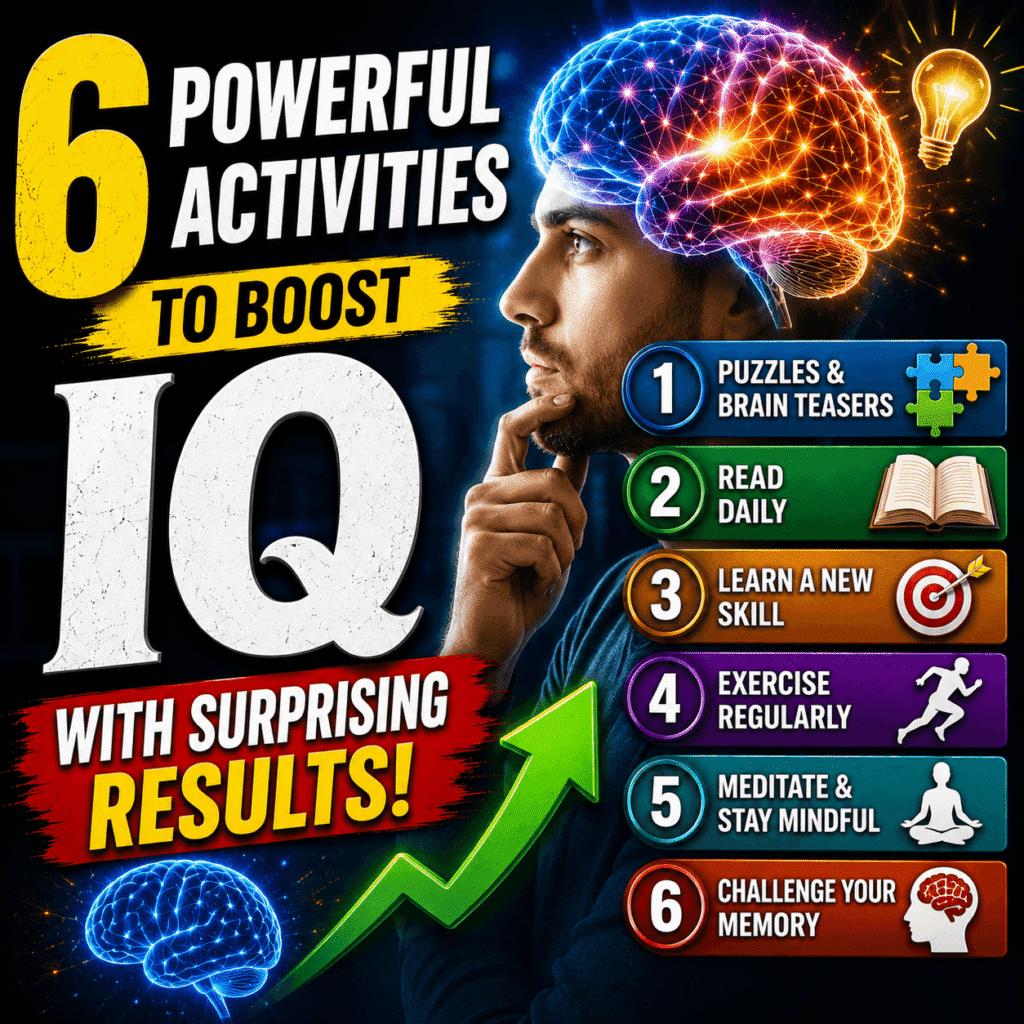
The six activities below cover mental, physical, and social dimensions of cognitive health, deliberately avoiding a list that leans entirely on puzzles or entirely on lifestyle change. Each entry includes an overview of why it works, the mechanism behind its cognitive benefit, and a note on who it suits best, so a reader can build a routine from more than one category rather than relying on a single habit.
2.1 Solving Logic and Number Puzzles Daily
Overview: Daily logic and number puzzles remain one of the most direct activities to boost IQ because they target fluid reasoning, the same skill measured on most IQ test sections, through a low-cost format that scales cleanly from beginner to advanced difficulty.
Mechanism: Each puzzle requires generating a hypothesis, testing it against evidence, and revising it when wrong, a structured reasoning loop that strengthens working memory and pattern recognition with repeated practice, as already covered in detail for number sequence puzzles elsewhere in this series.
Who it suits: This activity suits readers who want a short, structured daily habit with clear progress markers, and the main trade-off is that puzzles alone do little for physical or social dimensions of brain health, so pairing them with at least one other activity below gives more complete coverage.
2.2 Learning a New Language
Overview: Learning a new language ranks among the more demanding activities to boost IQ, since it requires sustained attention, memory, and rule-application skills simultaneously rather than just one isolated cognitive function, making it a particularly comprehensive mental workout.
Mechanism: Switching between two languages requires constant cognitive control, suppressing one language’s rules while applying the other’s, and this repeated control practice is thought to strengthen executive function more broadly, with some research suggesting language learners build added cognitive reserve that helps buffer against age-related decline.
Who it suits: This activity suits readers willing to commit real time over months rather than a quick daily habit, and the trade-off is a slower, less immediately visible payoff compared with a puzzle routine, though the breadth of skills exercised is considerably wider.
2.3 Playing a Musical Instrument
Overview: Learning or practicing a musical instrument combines fine motor coordination, auditory processing, and pattern memory in a single activity, making it one of the more well-rounded activities to boost IQ available without any digital tool or app required.
Mechanism: Reading musical notation while coordinating both hands and listening for accuracy demands rapid integration across several brain systems at once, and this multisensory integration is part of why musicians often show enhanced auditory processing and working memory compared with non-musicians in cognitive studies.
Who it suits: This activity suits readers who enjoy a tangible creative skill alongside the cognitive benefit, and the trade-off is a steeper initial learning curve and, often, the cost of an instrument or lessons, which makes it less immediately accessible than a puzzle book.
2.4 Regular Aerobic Exercise
Overview: Regular aerobic exercise is the one activity on this list with no puzzle or learning component at all, yet it remains among the most well-supported activities to boost IQ because of its direct, measurable effect on brain structure and blood flow.
Mechanism: Aerobic activity increases blood flow to the brain and supports the growth of new connections in regions tied to memory and executive function, complementing the neuroplasticity benefits already covered for structured brain training and neuroplasticity elsewhere in this series rather than competing with them.
Who it suits: This activity suits nearly everyone regardless of puzzle-solving interest, and the main trade-off is that benefits build gradually over weeks of consistent activity rather than producing the immediate, puzzle-like feedback some readers find motivating.
2.5 Reading Complex, Challenging Material
Overview: Deliberately reading material slightly above a comfortable level, rather than only familiar genres, is an underrated entry among activities to boost IQ because it stretches vocabulary, comprehension, and the ability to hold a complex argument in mind across many pages.
Mechanism: Following an unfamiliar argument structure or dense vocabulary forces active inference about meaning from context, a verbal-reasoning exercise comparable in principle to the pattern-inference work done in logic puzzles, just applied to language rather than numbers or shapes.
Who it suits: This activity suits readers who already enjoy books and want to extend that habit deliberately, and the trade-off is that progress is harder to measure than with puzzles, since there is no score or solved answer to confirm improvement directly.
2.6 Practicing Strategic Games Like Chess
Overview: Strategic games such as chess sit between puzzle-solving and social interaction, making them one of the more engaging activities to boost IQ for readers who find solo puzzle books repetitive but still want a structured reasoning challenge.
Mechanism: Planning several moves ahead while anticipating an opponent’s response trains working memory and forward planning simultaneously, and the immediate, visible consequence of a misjudged move provides faster feedback than many other activities on this list, reinforcing careful, deliberate reasoning over time.
Who it suits: This activity suits readers who enjoy competition or social play alongside cognitive challenge, and the trade-off is that finding a regular opponent or club can take more effort to arrange than simply opening a puzzle book alone.
3. Comparing Activities to Boost IQ at a Glance
The table below summarizes the primary skill each activity targets and a realistic weekly time commitment, useful for picking a starting combination rather than attempting all six at once.
| Activity | Primary Skill Targeted | Typical Weekly Time |
|---|---|---|
| Logic and number puzzles | Fluid reasoning, working memory | 1.5-2 hours |
| Learning a new language | Executive function, memory | 3-5 hours |
| Playing a musical instrument | Auditory processing, coordination | 2-4 hours |
| Regular aerobic exercise | Blood flow, neuroplasticity | 2.5-3 hours |
| Reading challenging material | Verbal reasoning, vocabulary | 2-3 hours |
| Strategic games like chess | Planning, working memory | 1-3 hours |
4. How to Choose Activities to Boost IQ for Your Age
The right combination of activities to boost IQ shifts somewhat with age, energy levels, and available time, though every activity on this list remains genuinely available at almost any stage of adulthood. Younger adults often have more flexibility to commit to a demanding option like language learning, while older adults may prioritize activities that pair well with social connection or that accommodate physical limitations more easily.
| Age Range | Suggested Priority Activities |
|---|---|
| 20s-30s | Language learning, instrument practice, puzzles |
| 40s-50s | Puzzles, strategic games, aerobic exercise |
| 60s and beyond | Aerobic exercise, strategic games, reading |
4.1 Matching Activities to Available Time
Someone with only fifteen or twenty minutes free most days will get more realistic, sustained benefit from daily puzzles than from an instrument requiring thirty minutes of focused practice several times a week, simply because the lower-commitment activity is far more likely to actually happen consistently. Matching an activity to genuinely available time, rather than the time a reader wishes they had, prevents the common pattern of an ambitious plan collapsing within the first two weeks.
Combining a low-commitment daily habit, such as a short puzzle session, with one higher-commitment weekly activity, such as a chess club or a language class, tends to work better than choosing two demanding activities at once. This mirrors the rotation principle already established for brain training: variety across a week matters more than maximizing any single activity, and a realistic combination sustained for months outperforms an ambitious one abandoned after a few weeks.
4.2 Considering Physical and Social Factors
Physical limitations should shape activity choice rather than rule out aerobic exercise entirely, since walking, swimming, and cycling all count and can be adjusted in intensity to match individual ability, mobility, or recovery from injury. The cognitive benefit of aerobic activity comes from sustained, moderate effort over time, not from a specific sport, which keeps this option genuinely available across a wide range of physical circumstances.
Social factors matter as well, since an activity paired with regular human interaction, such as a chess club, a book discussion group, or a language exchange partner, often sustains motivation longer than a purely solo habit. Readers who have struggled to maintain a solitary puzzle routine in the past may find that adding a social dimension to one activity on this list solves the consistency problem more effectively than switching puzzle formats again.
5. How to Get the Best Results From Activities to Boost IQ
Choosing the right activities to boost IQ matters less than how consistently they get practiced, since the cognitive research behind every option on this list assumes sustained engagement over months, not a single enthusiastic week followed by abandonment. The Harvard Health overview of cognitive exercise notes that effective brain training requires challenge, complexity, and repeated practice over time, a standard that applies just as directly to language learning or chess as it does to puzzle books.
Combining at least two activities from different categories, one mental and one physical or social, gives broader cognitive coverage than maximizing a single favorite habit, echoing the variety principle already established for daily brain training in this series. Tracking simple markers of progress, such as a puzzle difficulty level, a vocabulary count, or a chess rating, keeps the routine motivating in the same way a recall log keeps a memory-retention habit on track over many weeks.
Conclusion: Activities to Boost IQ at Any Stage of Life
The most effective activities to boost IQ are not a single secret habit but a combination drawn from mental, physical, and social categories, sustained consistently over months rather than attempted intensely for a single week. Logic puzzles, language learning, music, exercise, challenging reading, and strategic games each strengthen a different cognitive system, and choosing at least two that fit a reader’s actual schedule and interests beats chasing every option at once.
For the puzzle-based activity covered in this comparison, Brain & IQ Workout provides a structured, graded entry point: more than twenty puzzle types across five rising difficulty levels, with every answer explained, built for the short daily habit this article recommends pairing with at least one other activity above.
As an Amazon Associate, BeIN ADVISOR earns from qualifying purchases.