Brain training books turn vague intentions to “exercise the mind” into a concrete, daily activity with clear puzzles, levels, and answers. Anyone who has tried a random phone app for a week and quietly abandoned it knows how easily an unstructured habit fades, while a physical book with numbered levels keeps the next session obvious and the progress visible. This article compares five brain training books for adults, explains what separates a genuinely useful one from a thin collection of filler puzzles, and shows how to get real cognitive benefit from whichever book ends up on the shelf.

Each pick below is described across the same four dimensions: puzzle variety, difficulty progression, answer format, and overall value for a daily fifteen-to-twenty-minute habit, the routine already shown to support brain training and memory retention in earlier articles in this series. Readers will also find a comparison table, a buying guide for matching a book to skill level, and a dedicated section on getting the most out of any brain training book rather than letting it sit half-finished on a shelf.
1. How These Brain Training Books Compare
The books below are compared across four practical dimensions rather than scored against a single standard: how many distinct puzzle types each one covers, how its difficulty is organized, what form its answers take, and how much daily content it provides relative to its price. These dimensions describe what a book is built for, not how good it is. A broad survey of illusions and a graded daily workbook are designed for different readers, and neither is a weaker version of the other. The most common reason a puzzle book goes unfinished is a mismatch between the book and the routine, not poor quality, so weighing the dimension that matches an existing habit most heavily is the practical way to choose.
2. Top Brain Training Books for Adults
The five books below cover a deliberate range, from a single graded workbook built for daily rotation to a broader science-based read on lifelong brain health. Each entry below includes a market overview, a look at the puzzle formats and structure inside, and a note on who the book suits best, so a reader can match a pick to their own habits rather than choosing on cover design alone.
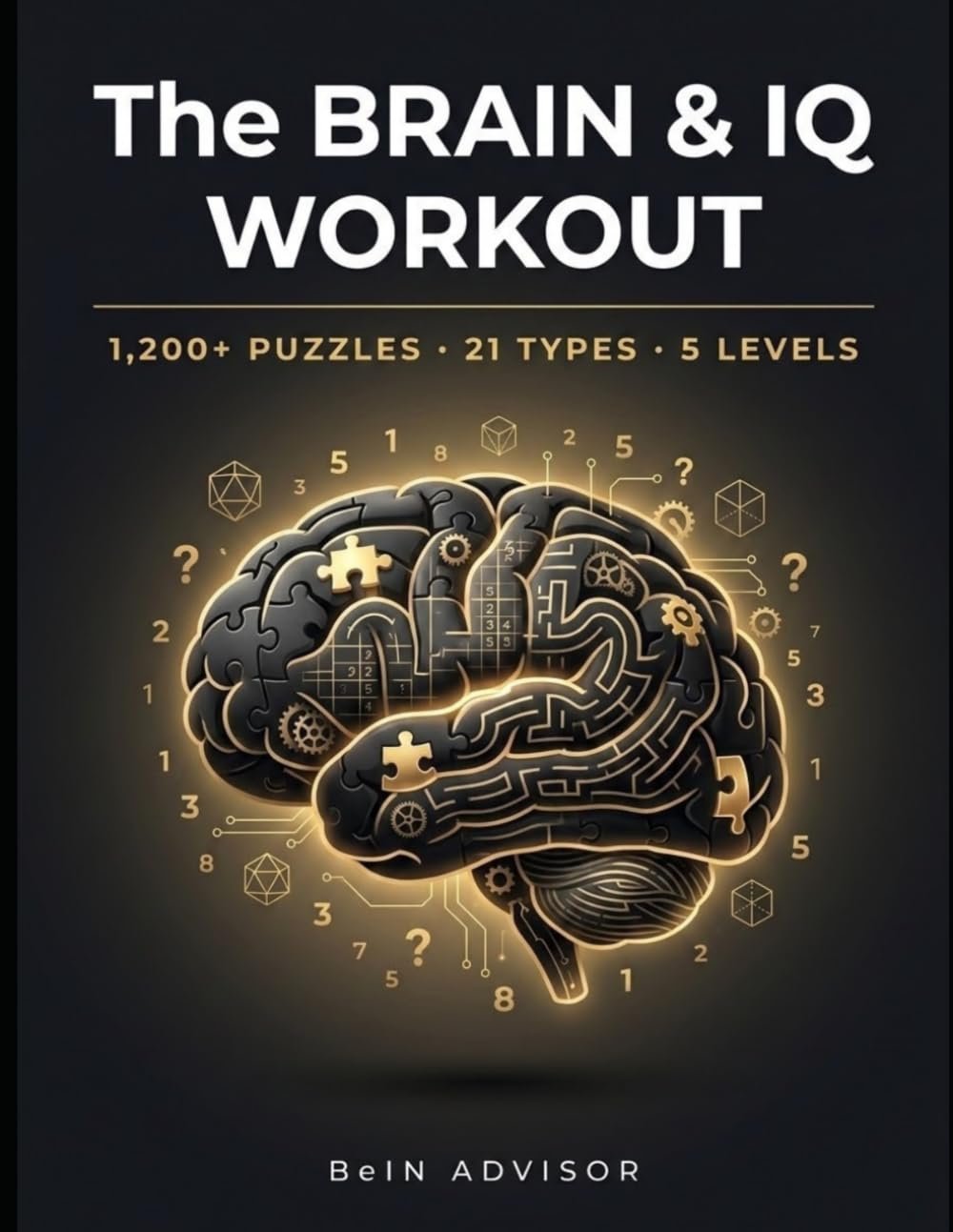
2.1 Brain & IQ Workout
Disclosure: Brain & IQ Workout is published by BeIN ADVISOR, the publisher of this site. It appears here because it fits the graded-workbook category this comparison covers, and readers should weigh that connection when reading the assessment below.
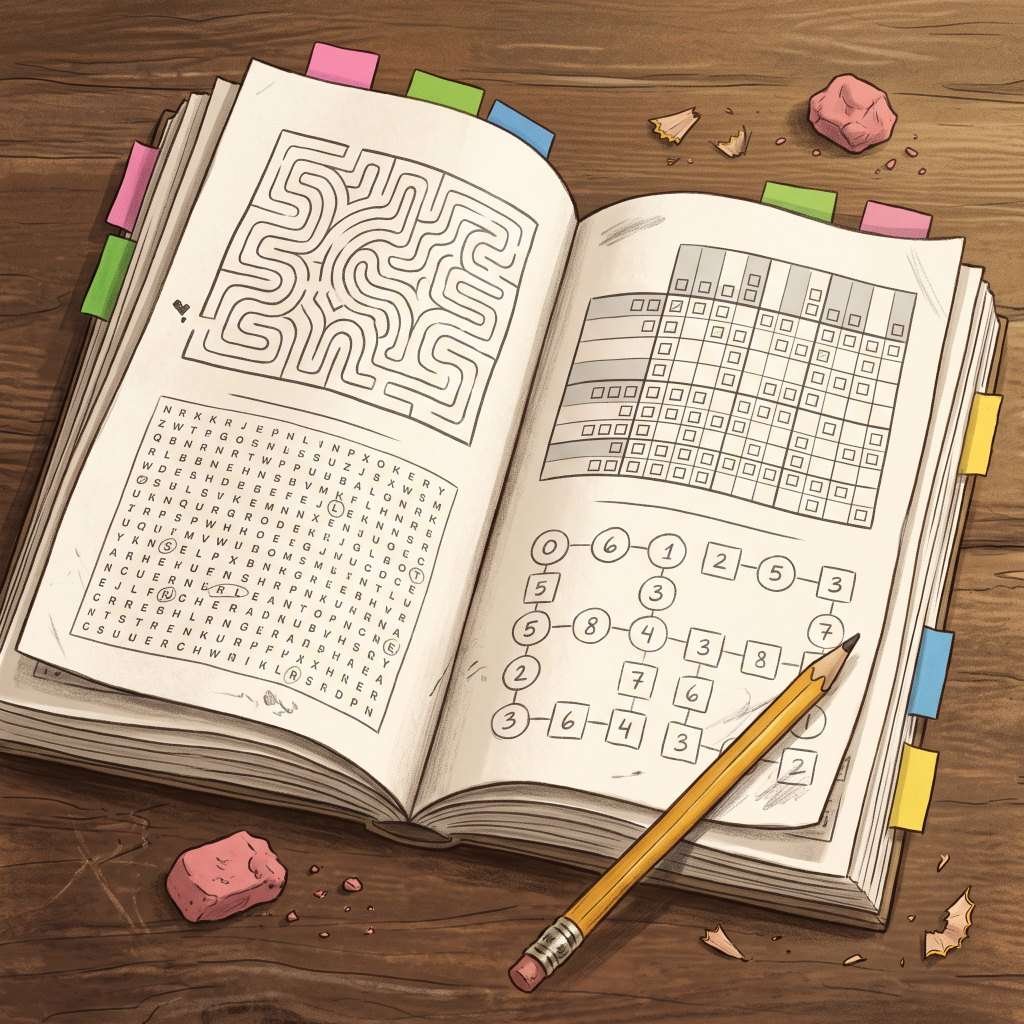
Format and structure: The book includes more than twenty puzzle types across logic grids, number sequences, Sudoku-style grids, mazes, word search, and several premium logic formats, all solver-verified for a unique answer. The answer key at the back covers every puzzle in the book, and each solution has been checked for accuracy rather than printed unverified, which matters most in a long collection where a single broken puzzle can stall an entire session.
Who it suits: This book suits readers who want one structured daily resource instead of juggling several apps or thin puzzle pamphlets, and the main trade-off to weigh is that its focus stays on logic, number, and spatial puzzles rather than trivia or general-knowledge questions.
2.2 The Big Book of Brain Games
Overview: The Big Book of Brain Games by Ivan Moscovich is a long-running favorite that compiles a very wide spread of optical illusions, logic puzzles, math challenges, and visual reasoning tasks, positioning itself as a broad survey of brain teasers rather than a single focused puzzle type.
Format and structure: Its sheer size, over four hundred puzzles, means a reader rarely runs out of fresh material, and the variety spans categories that few single-format books attempt, including classic illusions and probability-based brain teasers. Difficulty is grouped loosely by category rather than by a single rising scale across the whole book.
Who it suits: This book suits readers who enjoy variety and exploring unfamiliar puzzle formats, and the trade-off is a less structured difficulty curve, which makes it a better browsing companion than a strict daily program for someone following a graded routine.
2.3 Brain Games: Brain Teasers, Logic Puzzles, and Memory
Overview: This widely available title from the long-running Brain Games series focuses on a manageable, approachable mix of teasers, logic puzzles, and memory exercises, aimed squarely at readers who want a casual, low-commitment entry point rather than an intensive program.
Format and structure: Puzzles tend to be shorter and quicker to complete than in denser workbooks, with large, clear print that suits relaxed reading conditions. The memory-specific section gives it a slight edge for readers focused mainly on recall exercises rather than logic or spatial puzzles.
Who it suits: This book suits readers easing into a brain training habit for the first time, and the main trade-off is that its puzzles rarely reach the harder difficulty levels that more experienced solvers eventually need for continued challenge.
2.4 Mensa Mighty Mind-Bending Puzzles
Overview: Produced in association with British Mensa, this collection leans into harder logic and lateral-thinking puzzles aimed at readers who already find typical newspaper puzzle pages too easy and want a genuine challenge rather than a relaxed pastime.
Format and structure: The puzzles skew toward lateral thinking, number theory, and intricate logic grids, with fewer simple warm-up puzzles than competing titles. Answers are explained well enough for a determined reader to follow the reasoning, though the entry difficulty is noticeably steeper from the first page.
Who it suits: This book suits confident, experienced puzzle solvers looking for a genuine test, and the trade-off is that newer solvers may find the lack of an easier on-ramp discouraging rather than motivating in the first few sessions.
2.5 Keep Sharp: Build a Better Brain at Any Age
Overview: Written by Sanjay Gupta, Keep Sharp is not a puzzle workbook but a science-based companion read that explains the lifestyle, sleep, and exercise factors that influence long-term brain health, complementing a puzzle-focused routine with the broader context behind why it works.
Format and structure: The book is organized around accessible chapters on memory, aging, diet, and recovery rather than puzzles, drawing on interviews with researchers and physicians to explain the science behind cognitive health in plain language, with practical takeaways closing each chapter.
Who it suits: This book suits readers who want to understand the reasoning behind a brain training habit, not just practice it, and the trade-off is that it offers no puzzles itself, so it works best paired with one of the workbook-style titles above.
3. Comparing Brain Training Books at a Glance
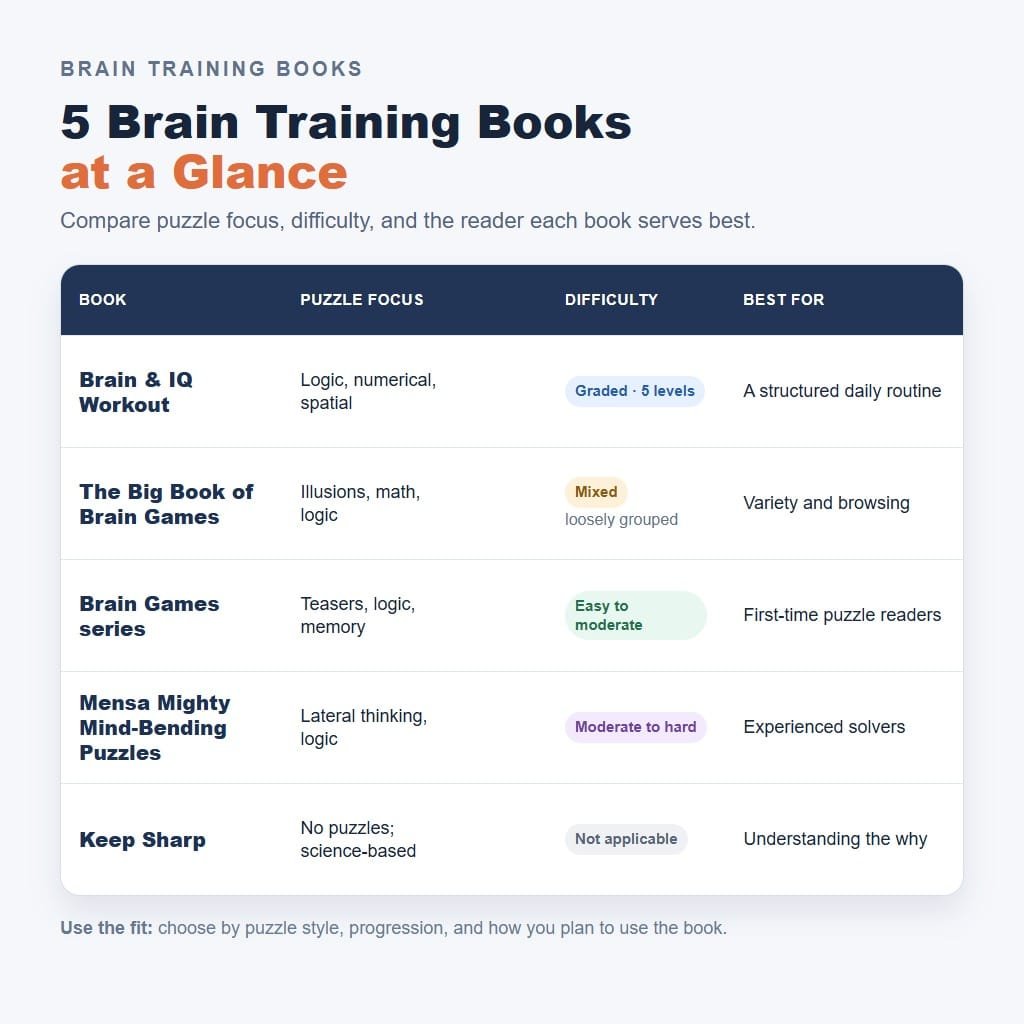
The table below summarizes the main differences between these brain training books, covering puzzle focus, difficulty range, and the type of reader each one suits best, to make a side-by-side comparison faster than reading every section in full.
| Book | Puzzle Focus | Difficulty Range | Best For |
|---|---|---|---|
| Brain & IQ Workout | Logic, numerical, spatial | Graded, 5 levels | A structured daily routine |
| The Big Book of Brain Games | Illusions, math, logic | Mixed, loosely grouped | Variety and browsing |
| Brain Games series | Teasers, logic, memory | Easy to moderate | First-time puzzle readers |
| Mensa Mighty Mind-Bending Puzzles | Lateral thinking, logic | Moderate to hard | Experienced solvers |
| Keep Sharp | No puzzles, science-based | Not applicable | Understanding the why |
4. How to Choose the Best Brain Training Books
Choosing among brain training books comes down mainly to current skill level and the kind of routine a reader actually wants to keep. A complete beginner who picks a book aimed at experienced solvers often gets discouraged within the first week, while an experienced solver handed an entry-level title quickly outgrows it and loses motivation from the opposite direction. Matching the book to current ability, then planning to move up once it starts feeling easy, avoids both failure modes.
4.1 Matching a Book to Skill Level
Someone who has never worked through a structured puzzle book benefits most from a title with a clear easy entry point, such as the Brain Games series, before moving to a graded workbook like Brain & IQ Workout that raises difficulty in defined steps. This staged approach mirrors the rotation-and-progression principle already covered in this series: comfort with one level should prompt a deliberate move to the next, not an indefinite stay at whatever already feels easy.

Readers who already solve newspaper logic puzzles without much effort should skip the easiest titles entirely and start with a graded workbook at its higher levels, or move directly to a harder collection such as Mensa Mighty Mind-Bending Puzzles. Starting too easy wastes the early weeks of a routine on material that provides little genuine challenge, which, as covered earlier in this series, is exactly the condition under which cognitive gains plateau.
4.2 Print Format and Daily Usability
A book intended for daily use benefits from a binding and print size that hold up to repeated handling and remain comfortable to read in typical lighting, since a book that feels awkward to open and write in quietly discourages the very daily habit it is meant to support. Large, clear grids matter more than they might seem for puzzles like Sudoku or logic grids, where cramped printing makes errors more likely and the whole session more frustrating than it needs to be.

Readers who travel often or prefer working in short bursts during a commute may also weigh page count and book weight more heavily than puzzle variety, since a smaller, lighter title is genuinely easier to keep within reach every day. A book that never leaves a shelf because it is inconvenient to carry provides no cognitive benefit at all, regardless of how well-designed its puzzles are on paper.
5. How to Get the Best Results From Brain Training Books
Owning a well-chosen book is only the first step; the cognitive benefit comes from how consistently and deliberately it gets used. A short, fixed daily session, the same fifteen-to-twenty-minute window covered earlier in this series, turns any of these books from a one-time purchase into an ongoing habit, and reviewing the explained answer for every missed puzzle, rather than skipping straight to the next page, is what actually builds the underlying skill rather than just filling pages.
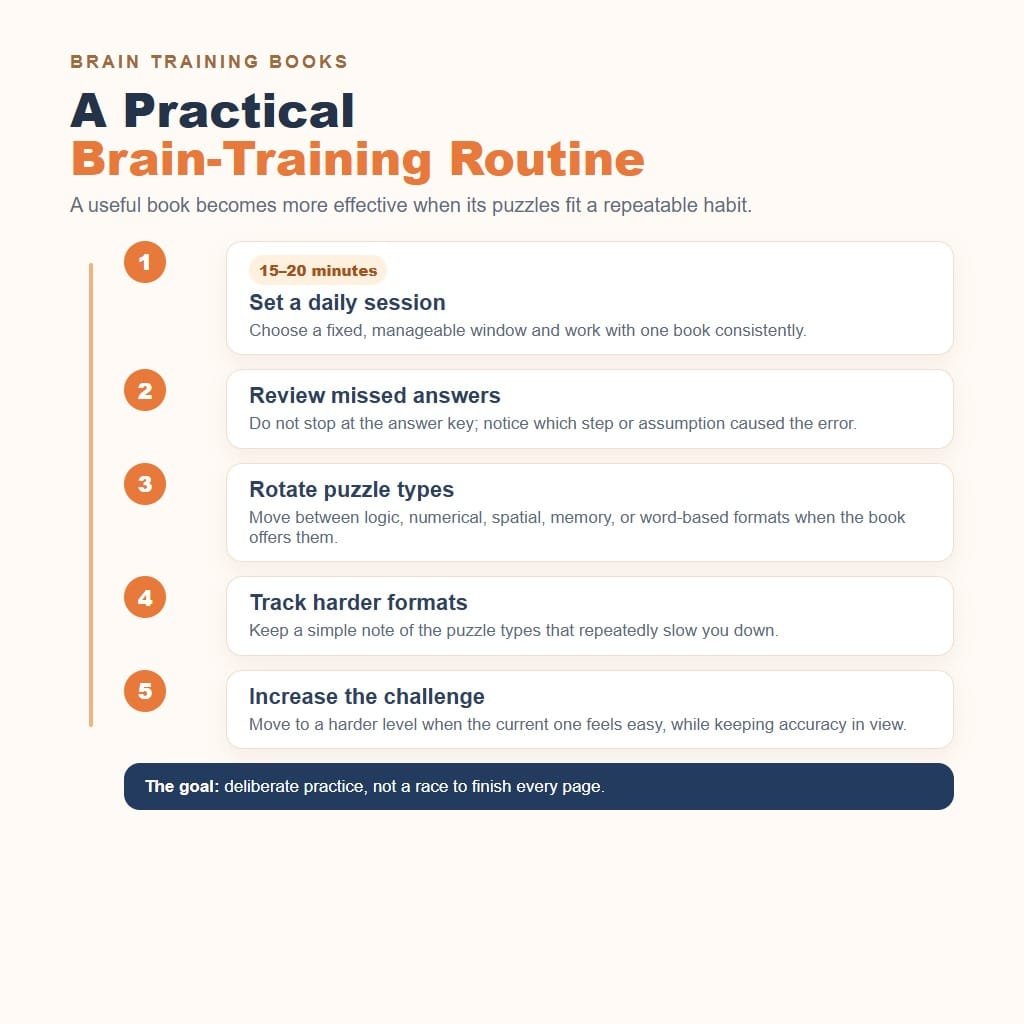
Rotating between puzzle types within the same book, rather than always solving the favorite format first, also keeps multiple cognitive systems engaged, echoing the variety principle already established for daily brain training. Tracking which puzzle types feel consistently harder over several weeks helps identify exactly where to focus extra attention, turning a static book into an adaptive, ongoing practice rather than a fixed sequence of pages worked through once and shelved.
Conclusion: Brain Training Books — Finding Your Best Fit
The right pick among brain training books depends less on which title is objectively “best” and more on matching current skill level, preferred puzzle types, and daily routine to a book built for that exact combination. A graded workbook like Brain & IQ Workout suits a structured daily habit, a broad survey like The Big Book of Brain Games suits variety-seekers, and a science-based read like Keep Sharp suits anyone who wants the reasoning behind the routine, not just the puzzles themselves.
For readers who want the structured, graded-difficulty approach this comparison favors for daily consistency, Brain & IQ Workout remains the most direct match: more than twenty puzzle types, five rising difficulty levels, and a complete, accuracy-checked answer key built for the rotation-and-progression routine this series recommends throughout.
As an Amazon Associate, BeIN ADVISOR earns from qualifying purchases.