
Brain training has moved from a niche hobby into a daily habit for people who want a sharper, more resilient mind. Anyone who has felt mentally foggy after a long week of screens and shallow tasks understands why this matters: the brain, like a muscle, weakens without deliberate use and strengthens with consistent challenge. This article explains what brain training actually does inside the brain, why some methods work far better than others, and how to build a routine that delivers real, measurable gains in memory, focus, and problem-solving.
Readers will get a clear breakdown of the science behind cognitive exercise, the types of activities that produce the strongest results, and a realistic weekly structure that fits a busy schedule. Along the way, common mistakes that quietly stall progress are addressed, along with practical fixes anyone can apply immediately. By the end, the goal is a confident, evidence-based plan rather than a vague intention to “do more puzzles.”
1. What Is Brain Training and Why It Matters
Brain training refers to structured mental exercises designed to challenge specific cognitive skills, such as working memory, reasoning, attention, and processing speed. Unlike casual entertainment, effective brain training follows a deliberate format: a task with a clear rule set, a measurable outcome, and a difficulty level that rises as the user improves. This matters because the brain only adapts when it is pushed slightly beyond its current comfort level, a principle researchers call productive difficulty. Without that rising challenge, the same crossword or sudoku stops producing new gains after a few weeks and becomes routine rather than training.
1.1 Defining Brain Training
At its core, brain training is any structured activity that asks the brain to solve a novel problem under a defined rule set. Logic grids, number sequences, and visual pattern puzzles all qualify because each one demands active reasoning rather than passive recall. In contrast, rereading familiar material or watching a video does not count as training, since no new mental effort is required. The distinction matters because many people assume that any “brain game” app or word search automatically improves cognition, when the real benefit depends entirely on whether the task keeps demanding more from the user over time.
A useful test is whether a given puzzle still feels slightly uncomfortable after a week of practice. If a sudoku grid or logic puzzle has become easy and automatic, it has likely stopped contributing meaningfully to brain training and now serves mainly as relaxation, which still has value but should be paired with a harder task. Structured puzzle collections that scale difficulty across levels, such as a graded workbook, solve this problem directly by forcing a return to genuine challenge every few sessions instead of letting the brain coast on mastered material.
1.2 The Cognitive Science Behind It
Cognitive scientists describe the brain’s capacity to reorganize itself in response to new demands as neuroplasticity, and it forms the biological basis for every claim made about brain training. When a person repeatedly practices a reasoning task, the neurons involved in that task strengthen their connections, making future attempts faster and more efficient. According to Cleveland Clinic’s overview of neuroplasticity, new synaptic connections form between billions of neurons as the brain takes in information, and this process underlies both learning and recovery from injury.
This means the benefits of brain training are not abstract or purely motivational; they reflect measurable structural change. However, the same research stresses that plasticity follows specific principles, including repetition, intensity, and specificity, which is why scattered, occasional puzzle-solving rarely produces noticeable results. A focused routine that revisits the same cognitive domains several times a week aligns far better with how plasticity actually works than an unstructured habit of opening an app whenever boredom strikes.
2. How Brain Training Affects the Brain
The effects of consistent mental exercise extend across several distinct cognitive systems rather than producing one generic boost. Working memory, sustained attention, and processing speed each respond to slightly different types of challenge, which is why a varied routine outperforms repeating a single puzzle type indefinitely. Understanding which mechanism is being trained helps explain why some days feel more mentally demanding than others, and why progress in one skill, such as memory, does not automatically transfer to a different skill, such as spatial reasoning.
2.1 Neuroplasticity and Mental Exercise
Every time a person works through a logic puzzle or number sequence that genuinely challenges them, the brain recruits a wider network of regions than it would for a familiar task. This recruitment is the early stage of plasticity, where the brain searches for an efficient strategy rather than relying on automatic recall. Over repeated sessions, this search becomes faster and more targeted, which is experienced subjectively as a puzzle type feeling easier even though the underlying problems remain just as complex.
As a result, the most efficient brain training routines rotate between several puzzle families rather than mastering one and stopping. Once a logic grid or arithmetic sequence stops requiring real effort, the marginal benefit drops sharply, and the time would be better spent on a new puzzle type that recruits fresh neural pathways. This rotation principle explains why structured puzzle books that mix categories, such as logic, spatial, and numerical reasoning, tend to produce broader cognitive gains than single-format apps.
2.2 Memory, Focus, and Processing Speed
Working memory, the ability to hold and manipulate information briefly, improves through tasks that require tracking several variables at once, such as logic grids with multiple clues or number pyramids that build on earlier steps. Focus, meanwhile, strengthens through tasks with a single sustained goal and no shortcuts, such as a maze or a word search under a time limit. Processing speed responds best to timed arithmetic or pattern-recognition tasks, where the same reasoning must be repeated quickly rather than slowly and carefully.
Because these three skills respond to different task structures, a single weekly session rarely covers all of them well. For instance, someone who only practices sudoku will likely see strong gains in focus and pattern recognition, but comparatively little improvement in working memory unless logic grids or multi-step puzzles are added. A deliberately varied routine, even a short one, therefore produces more balanced cognitive benefits than a longer session spent on one favorite puzzle type.
3. Types of Brain Training Activities
Not all puzzle categories train the same mental skill, so understanding the major types helps build a routine that covers memory, logic, and visual reasoning rather than just one narrow ability. The table below summarizes the main categories used in structured brain training programs, the cognitive skill each one targets primarily, and a typical difficulty range so a beginner can start appropriately and progress over time.
Puzzle Category | Primary Skill Trained | Typical Difficulty Range |
|---|---|---|
| Logic grids | Working memory, deduction | Beginner to advanced |
| Number sequences | Pattern recognition, reasoning | Beginner to intermediate |
| Sudoku and KenKen-style grids | Sustained focus, logic | Beginner to advanced |
| Spatial and maze puzzles | Visual-spatial reasoning | Beginner to intermediate |
| Cryptic word puzzles | Verbal reasoning, flexibility | Intermediate to advanced |
3.1 Logic and Number Puzzles in Brain Training
Logic and number puzzles form the backbone of most structured brain training programs because they demand active deduction rather than recall. A logic grid, for example, requires the solver to hold several clues in mind simultaneously and eliminate possibilities step by step, which directly exercises working memory and sustained reasoning. Number sequence puzzles add a layer of pattern recognition, asking the solver to identify the underlying rule before predicting the next term, a skill that transfers usefully to everyday tasks like budgeting and planning.
These puzzle types also scale cleanly across difficulty levels, which makes them ideal for long-term progress tracking. A beginner might start with four-clue logic grids and simple arithmetic sequences, then move toward six-clue grids and multi-step sequences as confidence grows. Graded puzzle collections that organize content by level, rather than mixing easy and hard puzzles randomly, make this progression far easier to follow and sustain over weeks rather than days.
3.2 Pattern and Visual Puzzles
Pattern and visual puzzles, including mazes, shape sequences, and grid-based logic challenges, train a different cognitive pathway than number-based reasoning. These tasks rely heavily on visual-spatial processing, the mental system responsible for tracking position, direction, and shape relationships. People who spend most of their day on verbal or numerical tasks, such as writing or accounting, often benefit the most from adding visual puzzles, since this balances the cognitive load across both major reasoning systems rather than reinforcing the same pathway repeatedly.
Mazes and spatial puzzles also offer a useful psychological benefit beyond raw cognitive training: they have a clear visual endpoint, which makes progress feel tangible in a way that abstract number puzzles sometimes do not. This visible sense of completion can sustain motivation during weeks when other puzzle types feel repetitive. A well-rounded routine therefore mixes abstract reasoning puzzles with at least one visual or spatial category each week to keep both motivation and cognitive coverage strong.
4. Benefits of Brain Training for Long-Term Health
Beyond the immediate satisfaction of solving a difficult puzzle, consistent brain training is associated with benefits that compound over months and years rather than appearing overnight. These benefits span both performance gains, such as sharper focus during work tasks, and protective effects, such as building cognitive reserve that may help buffer against age-related decline. Distinguishing between these short-term and long-term effects helps set realistic expectations for anyone starting a new routine.
4.1 Short-Term Brain Training Gains
In the first few weeks of a consistent routine, most people notice improvements in the specific skills they practice most often, such as faster pattern recognition or steadier focus during a logic puzzle. These early gains tend to be domain-specific, meaning someone who only practices sudoku will likely get faster at sudoku without a matching improvement in unrelated tasks like verbal memory. This is a normal and expected pattern, not a sign that the training is failing, and it is exactly why a varied weekly routine produces broader real-world benefits than a single repeated puzzle type.
Many users also report a subtle but noticeable improvement in everyday focus, such as reading a dense report without losing the thread or following a multi-step recipe without rechecking instructions repeatedly. These changes are difficult to measure precisely outside a laboratory, but they align with the underlying mechanism of strengthened working memory and attention control. Tracking a simple completion log for a few weeks is often enough for someone to notice these small but meaningful shifts in daily mental stamina.
4.2 Long-Term Brain Health
Over a longer horizon, the value of brain training shifts from skill-specific gains toward building what researchers call cognitive reserve, a buffer of neural efficiency that can help the brain compensate for age-related changes. The Harvard Health overview of cognitive exercise notes that brain plasticity requires regular training, since cognitive skills naturally decline with age without consistent engagement, and that effective exercises share three traits: challenge, complexity, and repeated practice over time.
This long-term framing also explains why diet and lifestyle factors matter alongside puzzle practice. Nutrients that support neural function, such as those found in lion’s mane mushroom, are often discussed alongside cognitive training because both approaches target the same underlying goal of supporting healthy brain structure. Combining a consistent puzzle routine with supportive daily habits, including sleep and physical activity, gives the brain the best possible conditions to translate training into durable, long-term resilience.
5. How to Build an Effective Brain Training Routine
A routine succeeds or fails based on structure far more than raw enthusiasm. The strongest programs share three traits: a fixed, realistic schedule, a way to track measurable progress, and enough variety to keep multiple cognitive systems engaged. Building these elements in from the start prevents the common pattern of starting strong for a week and then quietly abandoning the habit once novelty fades, which is the single biggest reason brain training programs fail to deliver results.
5.1 Setting a Realistic Brain Training Schedule
A sustainable schedule beats an ambitious one almost every time. Fifteen to twenty minutes, four or five days a week, produces more durable results than a single ninety-minute session on a weekend, because plasticity depends on repeated, spaced practice rather than occasional intensity. Anchoring the session to an existing habit, such as right after morning coffee or during a commute, removes the need for willpower and turns the routine into something closer to brushing teeth than an optional chore.
Consistency principles that work for other habits apply directly here as well. The same momentum-building approach described in the 5 second rule for fast decisions can help someone start a session on days when motivation is low, since the hardest part of any cognitive routine is usually opening the puzzle book rather than solving the puzzle itself. Once the first page begins, momentum typically carries the session through to completion.
5.2 Tracking Progress and Staying Motivated
Progress in brain training is easy to underestimate without a simple tracking method, since improvements happen gradually and rarely feel dramatic day to day. A basic log noting the puzzle type, the level completed, and the time taken provides enough data to spot real trends after two or three weeks. Seeing a logic grid that once took fifteen minutes now take nine minutes is a concrete, motivating signal that the underlying skill has genuinely improved.
Difficulty progression matters just as much as time tracking. A structured workbook organized into clear levels removes the guesswork of deciding when to move up, since the next level is simply the next section of the book. This built-in progression also prevents the common trap of staying at a comfortable difficulty for months, which feels productive but delivers diminishing cognitive returns once a puzzle type has become routine rather than challenging.
6. Common Mistakes in Brain Training
Even motivated beginners often undermine their own progress through a handful of predictable mistakes. Recognizing these patterns early saves months of effort spent on a routine that feels productive but quietly stalls. The two most common issues, relying on a single puzzle type and skipping difficulty progression, account for the majority of cases where someone reports feeling “stuck” despite regular practice.
6.1 Overreliance on a Single Puzzle Type
It is natural to gravitate toward whichever puzzle type feels most enjoyable, but repeating the same category indefinitely trains one narrow skill while leaving others untouched. Someone who only solves sudoku for months will likely become very fast at sudoku specifically, without seeing matching gains in working memory or verbal reasoning. This narrow focus can create a false sense of overall improvement, since the felt sense of “getting better at puzzles” does not always generalize beyond the specific format being practiced.
The fix is straightforward: rotate through at least three or four puzzle categories across a typical week, covering logic, numerical, and spatial reasoning rather than just one favorite. A workbook that organizes multiple puzzle families into a single structured program removes the friction of sourcing variety manually, which is often the real reason people default to one familiar app or puzzle type instead of branching out on their own.
6.2 Skipping Difficulty Progression
The second major mistake is staying at a comfortable difficulty level long after it has stopped providing real challenge. Once a puzzle can be solved almost automatically, the brain is no longer engaging the deliberate problem-solving circuits that drive plasticity, even though the activity still feels mentally engaging in the moment. This is the cognitive equivalent of lifting the same light weight for years and expecting continued strength gains; comfort and progress are rarely the same thing.
Avoiding this trap requires a deliberate decision to move up a level on a fixed schedule, such as every two weeks, rather than waiting for a puzzle to feel impossible before advancing. A graded structure with five clear difficulty tiers makes this decision automatic instead of subjective, since the next tier is simply the next section rather than a judgment call that procrastination can quietly delay indefinitely.
| Mistake | Effect | Fix |
|---|---|---|
| One puzzle type only | Narrow, domain-specific gains | Rotate 3-4 categories weekly |
| No difficulty increase | Plateau, diminishing returns | Advance levels on a fixed schedule |
| Inconsistent schedule | Weak, short-lived gains | Anchor sessions to an existing habit |
| No progress tracking | Low motivation, early dropout | Log puzzle type, level, and time |
Conclusion: Brain Training for a Sharper, Healthier Mind
Brain training delivers real, measurable benefits when it follows the principles that make plasticity work: genuine challenge, varied puzzle categories, and consistent, trackable practice. A scattered habit of occasional puzzles produces little change, but a structured routine that rotates logic, numerical, and spatial reasoning while steadily raising difficulty builds both short-term sharpness and long-term cognitive reserve. The science is consistent on this point, and the practical steps outlined above turn that science into a routine anyone can sustain.
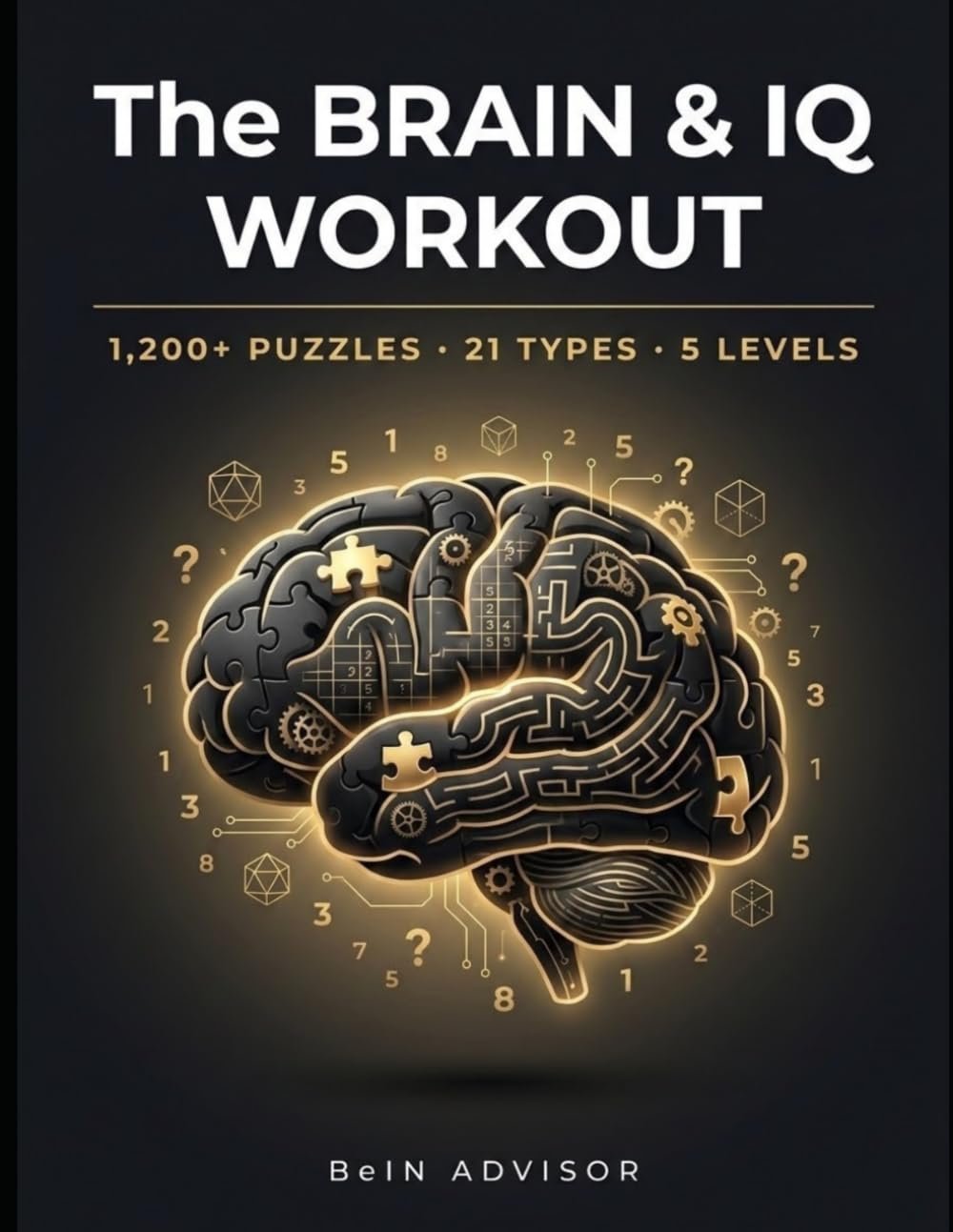
For anyone ready to put brain training into practice rather than just reading about it, a structured, graded puzzle collection removes the guesswork of variety and progression described throughout this article. Brain & IQ Workout organizes hundreds of solver-verified logic, numerical, and spatial puzzles across five rising difficulty levels, with a complete answer key whose solutions have each been checked for accuracy. It is built specifically for the rotation-and-progression approach this article recommends, making it a practical next step for turning brain training from an intention into a habit.
As an Amazon Associate, BeIN ADVISOR earns from qualifying purchases.