
Most goals quietly die in the few seconds between an idea and action. You think about exercising, then you hesitate, and the moment slips away. The 5 second rule targets that exact gap with a simple countdown. You count five, four, three, two, one, and then move at once. This small window interrupts doubt before it hardens into an excuse. As a result, you act on instinct instead of arguing yourself out of it.
The idea sounds almost too simple to matter, yet its power lies in timing. Hesitation gives your brain time to invent reasons to stay comfortable. Counting backward, however, hands your mind a small, clear task instead. Meanwhile, that count pulls you out of autopilot and into a decision. Therefore, the urge to delay loses its grip within moments. In fact, many people use this single tool to start habits they had postponed for years.
This guide explains the 5 second rule in a clear, practical way. First, we cover where it came from and how the countdown works. Next, we look at the simple brain science that makes it effective. After that, you get a step-by-step method and real daily uses. Additionally, we cover common mistakes and how to keep the habit alive. By the end, you will know exactly how to act before hesitation wins.
1. What the 5 Second Rule Is
The 5 second rule is a simple tool for turning intention into action. The moment you feel an instinct to act on a goal, you count backward. You say five, four, three, two, one, and then you physically move. That movement can be standing up, picking up the phone, or starting the task. The countdown works as a starting ritual that signals your brain to go. Without it, hesitation expands and quietly talks you out of the action. With it, you bridge the gap between knowing and doing. Moreover, the rule needs no app, no cost, and no special training. As a result, anyone can use it anywhere, the very first time they try.
1.1 The Origin of the 5 Second Rule
The 5 second rule was popularized by author and speaker Mel Robbins. She created it during a difficult period when she struggled to get out of bed. One night, she saw a rocket launch counting down to liftoff. Inspired, she decided to count backward and launch herself up the next morning. To her surprise, the small trick actually worked the very first time. Therefore, she began applying the same countdown to other avoided tasks. Over time, it grew into a method shared with millions of people. According to Mel Robbins, the rule reshaped her habits and confidence.
The concept spread because it solved a problem almost everyone recognizes. People rarely fail from a lack of knowledge about what to do. Instead, they stall in the gap between intention and the first move. The 5 second rule gives that gap a clear, repeatable interruption. As a result, it found a wide audience among readers chasing better habits. Furthermore, its simplicity made it easy to test and share. Many users report acting on goals they had delayed for years. In short, the rule turned a vague wish to change into a concrete trigger.
1.2 The Simple Countdown Method
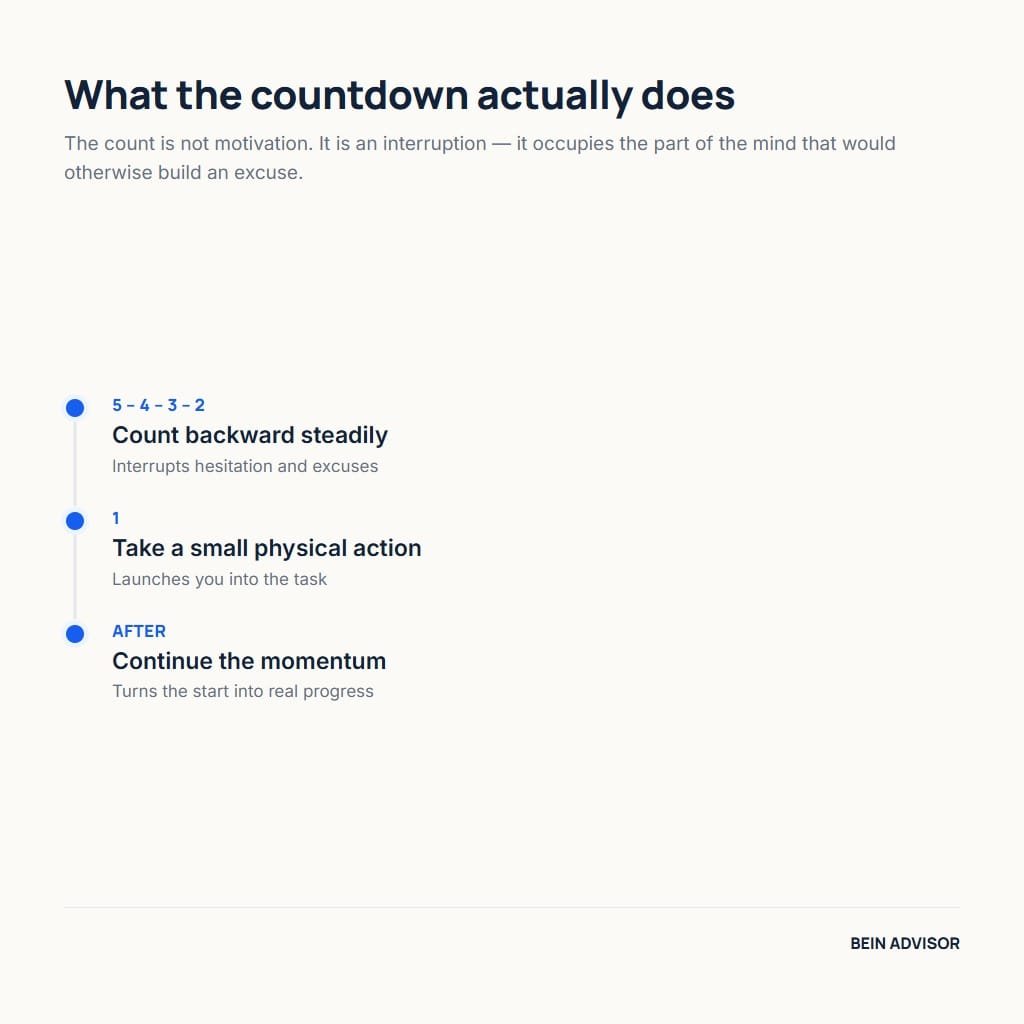
Using the method takes only a few seconds and no preparation at all. The instant you feel the pull to act, you start counting backward. You move from five down to one in a steady, deliberate rhythm. On one, you take a physical action toward the goal immediately. For example, you stand, open the document, or speak the first word. This order matters, because counting up has no natural endpoint. Counting down, by contrast, builds toward a clear moment of launch. Therefore, the brain treats one as a signal to move now.
The physical movement on one is the part people most often skip. Counting alone does nothing unless it ends in real action. The motion locks in the decision before doubt can return. Meanwhile, even a tiny step counts as movement that breaks the freeze. For instance, putting one foot on the floor begins getting out of bed. Similarly, opening your email starts the task you were avoiding. As a result, the countdown and the action work only as a pair. In practice, the rule is the count plus the move, never the count alone.

2. The Science Behind the 5 Second Rule
The 5 second rule works because of how the brain handles hesitation. Your mind is wired to protect you from discomfort and risk. When you pause before a hard task, that protective system seeks safer options. Within seconds, it offers excuses that feel reasonable and convincing. The countdown interrupts this process before it can take over. By giving the brain a simple task, it shifts focus away from fear. Meanwhile, deciding moves control to a more deliberate part of the mind. As a result, you respond on purpose instead of by habit. Therefore, the rule is less about willpower and more about timing.
2.1 How Hesitation Hijacks the Brain
Hesitation is not a character flaw, but a natural brain response. When a task feels hard, the mind predicts discomfort and pulls back. This reaction happens fast, often before you are even aware of it. As a result, you drift toward whatever feels easy and safe instead. For example, you reach for your phone rather than start the report. The longer you pause, the stronger the urge to avoid becomes. Therefore, hesitation feeds on time and grows with every passing second. In short, waiting is exactly what lets resistance win.
Habits make this avoidance even harder to notice or stop. Much of daily behavior runs on automatic patterns the brain prefers. These patterns save energy, yet they also keep you stuck in old routines. Consequently, breaking a habit needs a deliberate interruption from outside the loop. Without one, you repeat the same avoidance without truly choosing it. The 5 second rule supplies that interruption at the key moment. Meanwhile, it forces a conscious decision before autopilot takes the wheel. As a result, you reclaim a choice that habit had quietly made for you.
2.2 Why Counting Backward Works
Counting backward is more than a quirky trick; it has a clear purpose. The task occupies the part of your mind that would otherwise make excuses. While you focus on the numbers, the worry loop loses its fuel. Therefore, the count creates a short mental pause from fear. This pause is exactly long enough to choose action over avoidance. Moreover, moving from five to one builds a sense of momentum. Each number brings you closer to a defined launch point. As a result, one becomes a trigger your brain learns to obey.
Psychologists describe this as shifting from reaction to deliberate control. The countdown moves you out of an automatic state and into an intentional one. In that brief window, you assert control over your own behavior. Consequently, you act from choice rather than from fear or habit. Over time, repeating this pattern strengthens the link between the count and action. For example, the trigger grows faster and more reliable with practice. Eventually, the rule feels almost automatic, like a mental starting gun. In turn, action becomes your default response to hesitation.
3. How to Use the 5 Second Rule
Knowing the theory matters little without a clear way to apply it. Using the 5 second rule well comes down to a simple, repeatable habit. You notice the instinct to act, then start the countdown right away. From five to one, you keep the rhythm steady and deliberate. On one, you move before your mind can offer a single excuse. The key is to act the moment you feel the first pull. Waiting even a little lets hesitation slip back into control. Therefore, speed between the count and the action is everything. With practice, the whole sequence takes only a few seconds.
3.1 The Step-by-Step Countdown
Start by catching the exact moment you sense an instinct to act. That instinct is a quiet signal that you should move toward a goal. As soon as you feel it, begin counting backward from five out loud. Saying the numbers aloud makes the trigger stronger and harder to ignore. Move steadily through five, four, three, two, and finally one. Keep the pace even so the count builds toward a clear finish. On one, launch into the smallest possible first action immediately. For example, stand up, open the file, or dial the number.
Treat the countdown as a firm rule, not a loose suggestion. If you bargain with yourself mid-count, the rule loses its power. Therefore, decide in advance that one always ends in movement. When resistance appears, simply restart the count and move on one again. With repetition, your brain links the number one to immediate action. Meanwhile, the gap between deciding and doing keeps getting shorter. As a result, the method becomes faster and more reliable over time. In practice, consistency matters far more than perfect timing.
3.2 Pairing It With Action
The rule only works when the count leads straight into a real step. A countdown with no movement simply trains you to ignore it. Therefore, always attach the smallest concrete action to the number one. The action should be tiny enough that you cannot easily refuse it. For example, write one sentence rather than the whole report. Similarly, put on your shoes instead of planning the entire workout. This small start breaks inertia and creates immediate momentum. Once you begin, continuing usually feels far easier than starting did.
Choosing the right first action makes the rule far more effective. Pick a step that points clearly toward your larger goal. Then make it so simple that hesitation has nothing to grab. After the first move, let momentum carry you into the next one. Meanwhile, avoid planning too much, since planning can become another delay. The point is to act first and refine the details later. As a result, the rule turns a vague intention into visible progress. Over time, these small launches add up to real, lasting change.
4. Using the 5 Second Rule to Beat Hesitation
Hesitation shows up most when a task feels boring, hard, or risky. The 5 second rule is built for exactly these difficult moments. It gives you a fast way to act before doubt takes hold. Instead of weighing every reason to wait, you simply count and move. This approach works for procrastination, fear, and slow decisions alike. Each of these problems lives in the same gap between thought and action. By closing that gap quickly, the rule removes their main advantage. Therefore, it helps in many situations that share one root cause. Both examples below rely on the same core habit you already learned.
4.1 Breaking Procrastination
Procrastination thrives on the comfort of starting later instead of now. You tell yourself the task will feel easier after one more break. However, later rarely arrives, and the task keeps growing in your mind. The 5 second rule cuts through this loop with a fast launch. The instant you notice yourself delaying, you count and begin. On one, you take the smallest first step toward the work. For example, you open the document and type a single line. As a result, the task stops feeling huge and starts feeling possible.
Starting is almost always the hardest part of any avoided task. Once you begin, the imagined difficulty usually shrinks quickly. The rule works because it forces that first step to happen now. Meanwhile, it denies your brain the time to build a convincing excuse. Therefore, you bypass the debate and move straight into action. With repetition, starting becomes a reflex rather than a battle. In turn, tasks pile up less and progress feels steadier. Over time, beating procrastination once makes the next start easier.
4.2 Making Faster Decisions
Endless deliberation can be as harmful as never deciding at all. Many small choices do not deserve hours of anxious thought. The 5 second rule helps you commit before overthinking sets in. When a low-stakes decision appears, you count down and choose. On one, you pick an option and move forward without spiraling. For example, you reply to the message instead of rereading it ten times. As a result, you save mental energy for choices that truly matter. Meanwhile, quick decisions keep your day moving instead of stalling.
Faster decisions also build confidence in your own judgment over time. Each quick, committed choice proves that you can trust yourself. Therefore, the fear around deciding slowly begins to fade. Of course, big decisions still deserve careful thought and research. The rule is best for the countless small choices that clog your day. For instance, it helps you start a chore, send a reply, or speak up. By acting on these quickly, you free attention for deeper work. In short, the rule trims hesitation from the decisions that least need it.
5. Everyday Applications of the 5 Second Rule
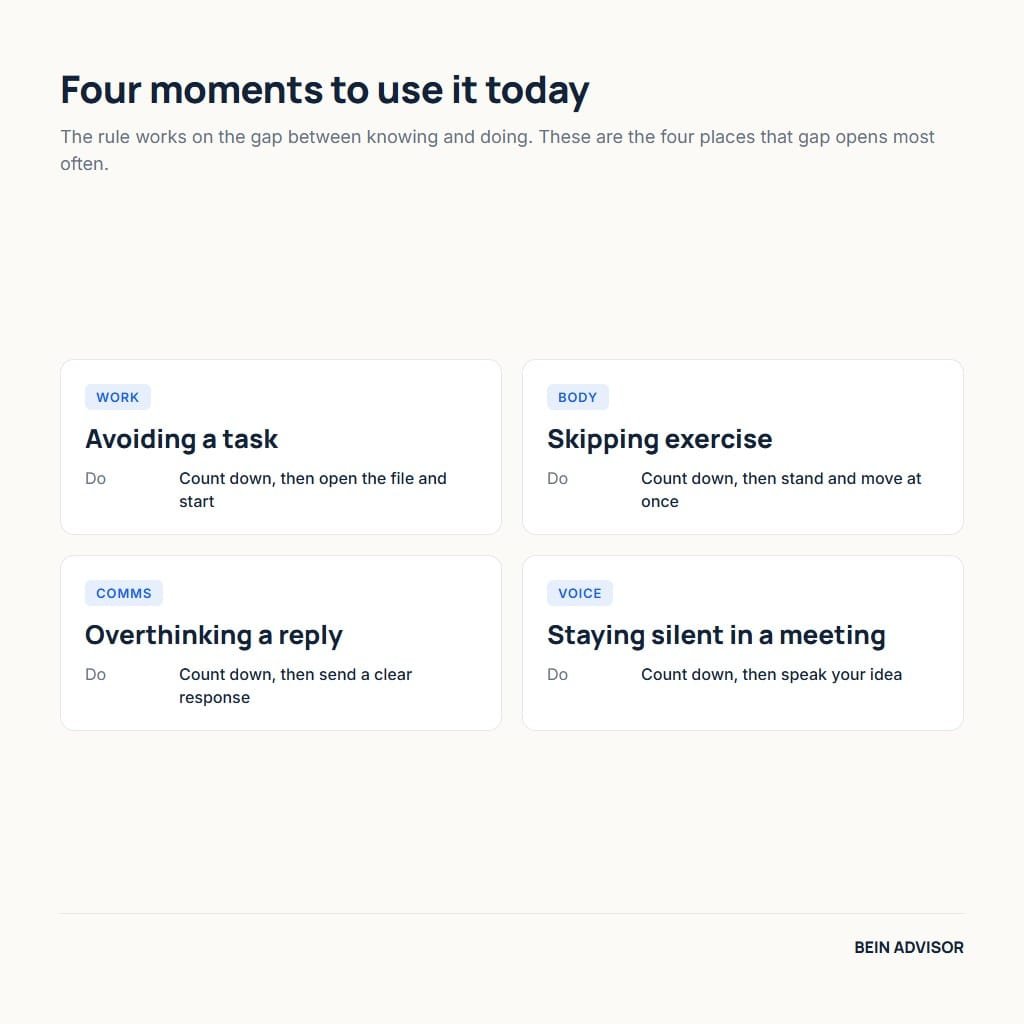
The real value of the 5 second rule shows in everyday situations. It is not only for dramatic moments or major life changes. Instead, it shines in the small choices that fill an ordinary day. You can use it to start work, exercise, or a hard conversation. Each time, the same countdown turns intention into immediate action. Because the tool is so simple, it fits almost any context. Therefore, you can apply it at home, at work, and in between. The more situations you use it in, the more natural it becomes. A short table below summarizes how to apply it in each case.
5.1 Work and Productivity
Work is full of tasks that invite delay and quiet avoidance. The 5 second rule helps you begin them without a long internal fight. When you catch yourself stalling, you count and start the task. On one, you open the file or write the first difficult email. For example, you begin the report you have postponed all morning. As a result, the hardest task often gets done earlier in the day. Meanwhile, finishing it removes the stress of carrying it around. In turn, the rest of your work feels lighter and clearer.
Meetings and teamwork also benefit from quicker, braver action. Speaking up in a meeting can feel risky in the moment. The countdown helps you share an idea before fear silences you. Therefore, you contribute instead of regretting your silence later. Similarly, the rule helps you tackle the email you keep avoiding. You can also link it with simple AI productivity tools for steady focus. As a result, small, prompt actions build into stronger work habits. Over time, this momentum noticeably improves your overall output.
5.2 Health and Personal Habits
Health goals often fail at the moment of starting, not planning. You know you should exercise, yet you hesitate and skip it. The 5 second rule pushes you past that first wave of resistance. When the urge to skip appears, you count and move at once. On one, you stand, change clothes, or step outside to walk. For example, you start a short workout instead of scrolling your phone. As a result, the habit begins before excuses can fully form. In time, these small launches build a steady, lasting routine.
The rule supports calmer, healthier choices throughout the whole day. It can help you pause a bad habit and pick a better option. For instance, you count before reaching for a snack you do not need. Then you choose water or a walk instead of acting on impulse. Meanwhile, a settled mind makes these choices easier to sustain, much like the calm described in our guide on lasting contentment. As a result, the rule supports both action and self-control. Over time, these choices shape a healthier daily life.
6. Common 5 Second Rule Mistakes to Avoid
Like any habit, the 5 second rule can be used in ways that weaken it. Most failures come from skipping the action or bargaining mid-count. Knowing these traps helps you keep the rule sharp and effective. The goal is to protect the link between the count and the movement. When that link stays strong, the rule keeps working reliably. When it breaks, the countdown slowly becomes background noise. Therefore, a little awareness keeps the method from fading over time. Consistency also turns the rule from a trick into a lasting habit. Avoiding the errors below keeps your trigger fast and dependable.
6.1 Mistakes That Weaken the Rule
The most common mistake is counting without ever moving on one. When you skip the action, the count stops meaning anything. Therefore, your brain quickly learns to ignore the numbers. Another mistake is negotiating with yourself in the middle of the count. If you allow debate, hesitation simply wins by default. Counting too slowly also drains the method of its urgency. The pace should feel brisk, building toward a clear launch. As a result, a sloppy countdown produces a sloppy, unreliable result.
People also misuse the rule by aiming it at the wrong choices. The tool is built for action, not for major life decisions. Using it to rush a serious choice can lead to regret. Therefore, reserve careful thought for high-stakes decisions that deserve it. Another error is expecting the rule to remove all discomfort. It does not erase fear; it simply helps you act despite it. As a result, expecting magic leads to disappointment and abandonment. In short, use the rule for starting, not for skipping real thought.
6.2 Building It Into a Lasting Habit
Consistency is what turns the rule from a trick into a reflex. The more often you use it, the faster the trigger becomes. Therefore, apply it to small moments many times each day. For example, use it to get up, start chores, or send replies. Each small win strengthens the link between counting and acting. Meanwhile, frequent practice keeps the habit fresh and automatic. As a result, the rule grows more powerful the more you rely on it. Over time, acting on instinct becomes your normal response.
Pair the rule with clear goals so your actions point somewhere useful. When you know your priorities, the countdown launches the right moves. Therefore, decide in advance which actions matter most to you. Then aim the rule at those actions whenever hesitation appears. Tracking small wins can also keep your motivation high. For instance, notice each time the rule helped you start something. As a result, you see proof that the method truly works. In turn, that proof makes you far more likely to keep using it.
| Step | What You Do | What It Achieves |
|---|---|---|
| 5–4–3–2 | Count backward steadily | Interrupts hesitation and excuses |
| 1 | Take a small physical action | Launches you into the task |
| After | Continue the momentum | Turns the start into real progress |
| Situation | How to Apply the 5 Second Rule |
|---|---|
| Avoiding a task | Count down, then open the file and start |
| Skipping exercise | Count down, then stand and move at once |
| Overthinking a reply | Count down, then send a clear response |
| Staying silent in a meeting | Count down, then speak your idea |
Conclusion: The 5 Second Rule — Act Before You Hesitate
The 5 second rule proves that lasting change can start with a tiny habit. A simple backward count interrupts hesitation before it becomes an excuse. From five to one, you shift from thinking into immediate action. The method needs no tools, no money, and no special talent. Instead, it relies on timing and a small move on the number one. As a result, anyone can use it to start what they keep avoiding. Above all, it closes the gap where most good intentions quietly die.
If hesitation has been holding you back, this rule is worth trying today. Notice the next instinct to act, then count five, four, three, two, one. On one, take the smallest possible step toward your goal. Use it for work, health, decisions, and brave conversations alike. With practice, acting on instinct will become your natural response. Over time, these small launches add up to real momentum and confidence. Start using the 5 second rule now, and act before you hesitate.