
Most people who quit in the first month quit for the same reason. They opened a job listing, saw eleven acronyms they had never met, and decided the door was closed. Cybersecurity for beginners looks impossible from outside because the field advertises its senior roles and hides its entry ones. The actual starting line is far lower than the listings suggest, and the path from it is more ordinary than the mythology around hacking implies.
This article lays out that path over a realistic six months. It covers what the field actually contains, the three foundations no specialism lets you skip, and a month-by-month plan you can run alongside a job. Additionally, it explains which entry certificate is worth paying for and what a certificate cannot prove on its own. Each section answers a question that decides whether the six months produce anything.
No promises about salaries appear here, and no timeline is guaranteed. What follows is the sequence that works, in the order that works, with the traps that waste the most time marked. Six months of steady, boring practice beats two weekends of enthusiasm every time. Consequently, the plan below is built around what a person with a full-time job can actually sustain.

1. What Cybersecurity for Beginners Actually Covers
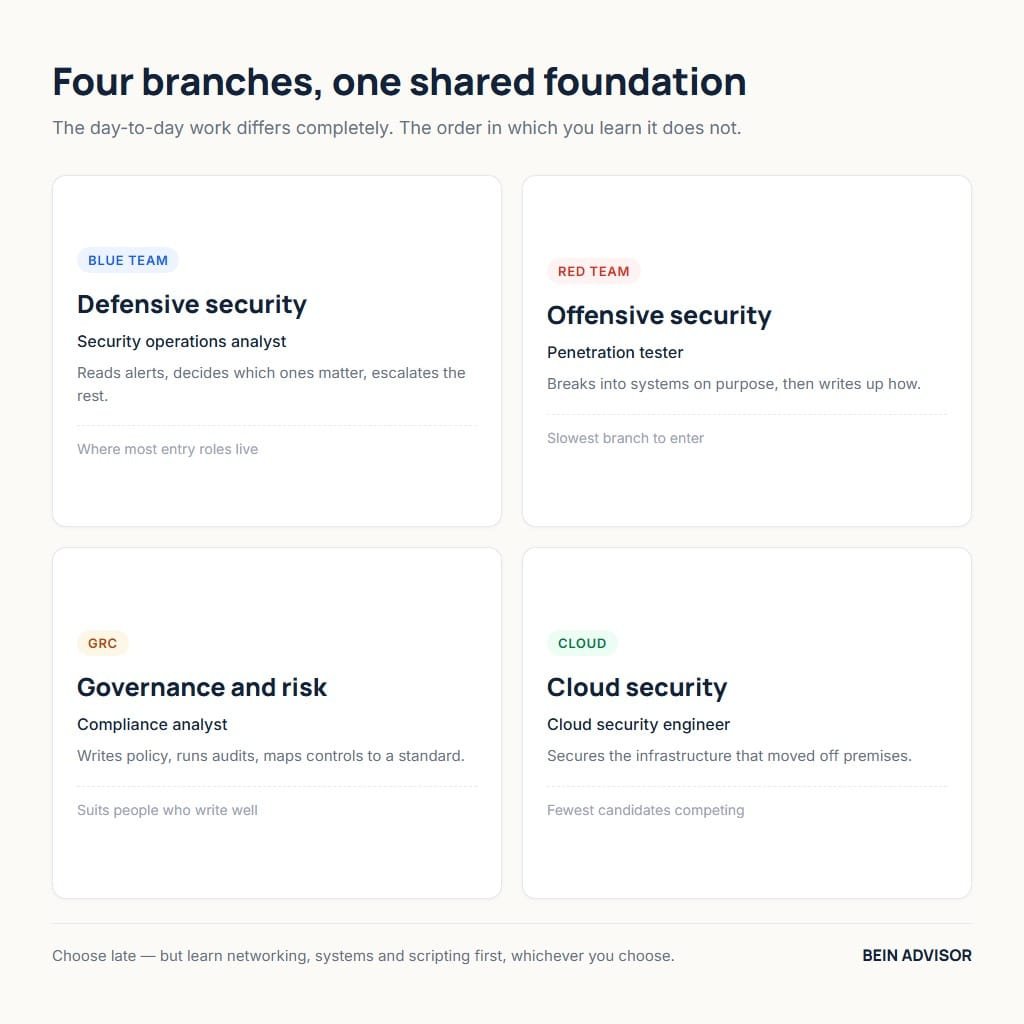
The word describes a dozen jobs that share almost nothing day to day. One person spends the shift reading alerts in a monitoring console. Another writes policy documents and maps controls to a standard. A third breaks into systems on purpose and writes a report about how. As a result, “getting into cybersecurity” is not a single destination, and choosing between these branches early saves months of studying the wrong material. The branches do share a foundation, which is why the order in this article matters more than the branch you eventually pick.
1.1 The Fields Inside the Field
Defensive work, often called blue team, is where most entry roles live. A security operations analyst watches alerts, decides which ones matter, and escalates the rest. The work is investigative rather than dramatic, and it teaches more in six months than any course does. Furthermore, it is the branch most likely to hire someone without a degree, because the skill is demonstrable in a lab. Offensive work, the red team side, gets the attention and takes far longer to enter.
Two other branches are routinely overlooked and hire steadily. Governance, risk and compliance turns regulation into practice: writing policy, running audits, mapping controls. It suits people who write well and think in systems, and it rarely requires deep technical depth at entry. Meanwhile, cloud security has grown into its own discipline as infrastructure moved off premises. Both pay comparably to analyst roles and compete for far fewer candidates. That makes them worth a serious look rather than a footnote.
1.2 Where Cybersecurity for Beginners Usually Starts
A large share of people arrive from an adjacent technical job. Help desk, system administration and network support all supply the context the field assumes you have. Someone who has reset a hundred passwords already understands what an attacker is attacking. Therefore, if you hold one of those roles, you are further along than the job listings make you feel. The gap is vocabulary and specific tooling rather than fundamentals.
Arriving from outside technology is slower but entirely normal. Teachers, accountants and nurses move into this field regularly. The ones who succeed treat the first three months as general IT rather than security. They learn how a network moves a packet and how an operating system handles a file before touching an attack technique. In contrast, people who start with hacking tutorials build a shallow layer with nothing underneath. The gap shows in the first technical interview.
2. The Foundations Cybersecurity for Beginners Cannot Skip
Three foundations sit under every branch, and no specialism excuses you from them. Networking explains how data moves and therefore how it is intercepted. Operating systems explain where software keeps its secrets and how permission is granted or stolen. Scripting turns a repetitive manual check into something you run once and trust. Consequently, the fastest route is not the one that reaches an attack technique soonest. It is the one that builds these three properly. Everything after them then makes sense.
2.1 Networking and Operating Systems
Networking is the single highest-value subject at the start. Learn what an IP address and a subnet do, how DNS turns a name into an address, and what actually happens across a TCP handshake. Understand the difference between HTTP and HTTPS at the level of what is encrypted and what is not. For example, knowing that DNS queries are often unencrypted explains a whole family of attacks in one sentence. Everything you later read about traffic analysis rests on this layer.
Operating systems come next, and you need both families. Linux teaches the command line, file permissions, users and processes, and it is where most security tooling runs. Windows matters because it is what most organisations actually use, which makes Active Directory a core topic rather than an optional one. Additionally, learning both keeps doors open: a defensive role in a Windows shop and a tooling role on Linux servers are very different jobs. Install both, break them, and repair them.

2.2 Why Scripting Comes Before Tools
Python is the usual first language and remains the right choice. You are not building applications; you are parsing a log file, calling an API, and automating a check you would otherwise run by hand. That is a small, learnable subset, and it pays back within weeks. Bash matters for the same reason on the Linux side, and PowerShell does the equivalent job on Windows. In fact, an analyst who can write forty lines of Python is measurably more useful than one who has memorised another tool’s menu.
Tools change constantly, and the ones you memorise now may be replaced. The reasoning underneath them does not change, which is why scripting belongs before tooling rather than after it. Someone who understands what a scanner is doing can pick up a new scanner in an afternoon. Conversely, someone who only knows the buttons has to start again each time the vendor changes. Learn the concept, then let the tool be an implementation detail of it.
3. A Six-Month Plan for Cybersecurity for Beginners
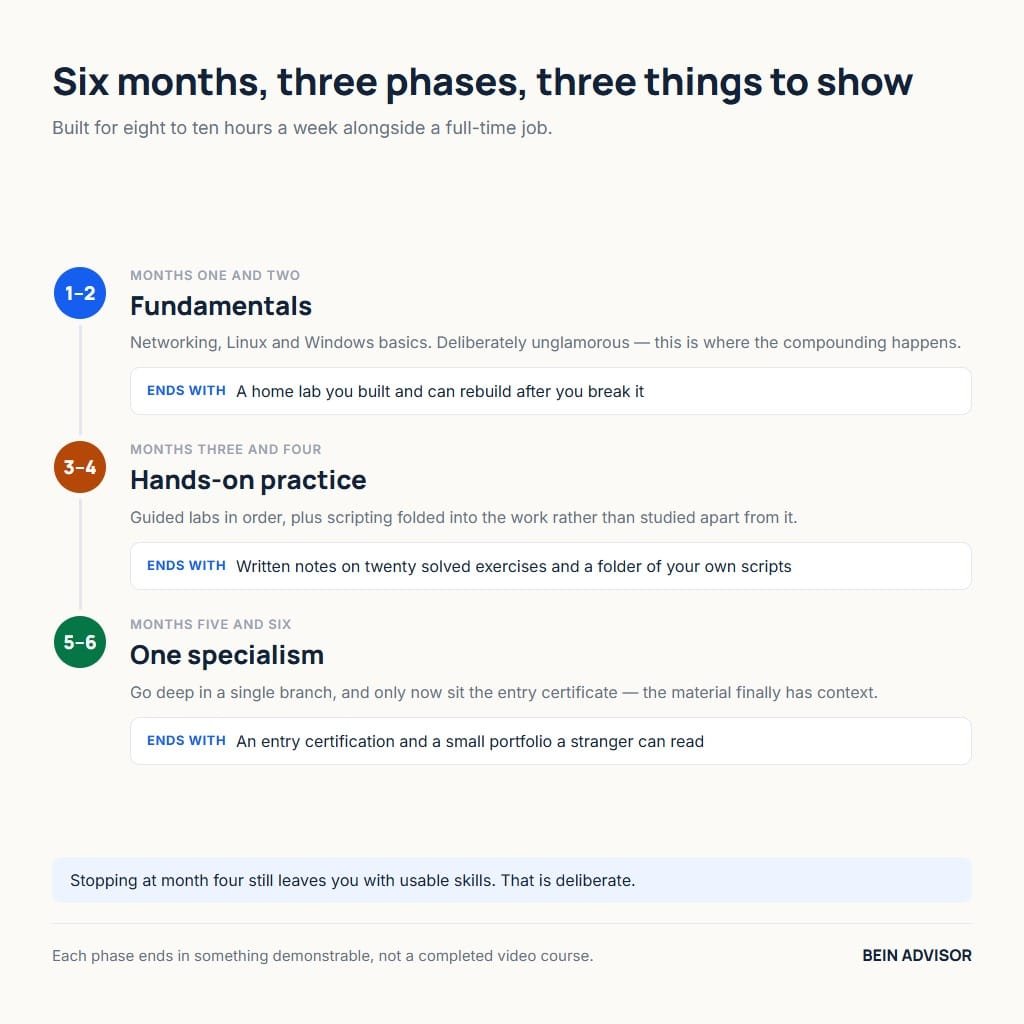
The plan below assumes eight to ten hours a week. That is what someone in full-time work can sustain without burning out. It is deliberately unglamorous in the first third, because that is where the compounding happens. Each phase ends with something you can show rather than something you have merely watched. Moreover, the sequence is designed so that abandoning it at month four still leaves you with usable skills. The table sets out the shape before the detail.
| Phase | Focus | What you should have at the end |
|---|---|---|
| Months one and two | Networking, Linux, Windows basics | A home lab you built and can rebuild |
| Months three and four | Hands-on labs and scripting | Written notes on twenty solved exercises |
| Months five and six | One specialism plus a certificate | An entry certification and a small portfolio |
3.1 Months One and Two: Fundamentals
Spend this block on networking and operating systems, and resist every temptation to skip ahead. Build a small home lab with virtual machines: one Linux server, one Windows client, and a network between them you configured yourself. The lab matters more than any course, because rebuilding it after you break it is where the learning happens. Structured video courses on platforms such as Coursera or Udemy work well here for sequence and pace.
Take notes in your own words rather than copying slides. Writing a concept down as an explanation to yourself exposes the parts you have not understood, which watching never does. Keep those notes in one searchable place; you will reread them constantly in month five. For instance, a running document on how DNS resolution works will be more useful to you than any bookmark. Our article on using Notion AI to organise daily tasks covers a workable setup for exactly this kind of study log.
3.2 Months Three and Four: Hands-On Practice
Now move to guided practice platforms, where you attack and defend deliberately vulnerable machines. Work through beginner paths in order rather than jumping to whatever looks exciting. The point is not to collect completions; it is to build the habit of investigating something you do not understand yet. Similarly, start writing short notes on each exercise: what you tried, what failed, what finally worked. Those write-ups become your portfolio without any extra effort later.
Fold scripting into this block instead of studying it separately. Every time you repeat a manual step twice, write the ten lines that do it for you. Parse a log file, extract the failed logins, count them by address. That single exercise teaches file handling, string parsing and basic analysis at once. As a result, month four should end with a small folder of scripts. You wrote them for your own real problems. In an interview that is worth more than a certificate alone.
3.3 Months Five and Six: Specialising
Pick one branch now and go deep rather than broad. If defence appeals, learn how a SIEM aggregates logs and how detection rules are written and tuned. If governance suits you better, study one framework properly and practise mapping real controls to it. Furthermore, this is the block where a certificate makes sense, because you finally have the context to understand its material rather than memorise it. Studying for the exam then reinforces what you already half know.
Use the same block to tidy what you have into something visible. Turn the best of your lab write-ups into short public posts, and put your scripts somewhere a stranger can read them. Neither needs to be impressive; both need to exist. In contrast, a candidate with no visible work asks an employer to take everything on trust, and at entry level that is a hard ask. Consistent, modest evidence beats a single ambitious project you never finished.
4. Certifications in Cybersecurity for Beginners
Certificates do one job well and are frequently asked to do a second job they cannot. They get a CV past an automated filter and signal that you have covered a defined syllabus. They do not demonstrate that you can investigate anything, and experienced interviewers know the difference. Therefore, the question is never whether to get one, but which one and when. Taking it too early wastes the money, because the material lands as vocabulary rather than understanding.
4.1 Which Entry Certificate Is Worth the Money
CompTIA Security+ remains the most widely recognised entry credential. It appears by name in a large share of junior listings. It is vendor-neutral, broad, and it maps well to the foundations described above. Vendor certificates from the major cloud providers are the sensible second choice if cloud security is your branch. Additionally, several free or low-cost introductory programmes now exist, and they are a reasonable way to test your interest before spending on an exam.
| Certificate type | What it signals | Best taken |
|---|---|---|
| Vendor-neutral entry | Broad foundations across the field | Month five, after the fundamentals |
| Cloud provider entry | Depth in one platform | Once you have chosen cloud security |
| Free introductory programme | That you have tested your interest | Month one, before spending anything |
| Advanced or specialist | Experience you do not have yet | After a first role, not before |
4.2 What a Certificate Does Not Prove
An exam tests recall under time pressure, and the job tests investigation under uncertainty. Those are different skills, and the gap between them is where new certificate holders struggle. A technical interview will ask you to reason aloud about an unfamiliar situation, not to recite a definition. Consequently, the certificate should sit on top of practice rather than replace it. Candidates who pass an exam without ever building anything are exposed within ten minutes of a real conversation.
Certificates also say nothing about the parts of the job that decide whether you keep it. Writing a clear incident note, explaining a risk to someone non-technical, and knowing when to escalate all matter daily. The public workforce frameworks make this explicit: the NICE cybersecurity workforce framework describes roles in terms of tasks and skills rather than credentials. Reading how a role is actually defined is a better guide to preparation than any exam syllabus.

5. Building Proof for Cybersecurity for Beginners
Entry-level hiring is a trust problem. The employer cannot verify what you know, so they look for cheap signals that you have done the work rather than watched it. Evidence closes that gap faster than any additional course. Meanwhile, most candidates produce none at all, which means a modest amount of visible work stands out more than it should. The two things worth building are a lab you can describe and a handful of write-ups a stranger can read.
5.1 Labs, Write-Ups and a Home Setup
A home lab needs no budget and no special hardware. Virtualisation software on an ordinary laptop runs two or three machines comfortably, which is enough for everything at this level. Build a small network, add a deliberately vulnerable machine, and practise both attacking and detecting. Furthermore, the act of configuring it teaches more than the exercises you run inside it, because configuration is where real systems actually break.
Write up what you did in plain language, aimed at someone who was not there. State what you were trying to find, what you tried, where you were wrong, and how you corrected. That last part is what interviewers actually read for, because it shows reasoning rather than a result. For instance, a write-up that explains a wrong first assumption is stronger than one that presents a clean success. Publish them anywhere public and keep them short.

5.2 Where Employers Actually Look
Most junior roles are filled through a filtered CV and one technical conversation. The filter looks for named certificates and named technologies, so both should appear in plain words on your CV. The conversation tests whether you can think, so your write-ups matter more there than anything else. Therefore, treat the two artefacts as serving different stages rather than competing for your time.
Local professional communities are undervalued and cost nothing. Junior openings circulate at meetups and in online groups before they are advertised. Someone there will also answer the question that has blocked you for a week. In addition, security has a strong culture of people helping newcomers, which is unusual and worth using. Devices and accounts you already own are a legitimate practice ground too. Our article on checking a device IMEI properly applies the same verification habit on a small scale.

6. Getting the Best Results From Cybersecurity for Beginners
The difference between people who finish this plan and people who abandon it is rarely aptitude. It is almost always whether the routine survived a bad week at work. A schedule that assumes perfect motivation fails on the first busy Tuesday, and the failure usually ends the whole attempt. Consequently, the design of your week matters as much as the material in it. The two subsections below cover what makes a routine durable and which mistakes cost the most months.
6.1 A Study Routine for Cybersecurity for Beginners
Short and frequent beats long and rare. Five sessions of ninety minutes teach more than one exhausting weekend, because the gaps are where things consolidate. Fix the sessions to specific times rather than leaving them to willpower. Treat a missed one as a miss, not a reason to stop. Additionally, keep one session a week purely for revisiting old notes; without it, month one has faded by month four.
Protect the practical half of every session. It is easy to spend six months consuming courses and build nothing. Video is far more comfortable than a terminal that keeps refusing your command. Split the time deliberately: learn for forty minutes, then do for fifty. As a result, every week ends with something that exists. That output, accumulated over six months, is the entire difference between a candidate and a spectator.
6.2 The Mistakes That Waste Months
Collecting courses is the most common trap and the hardest to notice. A queue of unfinished material feels like progress and produces nothing. The fix is a hard rule: one course at a time, finished before the next begins. Chasing every new tool is the same error in another costume. Similarly, jumping straight to offensive techniques without fundamentals produces someone who can run an exploit and cannot explain it, which no interviewer misses.
Waiting to feel ready is the quietest waste of all. Junior listings describe an ideal candidate, not a required one. People who apply at month five with an unfinished portfolio get interviews. People at month twelve with a perfect one often never asked. Apply early and treat rejections as free feedback on what to study next. Ultimately, the market teaches faster than any syllabus, and it only teaches those who enter it.
Cybersecurity for Beginners FAQ
Do I need a degree to start?
No, and a large number of practitioners do not hold one. A degree helps with some employers and some countries, particularly for government work. Demonstrable skill plus one recognised certificate opens most junior doors on its own.
How long until a first role?
Six months of consistent study makes you employable for junior positions; how quickly one arrives depends on your market and your network. People coming from IT roles usually move faster because the context is already there. Applying while still studying shortens it considerably.
Which language should I learn first?
Python, without much debate. Add Bash if you work on Linux and PowerShell if you work on Windows, but neither before Python is comfortable. You need a working subset rather than fluency.
Conclusion: Cybersecurity for Beginners Rewards the Patient
The field is not closed, and it is not as technical at entry as its listings suggest. Cybersecurity for beginners is a sequence: fundamentals first, practice second, a certificate and a specialism last. Follow it in that order for six months and you will have a lab you built, scripts you wrote, and write-ups a stranger can read. Meanwhile, the people who skipped to the exciting part will still be looking for their first interview.
Start this week rather than next month, and start with networking rather than hacking. Build the lab, keep the notes, write the scripts, apply before you feel ready. Cybersecurity for beginners rewards steady, unglamorous work far more reliably than talent, and six months of it puts you in a genuinely different position. The door is lower than it looks, and it opens from the inside.
Practical Books for a Six-Month Cybersecurity Start
As an Amazon Associate, BeIN ADVISOR earns from qualifying purchases.
A book can organize study and give a beginner a vocabulary, but it cannot replace a safe lab, current vendor documentation, or supervised practice. Check the edition and price before buying, and treat every career claim as a possibility rather than a promise.
Cybersecurity for Beginners: The listing presents this guide as an accessible introduction to essential concepts for readers without a technical background, including a plain-language treatment of cybersecurity terms. It can support the fundamentals phase of the six-month plan; compare its explanations with current technical documentation and test ideas only in systems you own or are authorized to use.

Cybersecurity For Dummies: The current listing describes an updated primer covering personal and business information, common attacks, devices, cloud storage, social engineering, and response planning. That breadth can help a beginner map the field before choosing a speciality, but the book is not a substitute for an exam blueprint or live incident-response authority.

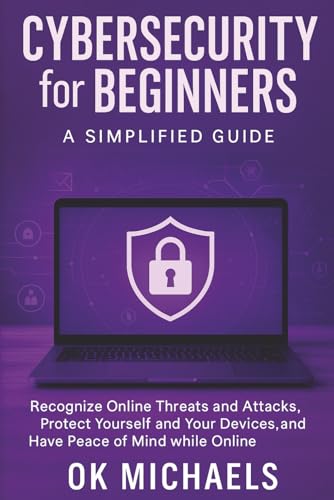
Cybersecurity for Beginners: A Simplified Guide: The listing focuses on recognizing online threats, phishing, fake websites, and protecting devices without requiring a technical background. It fits the early awareness stage of this plan; use its examples to create defensive exercises, never to probe another person’s account or network.
These books can support a disciplined start, but progress still depends on practice, documentation, authorization, and honest evidence of what you can do.