
Fish DNA injected into a face sounds like something invented for social media. It is not. The material has a chemical name, a receptor it acts on, and a paper trail in wound care that runs to hundreds of thousands of prescriptions. What it does not have is a large body of cosmetic trials. The gap between those two facts is where most confusion about Revital and every other salmon DNA booster begins. Both facts are usually presented together in a clinic, with the prescription history supplying the credibility and the cosmetic promise supplying the sale. Separating them takes about a minute and changes what you are agreeing to.
One point first, because it governs everything below. Clinics sell Revital as a salmon DNA skin booster, and the manufacturers of these vials do not publish brand-level clinical dossiers. The evidence below therefore applies to the molecule class as a whole. A clinic offering trial data for one named vial should be able to produce it. What matters is the molecule a product holds, and the judgement follows from it. That single habit does more work than any comparison of brand names. Names change between markets and seasons. The molecule and its concentration do not. Those two are what a clinician is actually choosing when they pick up a vial.
What follows explains what the molecule is and which receptor it works through. It reports what the randomised trials found, how many people they included, and where the evidence is strongest. It also covers the regulatory line that separates a licensed injectable from a cosmetic sold in an injectable-looking vial. That line matters more to your safety than any brand name on the box. It also sets out what to ask before anyone opens a seal, and why the answer belongs on paper. None of it requires a medical background, and every question in it can be asked without any awkwardness in the room.
No result is promised here. Nothing below replaces a consultation with a licensed clinician. What follows is the published evidence, including how thin parts of it are. The purpose here is narrower than a recommendation. It is to mark where the published record stops and where the clinic’s own account begins, so you can weigh the two separately. A clinician who has examined your skin can then apply both to your case, which no article can do. Everything below is checkable. Names and page references are given so you can go to the source yourself. The questions collected here are the ones that travel into a consultation.
1. What Revital and Other Salmon DNA Boosters Contain
Two related materials sit behind the marketing term. Polydeoxyribonucleotide, usually shortened to PDRN, is a mixture of low-molecular-weight DNA fragments derived from salmon sperm. Polynucleotides, shortened to PN, are higher-molecular-weight DNA fragments taken from salmon and other fish sources. Both arrive purified, and the DNA is not there to carry genetic information into your cells. The difference between the two matters more than the marketing suggests. Fragment size governs how quickly the material breaks down in tissue. It also governs how long the material stays there. A clinician asks about it before choosing. A label naming only the fish answers none of that.


1.1 The Receptor Revital and Its Class Act On
PDRN exerts anti-inflammatory and tissue-repair effects by activating adenosine A2A receptors. That is a specific, named mechanism with a literature behind it. Furthermore, it explains why the strongest evidence sits in wound care: calming inflammation and pushing repair is precisely what a healing wound needs. Naming the receptor also gives you something to check. A mechanism with a name appears in the literature and can be looked up, while a claim about renewal or rejuvenation traces back to nothing. For example, a specific receptor name is checkable, whereas a claim about renewal is not. Moreover, the name of the receptor is looked up in seconds.
Experimental work has also looked at collagen. One line of research reports that polynucleotides enhance collagen synthesis by modulating an enzyme in senescent macrophages. That work sits at the experimental stage. Consequently it stands as a plausible route, awaiting evidence about what happens in a human cheek. Senescent macrophages are immune cells that have lost efficiency with age, and adjusting an enzyme inside them is a legitimate research question. The distance between that finding and a visible change in a human face is measured in years of work. A quoted result came either from a dish or from skin, and the two carry different weight.
1.2 Why the Source Fish Is Changing
Salmon is the traditional source, and it is not the only one. Work on non-salmon sources, including microbial production, is under way as a sustainable alternative to the salmon-based material. The interest there lies in supply and consistency. For a buyer, the practical point is that the source on the label says little. Three things govern the product: fragment size, purity of the preparation, and stated concentration. None of the three appears in the word salmon. Together, the three place the product at once. The answer places the product at once. Purity is the third, and marketing pages leave it out.
Purification is the part that does the work here. The material entering a vial is not ground fish; it is fragmented, filtered DNA prepared to a specification. Consequently the phrase on a marketing page describes the origin story, while the quality of the preparation stays unstated. Two vials naming the same fish can differ in molecular weight, purity and concentration. Those three variables are what a clinician actually chooses between. None of those three variables is secret in a licensed product. They appear in the product file, and a clinic working with a licensed device can state them on request. An answer of trade secret describes a cosmetic.
This matters to a buyer for one practical reason. A vial labelled by its marketing name tells you almost nothing about which molecule it holds, at what concentration, or from which source. Therefore, ask whether the product is PDRN or PN, and ask what the stated concentration is. A clinic that cannot answer is describing a whole category under one name. Write the answer down before you leave the consultation. A comparison between two clinics only means something once you know both vials hold the same molecule at a comparable concentration. Memory is unreliable about numbers heard in passing. In practice, a written note survives the walk to the car park.
2. The Evidence Behind Revital and Its Molecule Class
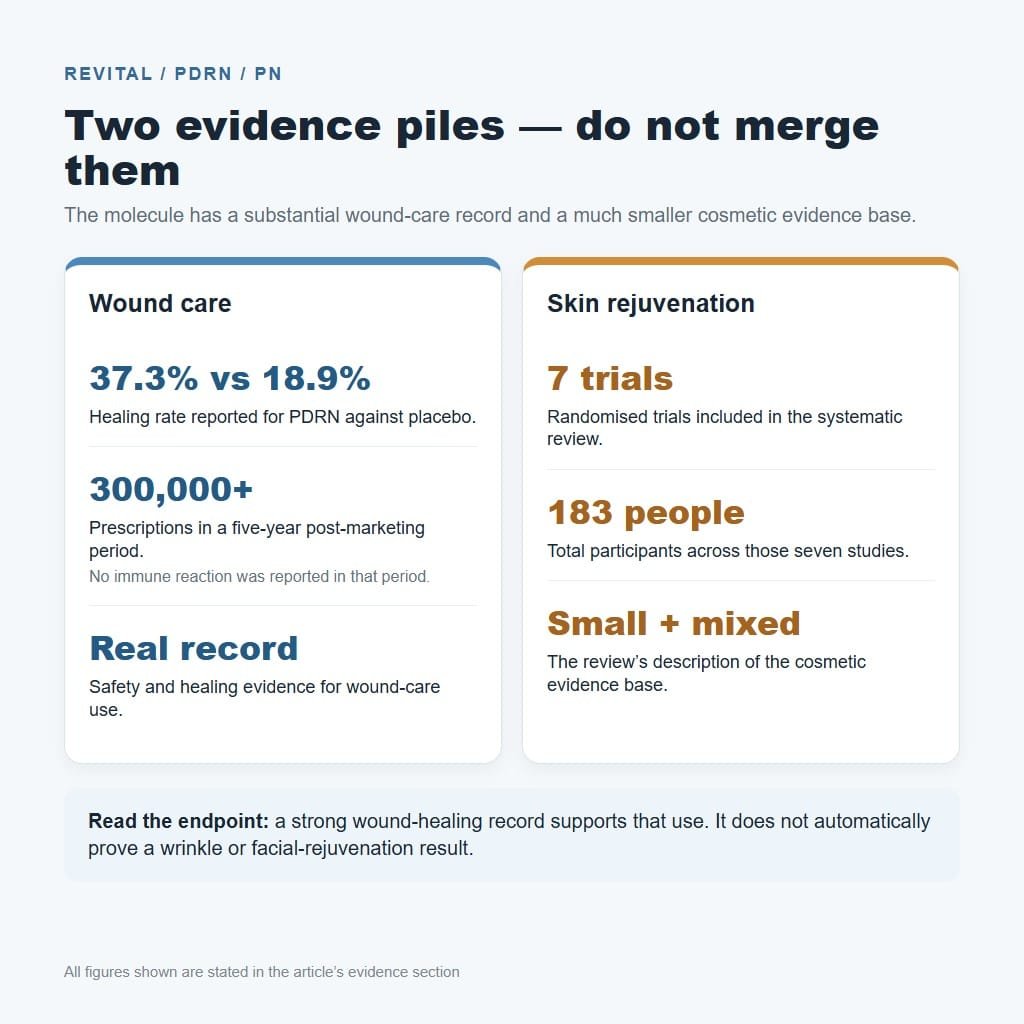
The evidence splits cleanly into two piles, and clinics tend to quote from one while selling the other. One pile, built on wound care, is large and old. Beside it the cosmetic pile is small and much newer. Reading a claim without knowing which pile it came from is the single easiest way to be misled here. The piles differ in more than size. Wound trials measure closure of an open injury in patients who are unwell, while cosmetic trials measure appearance in healthy skin. Findings from the first do not carry across to the second automatically, however similar the molecule is in both.
| Use | What the published work shows | How large |
|---|---|---|
| Wound healing | Healing rate 37.3% against 18.9% for placebo | Clinical study, plus five years of post-marketing data |
| Safety in wound care | No immune reaction reported over the post-marketing period | More than 300,000 prescriptions |
| Skin rejuvenation, scars, wounds | Improvements reported across outcomes | Seven randomised trials, 183 participants total |
| Periorbital area | Improved appearance and patient-reported satisfaction | One prospective observational cohort |
2.1 What the Randomised Trials Found
A systematic review gathered the randomised trials of polynucleotides and PDRN across skin rejuvenation, scar prevention and wound healing. Seven trials met the inclusion criteria. Between them they included 183 participants in total. The review reported improvements in wrinkle-related outcomes, scar measures and wound healing. The review is the right place to start precisely because it gathers every trial that met its criteria. A single flattering study is easy to find in any category. What a systematic review shows is how much evidence exists in total, and how consistent it is. In fact, the participant total carries the weight here. That number is where the weight sits.
Hold that number for a moment: 183 people, spread across seven separate studies. That averages twenty-six participants per trial. Small numbers do not make findings wrong. They make them preliminary, and preliminary is a description a clinic rarely volunteers. The relevant question about any trial is not how many studies exist, but how many people were in them and whether there was a comparison group. Ten small studies without controls carry less weight than one properly controlled trial, and the count alone hides that. The participant count reframes every percentage that follows it. Preliminary carries a different weight from wrong.
The review’s own summary is the line worth carrying away. The evidence base was small and heterogeneous. In plain terms, seven small studies measuring different things in different ways amount to a signal awaiting confirmation. Consequently, anyone quoting a precise percentage improvement for your face is quoting further than the review reaches. In every case, a quoted figure came from a study with a name and a year. A clinic that can name the source is working from the literature; one that refers to research generally is working from a brochure. The difference shows up in seconds. A name and a year take five seconds to give. Their absence takes longer to explain.
2.2 Where the Evidence Is Genuinely Strong
Wound healing is the exception, and it is a real one. A clinical study of PDRN reported a healing rate of 37.3% against 18.9% in the placebo group. Alongside it sits a five-year post-marketing period covering more than 300,000 prescriptions with no immune reaction reported. That is a larger human safety record than most injectable aesthetic ingredients have accumulated for any use. That prescription figure is worth holding onto, because few aesthetic materials carry anything comparable behind them. It says something real about how the molecule behaves in human tissue, even though it says nothing at all about what it will do to a wrinkle.
A good safety record for one use does not transfer automatically to another. The dose differs, the site differs, and the person receiving it differs. Nevertheless, it is a fair reason to treat this category differently from ingredients with no human record at all. In fact, that distinction is the most useful thing a reader can take from this section. Safety and efficacy are separate questions, and a strong answer to one is often presented as an answer to both. The substitution is easiest to spot when a clinic moves from the prescription record straight to a cosmetic promise without pausing between the two.
2.3 Injected Versus Applied to the Surface
The strongest human evidence for these molecules comes from clinic injections and wound care. It does not come from skincare rubbed onto the skin. That line has become easy to blur, because the same ingredient names now appear on serums. Depth is the whole difference. What is applied to the surface stops largely at the outer layer, whereas what is injected reaches the dermis. The trials behind the injection tested a route the serum does not use, and no concentration on a bottle changes that. The route decides the evidence. Therefore each product is fairly judged by the trials that used its own route.
A serum carrying the same word is not a cheaper version of the injection. It is a different product delivered to a different depth, and the trials behind the injection say nothing about it. Similarly, our guide to judging a serum before its evidence is in covers the same reasoning applied to a bottle you buy yourself. A serum may be a perfectly reasonable purchase on its own terms. The error lies in reading it as a cheaper version of the injection, or in reading the injection trials as support for the bottle. Consequently each deserves judging on the evidence gathered for it.
3. Licensing and the Revital Vial
This section is the reason to read the article. The aesthetic market carries two kinds of vial that look identical on a treatment tray. One holds a licence as an injectable medical device. The other is a cosmetic that was never approved for injection at all. Telling them apart takes one question, and no training at all. The difference between them is not visible in the glass, the label or the price. It sits in a registration file, and the number from that file is either available on request or it is not. That single answer tells you which of the two vials is on the tray.
3.1 How Korea Classifies These Products
South Korea’s regulator separates topical cosmetics from injectable medical devices, with sharply different requirements for each. Under the Korean classification, a general topical cosmetic does not undergo the pre-market review, sterility testing or endotoxin testing required for an injectable device. Its lawful route is topical, on the surface of the skin. So a product moving from a shelf into a syringe has changed category without changing anything a regulator reviewed. Nothing in the paperwork follows it across, and no test is added on the way. No test is added when a shelf product moves into a syringe. Nothing in the file changes either.
A Class III or IV medical device sits at the other end. It requires manufacturing certification, rigorous sterility testing and clinical verification before licensing. Its lawful route is sub-dermal injection. Notably, the regulator names polynucleotide products among the examples in that injectable category, alongside hyaluronic acid dermal fillers. The contrast is the useful part. Two vials can look identical while one has passed sterility and endotoxin testing and the other has passed neither. The registration number is the only way to tell. The number is checkable by anyone. Public registers make that a two-minute job. The register is public. Nobody needs a clinic’s permission to open it.
| General cosmetic | Class III or IV device | |
|---|---|---|
| Approval before sale | None required | Full pre-market review and licensing |
| Sterility and endotoxin testing | Not required | Required |
| Lawful route | Topical only | Sub-dermal injection |
| Example products | Creams, basic extracts, unverified vials | Polynucleotides, hyaluronic acid fillers |
3.2 The Loophole Behind a Revital-Style Vial
The gap between those two columns creates a commercial temptation. Manufacturers can make a product legally as a cosmetic, then package it in a medical-grade vial or ampoule that implies injectability to a foreign buyer. Nothing about the glass marks which category the contents belong to. The packaging is designed to reassure, and it does so honestly in a licensed product and misleadingly in an unlicensed one. Since the glass looks the same either way, the reassurance it offers is worth exactly nothing on its own. In practice the box carries the category, while the glass carries nothing. A category is either printed there or absent.
The incentive is easy to follow. Cosmetic manufacture is quicker, cheaper and free of pre-market review. The medical-grade ampoule is what convinces the buyer at the far end of the supply chain. A distributor abroad then sells to a clinic, and by the time the vial reaches a treatment room nobody in the room ordered the regulatory file. Therefore, the person best placed to ask is the patient, and asking costs nothing. This is also why the question rarely offends anyone. A clinic working with licensed product answers it in seconds, because the number is on the file it already holds. Only a clinic lacking that file finds the question difficult, and the difficulty itself is the answer.
A cosmetic never had to pass sterility testing or endotoxin limits, because nobody expected it to cross the skin. Licensed devices carry an endotoxin limit precisely because a regulator expected the contents to enter tissue. Cosmetics are not subject to that limit, so injecting one exposes tissue to a risk the product was never assessed to control. As a result, the question to ask is not whether a product is popular. It is whether a licence for injection exists where you are being treated. Endotoxin is worth understanding for one minute, because it explains why the testing exists. Bacterial residue in a fluid can cause fever and shock once it reaches the bloodstream. Testing for it is standard for anything meant to cross the skin. A cosmetic simply never faced that test.
4. Buying Revital or Any Injectable Safely
Regulators have moved on the grey market, which shows how large it became. In the United Kingdom, the medicines regulator has run a criminal enforcement effort against illicit trade in unlicensed injectables. The UK medicines regulator reports that its enforcement unit confiscated more than 27,000 units of unlicensed dermal fillers, valued at up to four million pounds. Those numbers describe fillers, and this molecule class was not among the seizures. They matter here because they measure the size of the market these vials travel through. A supply chain carrying unlicensed filler in that volume is not a careful one. The figure measures the market these vials travel through. It still tells you something useful about the route these vials travel.
4.1 What Can Go Wrong
The British College of Aesthetic Medicine has warned specifically about unregulated peptide and exosome injections sold online. The risks it names are contamination, incorrect dosing, inconsistent potency and sterility failure. Those four words describe what happens when nobody tested the vial. None of those four risks is theoretical. Each corresponds to a specific test that a licensed injectable has to pass. Where that testing was never required, each risk simply stays uncontrolled. Each of the four has a matching test. Ask which of them this vial passed. A vial that passed none of the four was never intended for a needle.
Documented harms from injecting unlicensed or cosmetic-grade vials include vascular occlusion with tissue death, granulomas forming as the immune system reacts to foreign material, and serious infection. Meanwhile, the penalties reach the practitioner too, since supplying prohibited injectable medicines carries unlimited fines and up to two years in prison under British law. Ultimately, a cheap vial is not a saving. Timing separates these harms from ordinary post-treatment swelling. Granulomas in particular can appear months after the session. They can also appear some distance from the injection site. That is why a clinician asks for the date and the product name, not a general description.
4.2 Questions That Separate the Two Vials
The question is whether this vial holds a licence for injection in your own country, since a licence issued elsewhere does not travel with it. Before anyone breaks a seal, ask to hold the vial and read its batch number yourself. Then ask whether the contents are PDRN or PN, and at what concentration. Photograph the packaging before it is opened. It takes seconds. The batch number is what you need if you ever report an adverse event, or tell another clinician exactly what was used. An opened vial proves nothing about where it came from. The label and the box carry different information, and both may matter later.
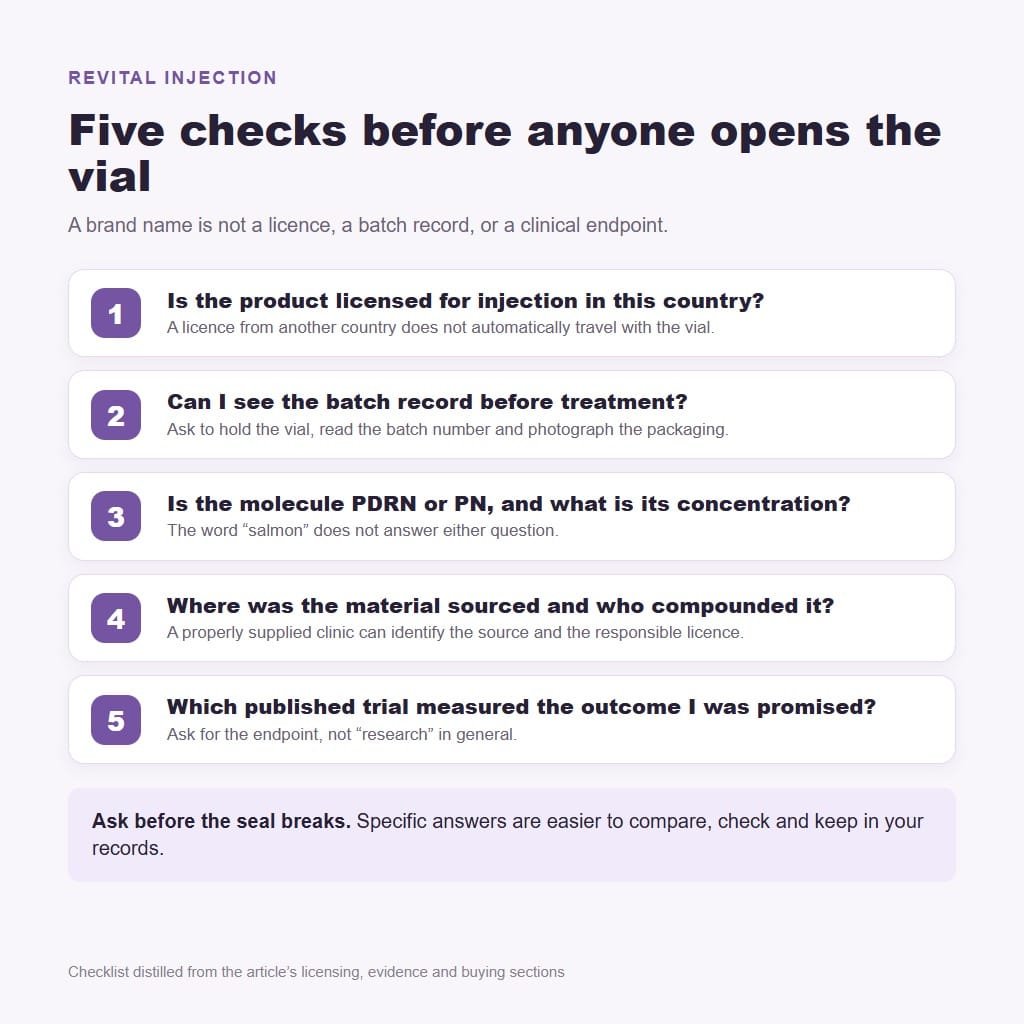
Regulators tell patients to request the batch record before an injectable procedure, and the vial in front of you either has one or does not. Confirm the licence covers injection in the country where you are treated. A licence issued in the country of manufacture does not automatically authorise injection in another country. In addition, a price far below the local market usually means the vial did not arrive through the official distributor. A low price is sometimes a genuine discount and sometimes a symptom. The registration number tells them apart; the invoice does not. Ask for the number, then check it yourself in the regulator’s public register before the appointment.
5. Setting Expectations for Revital
Realistic expectations shape satisfaction more than the product does, and the published work supports a modest frame. A prospective study of intradermal polynucleotide injections around the eyes reported improved appearance and patient-reported satisfaction with minimal adverse events. That finding came from one observational cohort. It is also not the same as a controlled comparison against a placebo. An observational cohort describes what the researchers saw. It leaves the effect of the molecule unseparated from the effect of the needle, the massage or the patient’s own expectation. That separation is exactly what a placebo comparison exists to provide. Ask whether a quoted study had a control group. That single question sorts most claims.
5.1 What the Category Is Reasonably For
The consistent theme across the research is repair and inflammation rather than volume. Nothing in this evidence describes a filler, and nothing describes a lift. Therefore, a patient hoping for changed facial structure is looking at the wrong category entirely. Someone hoping for volume is better served by a filler, and someone hoping for lift by another category again. Neither of those is a criticism of this molecule class. Each is simply a different job. Expecting one tool to do all three is how disappointment gets built in. Decide which of the three you actually want. The category follows from that answer.
Course length follows from that. The trials that examined these molecules ran courses of treatment across several appointments. Ask how many sessions your plan involves before you compare prices, because a per-session price and a per-course price look alike and are not. Multiply the session price by the number of sessions before you compare anything, and ask whether review appointments are inside or outside that figure. Clinics differ on this, and the difference tends to appear after the second visit rather than before the first. A schedule in writing compares cleanly against another clinic’s. A written plan is easier to compare than a quoted price.
Someone with thin, irritable, crepey skin is closer to what the trials examined. Similarly, someone recovering from a procedure sits nearer the wound-healing evidence than the cosmetic evidence. In contrast, someone wanting a defined jawline is asking a repair molecule to do a structural job. The general point is that this category answers a question about skin quality. Working out which question you are actually asking is worth doing before the consultation, since it decides whether this treatment belongs on your list at all. Skin quality and facial shape are separate goals. Name yours before the consultation begins. Skin quality and facial shape sit in different categories, and the treatment follows from which one you name.
5.2 Judging Your Own Result
Photograph before the first session, in daylight, from three angles, with no makeup. Repeat monthly at the same time of day. The comparison that matters is the first photograph against the last, and you cannot recreate the first one later. Use the same room, the same window and the same distance every time. Consistency matters more than photographic quality, since the images exist only for comparison against each other. Keep the images in a dated folder. A phone upgrade should not cost you the series. Similarly, a date and a weight beside each image keep the later comparison honest. Weight in particular moves a face more than most people expect.

Write down what you were told to expect, and when. A clinic that promised a specific outcome by a specific week has made a claim you can check. Meanwhile, note any lump, redness or tenderness with the date it appeared, since timing is the first thing a clinician will ask about. A promise with a date attached can be checked; a promise about improvement cannot. Get the specific version at the consultation and write it down, then compare it against your own photographs at the point the clinic named. Written expectations survive the appointment. Spoken ones rarely do. A note kept somewhere findable is worth more at month two than at month zero.
Revital and Salmon DNA Booster FAQ
Does the fish DNA change my own DNA?
No. The material is a mixture of purified DNA fragments, and the described mechanism is activation of adenosine A2A receptors. It acts as a signalling molecule at a receptor rather than as genetic material. The concern behind the question is understandable, and the answer does not depend on trusting a clinic. It follows from what the material is. These are fragments prepared and purified to a specification. They act at a receptor on the cell surface and do not enter the nucleus. Ask the question anyway if it worries you. A clinician will answer it in a sentence. The mechanism has a name, and the name can be looked up.
Is a serum with the same name equivalent?
No. The strongest human evidence comes from clinic injections and wound care, not from products applied to the surface. A serum shares a word with the injection and not its evidence. Ask what the serum is for on its own terms, and judge it against evidence gathered for topical products. That is a fair question with a fair answer. It is also a different question from the one the injection trials address. Judge the bottle on topical evidence. Judge the vial on injection evidence. Neither judgement settles the other, and no bottle inherits a trial. Ask each question separately. One at a time.
Is a fish allergy a reason to avoid it?
Tell your clinician about any fish or seafood allergy before treatment, and let them make that call. It belongs in a consultation with someone who can examine you. Bring the question in writing so it does not get lost. Your full allergy history matters here, along with any regular medication, and the fish question is only part of it. A clinician reads the whole list before deciding, and a partial history produces a partial answer. As a result, a list written before the appointment beats one recited from memory. Add every regular medication and any past reaction to an injectable. Your clinician reads the whole list before deciding anything.
Conclusion: Revital Belongs to a Repair Molecule Class
The mechanism is named and the wound-care record is substantial. The cosmetic evidence is seven small randomised trials totalling 183 people, described by the review that gathered them as small and heterogeneous. Both statements are true, so quoting the wound-care record without the limits of the cosmetic evidence gives an incomplete account. Reading both halves is what turns a sales conversation into a decision. A molecule can have a serious safety record and a thin cosmetic evidence base at the same time, and neither fact cancels the other out. Read the two together and the decision becomes yours. Read one alone and it becomes the clinic’s.
If you go ahead, put the licensing question first. Ask whether this vial is licensed as an injectable where you are being treated, ask what the molecule inside it is, and read the batch information yourself. Revital, or anything sold beside it, is one proposition as a licensed injectable device and something else entirely as an identical-looking cosmetic. Only one of the two was ever tested for a needle. Carry those three questions into every consultation, whatever the vial is called this season. Names rotate between markets and suppliers; the licensing status, the molecule and the batch number are the three things that stay meaningful.