
A clinic offers a vial, advertised as brighter skin from the inside. The molecule inside it is real, well studied, and central to how every cell in your body makes energy. None of that is the question. The question is whether putting it into a vein or under the skin does anything measurable to a face, and on that specific point the published record is empty. That emptiness is easy to miss. Everything around the appointment looks clinical. The vial is glass, the room is licensed, the price is high. None of the three answers the question, and none of them is meant to.
What follows separates three things that marketing keeps welded together. The biology of the molecule, which is solid. The human trials, which studied conditions unrelated to skin. And the delivery route, which is where the argument quietly breaks. It also covers what regulators have done about a NAD injection, because that part is not theoretical. The aim is a reader who can tell which of the three a clinic is talking about at any given moment. Once you can, most of the sales conversation sorts itself out in about a minute. Nothing below asks you to take a position on ageing research.
Nothing here is medical advice, and nothing replaces a conversation with a doctor who knows your history. What follows is what the evidence says, and where it stops. The purpose is narrower than a verdict. It marks where the published record ends and where the clinic’s own account begins, so you can weigh the two apart. A doctor who knows your history can then apply both to your case, which no article can do for you. In addition, every figure here has a source you can look up yourself. Nothing is asserted here without one. Any of them can be followed back to its source.
1. What a NAD Injection Contains
Nicotinamide adenine dinucleotide, NAD for short, is a coenzyme present in every living mammalian cell. It sits at the centre of cellular metabolism and mitochondrial energy production. It also serves as the exclusive co-substrate for two enzyme families, the sirtuins and the PARPs, which govern DNA repair, cellular senescence and stress resistance. None of that is disputed, and none of it is the point at issue. The biology is textbook material. What the biology does not settle is whether the finished molecule, delivered from outside, reaches a skin cell and does anything there. Delivery is the question, and delivery is where the record thins.

1.1 Why Clinics Sell a NAD Injection
Levels of this coenzyme decline with age across species. That decline is a genuine target in longevity research, and it explains the commercial interest. Clinics market intravenous infusions and localised injections for facial brightening, hydration and a general cellular glow. The decline is real and measurable, which is what makes the pitch persuasive. A real problem is being named. Whether this particular vial addresses it is a separate question, and one the marketing tends to fold into the first. In effect, two claims sit inside one sentence. Separate them before you decide. Therefore treat the decline and the vial as separate topics.
The names on the vials deserve one note. A prefix like NXC functions as a commercial brand identifier. Searching the biomedical literature for it returns unrelated topics, including a protein glycosylation motif and a Chinese herbal preparation for heart failure. Therefore, a brand prefix on a box tells you nothing about what has been tested. Ask what molecule the product contains, and ask for the concentration. Both belong on a label in a regulated product. A brand prefix answers neither, and prefixes change between markets and seasons while the contents may not. Both answers travel with you to the next clinic.
2. What the Human Trials of a NAD Injection Measured
The evidence in this section decides the whole question, so read the wording closely. A review of the medical and dermatological literature finds no peer-reviewed human clinical trials measuring facial skin outcomes after this coenzyme is given by infusion or injection. Not weak trials. None. That finding is unusual enough to deserve a second reading. Most cosmetic categories have thin evidence. This one has none for the route being sold, which is a different situation entirely and a much easier one to check. Meanwhile, absence is easier to verify than weakness. A search settles it in under a minute. In fact, the search takes under a minute.
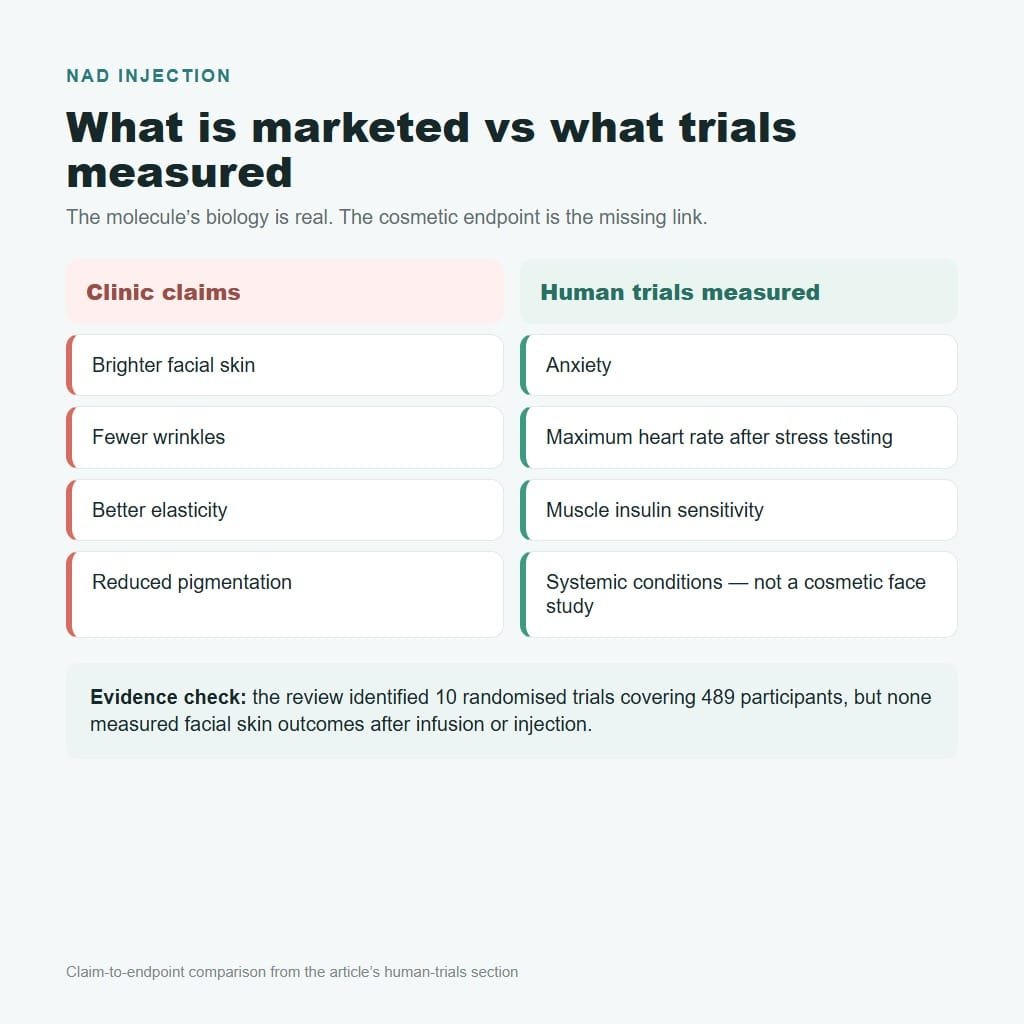
Brightness, wrinkle reduction, elasticity and pigmentation are the four outcomes the marketing describes. No published trial has measured any of them for this route of delivery. Those claims live in clinic blogs, social posts and commercial material, and they are absent from the peer-reviewed base. Whichever of the four a clinic claims, the measurement was published somewhere or nowhere. The question is neither hostile nor technical. It simply moves the conversation from a description to a source. Meanwhile, write down which outcome you were promised, with the date. That note travels with you to the next consultation. A promise with a date can be checked.
2.1 What the Trials Did Study
Human trials of the molecule and its precursors do exist, and they are worth knowing about. A systematic review identified ten randomised clinical trials covering 489 participants in total. The populations were people with chronic fatigue syndrome, Parkinson’s disease, Alzheimer’s disease and postmenopausal prediabetes. That review is the right starting point precisely because it gathers the trials rather than picking one. Any category can produce a single flattering study. What a systematic review shows is the whole set, and how consistent it is. For that reason, count the participants across the set rather than the number of papers. Four populations, none of them cosmetic.
Look at what those four populations have in common. They are all systemic conditions, studied for systemic endpoints, in people who were unwell. Not one of them was designed to answer a cosmetic question, and no dermatologist assessed a face in any of them. A separate pharmacological review reached a similar conclusion from different evidence: promising signals in psoriasis and skeletal muscle, and an explicit note that adequately powered trials for cosmetic dermatological conditions are lacking. The distance between those populations and a cosmetic clinic is the entire argument. It is not a technicality, and it is not a gap that more marketing can close. Only a trial measuring a facial outcome would close it.
The documented outcomes were decreases in anxiety, improvements in maximum heart rate after stress testing, and enhanced muscle insulin sensitivity. That list sits oddly against the reason a clinic offers you a vial. Consequently, a clinic citing “clinical studies” is not lying about their existence. It is relying on you not checking what they measured. Ask which endpoint a quoted study actually measured. Insulin sensitivity and heart rate are real findings, and neither is about a face. Naming the endpoint means working from the literature. Saying research shows means working from a brochure. A study name and a year come first; everything else follows from them.
| What is marketed | What human trials measured |
|---|---|
| Brighter facial skin | Not studied for this route |
| Fewer wrinkles | Not studied for this route |
| Better elasticity | Not studied for this route |
| Reduced pigmentation | Not studied for this route |
| — | Anxiety, maximum heart rate, insulin sensitivity |
2.2 The Laboratory Evidence, Honestly Framed
Preclinical work is real and it is not nothing. In cell culture, a liposomal formulation applied to human skin cells and endothelial cells reduced markers of cellular senescence, specifically the proteins p16 and p21. Other laboratory work has shown protective effects against ultraviolet damage. Cellular senescence markers are a legitimate research target, and p16 and p21 are the proteins researchers watch for it. Naming them is a sign of real laboratory work. What happens after the dish is the open part. In practice, cell culture and skin are two different arguments. Therefore judge each on its own evidence. Consequently, a laboratory signal and a treatment sit years apart.
A result in a dish amounts to a hypothesis about a person. The industry treats the gap between them as a formality. In fact, that gap is exactly where the evidence for this treatment ends, and the next section explains why. Years of work usually separate a laboratory signal from a treatment, and most signals do not survive the journey. Ask whether a quoted result came from cell culture or from skin. That single question sorts most of the claims made here. For instance, find out whether the result came from a dish or from a person. The answer places the claim immediately.
3. Why the NAD Injection Argument Breaks
The marketed hypothesis is straightforward. Flood the bloodstream with the coenzyme, and skin cells will take it up and repair themselves. Two facts stand in the way, and both come from basic pharmacology rather than from anyone’s opinion. Both facts are ordinary pharmacology, taught in any first course on the subject. Neither is contested by researchers working on the molecule. They simply do not appear in the version of the story told at the point of sale. Neither fact depends on anyone’s view of the treatment. Both come from ordinary pharmacology. Neither is contested by researchers. Both are textbook material.
3.1 The Molecule Is Unstable and Large
The intact molecule is highly unstable in human plasma. Furthermore, researchers have long considered direct cellular absorption of it unfeasible, because of its size and charge. Some work hypothesises a dedicated transporter, and a hypothesis is where that stands. Size and charge decide what crosses a cell membrane, and this molecule is unfavourable on both counts. A transporter may exist, and looking for one is reasonable research. Until it is found, the mechanism a clinic describes rests on an assumption. Ultimately, assumptions belong in research rather than in a consent conversation. Consequently, the mechanism stays a proposal. Until then, treat it as one.
Researchers have not established direct uptake of the intact coenzyme as the normal cellular route. They build it internally, either from tryptophan through the de novo pathway or from precursors through the salvage pathway. Therefore, delivering a ready-made coenzyme to the bloodstream asks the body to do something it does not normally do. The salvage pathway is the ordinary route, and it starts from smaller precursors that cells take up readily. That is the difference between supplying a building block and delivering a finished structure through a wall built to keep it out. Precursors cross. By contrast, the completed molecule largely does not.
3.2 The Comparison That Settles It
Nicotinamide, the vitamin B3 form also called niacinamide, is the same story told properly. It is stable, water-soluble, and it crosses the cell membrane easily. Once inside, it converts to the coenzyme through an established enzymatic pathway. Dermatologists have studied oral nicotinamide for reducing non-melanoma skin cancer risk in selected high-risk patients, and use it in managing acne, rosacea and atopic dermatitis. The comparison is worth holding onto, because it shows the argument is not against the biology. Another route reaches the same coenzyme with published dermatological evidence behind it. The disagreement is about delivery, not about the molecule. A clinic defending the injection is defending delivery, not biology.
Its evidence for skin is extensive: enhanced DNA repair, fewer ultraviolet-induced DNA lesions, reduced inflammatory signalling. Meanwhile, its safety at oral doses up to three grams a day is well characterised. In contrast, the injected coenzyme has no clinical trials for cosmetic dermatological outcomes at all. Ask a clinic offering the injection what it thinks the injected form does that the oral vitamin does not. The answer is informative either way. A clinician who acknowledges the evidence gap is telling you something a brochure never will. In either case, their answer tells you how they read their own evidence. That reading is worth more than a brochure.
| Form | How it is given | Evidence for skin |
|---|---|---|
| Nicotinamide (niacinamide) | Topical, oral | Extensive; DNA repair and inflammation |
| Nicotinamide riboside | Oral, infusion | Moderate, and about metabolic health rather than skin |
| The intact coenzyme | Infusion, injection | None for cosmetic skin outcomes |
4. Documented Harms of a NAD Injection
A treatment without proven benefit still carries risk, and this one carries two distinct kinds. The first comes from the molecule and the infusion itself. The second comes from what is in the vial, which turns out to be a separate and more serious problem. Keep the two apart when you weigh the treatment. One is about what the infusion does to you while it runs. The other is about what was in the vial before it started, and that second risk has produced a regulatory recall. Both belong in the consultation, and neither usually appears there. The two risks weigh differently, and separating them matters.

4.1 What Happens During the Infusion
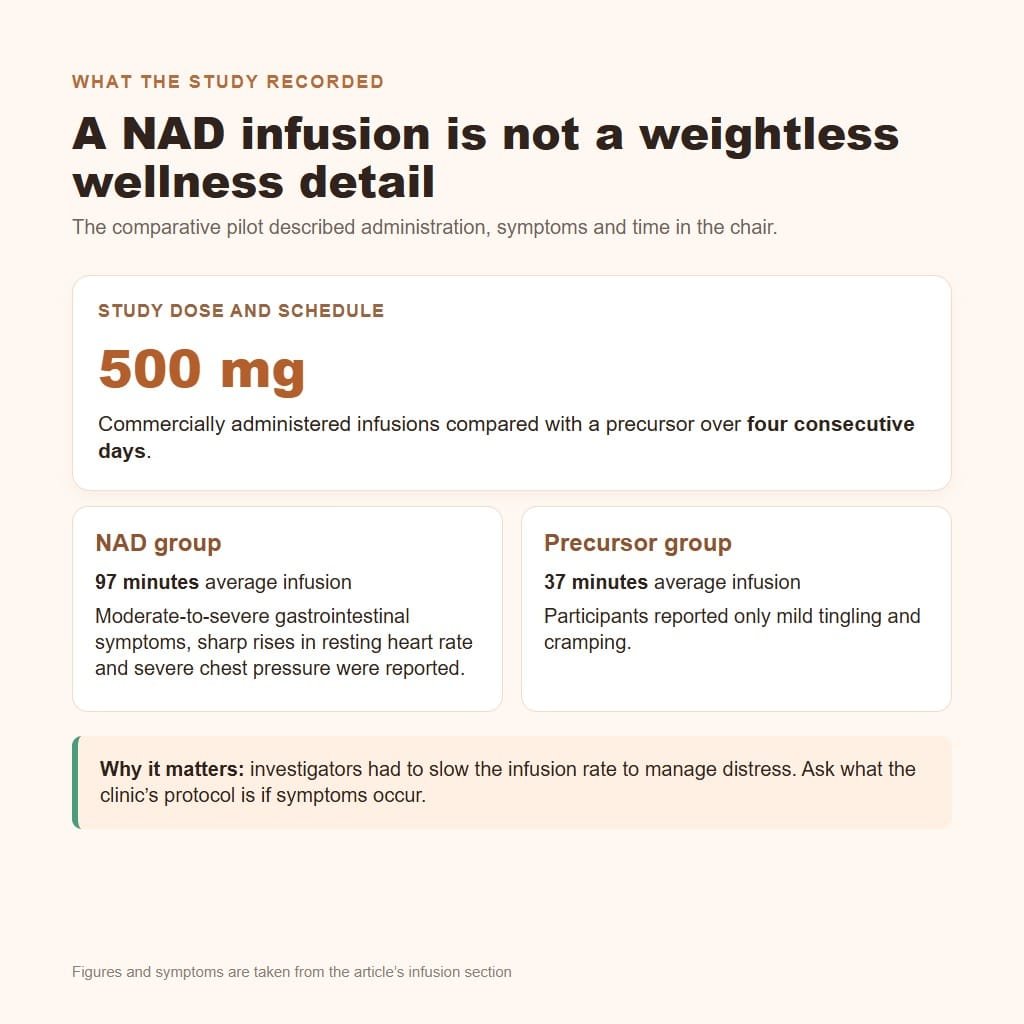
A retrospective pilot study compared commercially administered 500 mg infusions against infusions of a precursor over four consecutive days. Participants receiving the coenzyme reported moderate to severe gastrointestinal symptoms, sudden sharp rises in resting heart rate, and severe chest pressure during administration. Four consecutive days is a short study, and a pilot is a small one. The findings still describe what participants experienced during administration, which is the part a wellness framing tends to leave out entirely. Additionally, ask what was recorded during administration and not only afterwards. Symptoms during the drip belong in the record too. That record exists, or the clinic kept none.
Compare that against how the treatment is usually described. A drip marketed as a wellness appointment rarely comes with a warning about chest pressure. And the wider literature on high-dose administration records insomnia, acute fatigue, anxiety and muscle pain among reported effects. Ask what the clinic tells patients to expect during the infusion itself, and ask what its protocol is if you react. Clinics that have run these infusions answer specifically. One that has not will reach for reassurance instead. Furthermore, get that protocol in writing before the cannula goes in. A written protocol is easier to hold anyone to.
Investigators had to slow the infusion rate to manage that distress. As a result, the average infusion ran 97 minutes for the NAD group against 37 minutes for the precursor group. The precursor group reported only mild tingling and cramping. That difference in tolerability is a clinical finding. An infusion that has to be slowed by more than an hour to be tolerated is describing something about the substance, not about the schedule. Ask how long your appointment is planned to run, and why that figure was chosen. A slowed infusion is a clinical finding in its own right. Additionally, the figure appears in the study itself rather than in a summary of it.

4.2 What Regulators Found in the Vials
Remember this during any consultation. The United States regulator issued a Class I recall, its most serious category, for a compounded injectable product of this coenzyme because of endotoxin contamination. That designation means use of the product may cause serious harm or death, which is why the grade exists. A Class I recall is the top of the scale, and regulators do not issue one lightly. The reason matters as much as the grade, since the problem lay in what came with the molecule into the vial. In this case grade and reason both matter, so ask about each. In addition, ask which product the recall named.
Endotoxins are fragments of bacterial cell wall, and they survive processes that kill the bacteria themselves. A supplement powder that would pass unnoticed through a stomach becomes a different proposition in a vein. That is why sterile injectable manufacture carries limits that oral manufacture does not. This is the point that most patients have never considered, and a minute is enough to grasp it. A powder made for swallowing has never faced the limits that apply to anything crossing the skin. Nothing about the packaging changes that. For instance, oral limits and injectable limits are set to different standards. Consequently, a powder that passes one may fail the other.
The underlying problem is sourcing. Food-grade material is made for oral supplements, and the agency has stated that it is entirely unsuitable for sterile intravenous compounding, because it never went through the purification that removes microbes and endotoxins. Reported adverse events have included severe chills, shaking, vomiting and fatigue, a pattern consistent with excessive endotoxin exposure. Ultimately, an infusion bypasses the barriers that make an oral supplement forgiving. Find out where the material was sourced and whether it is pharmaceutical grade, then who compounded it and under what licence. Both answers exist on paper in a properly supplied clinic. Their absence is itself the answer to your question.
5. The Regulatory Status of a NAD Injection
Approval status is the fastest way for a non-specialist to judge a treatment, and here it is unambiguous. In the United States, this is not an approved drug for any medical or aesthetic indication. When the regulator evaluated the substance for the list of bulk ingredients that pharmacies may compound with, it proposed not to include it. Approval status is public, free to check, and does not depend on trusting anyone in the room. Only the regulator in your own country governs what may be injected into you, whatever the country of manufacture allows. Furthermore, that register is public and free to search.
In the United Kingdom and the European Union, no marketing authorisation exists for aesthetic use. In Saudi Arabia, the regulator has acted against injectable products lacking the required clinical documentation, and the Saudi Food and Drug Authority has ruled that cosmetic products packaged in syringes, ampoules and vials for external use must leave circulation, and is phasing that ban in. That measure applies to cosmetic products intended for external use but packaged in forms associated with injection. The Saudi measure is worth noting for a reason beyond the region. It treats the packaging itself as the problem: a cosmetic in an injection-shaped container invites a use it was never assessed for. That reasoning applies wherever such a vial turns up.
5.1 Questions Worth Asking
Ask what regulatory status the product holds in your country, and ask to see that status as a licence, not as a reassurance. Where was the material sourced, and is it pharmaceutical grade? Additionally, find out who compounded it and under which licence. Write the answers as you hear them rather than reconstructing them later. Numbers and licence references have a way of becoming approximate in memory, and you will want the exact wording if you compare clinics or raise a concern afterwards. In addition, keep the note somewhere you can find it two months later. Memory reshapes numbers within days.

Write the answers down during the consultation rather than afterwards. A verbal claim about licensing is easy to make and hard to recall precisely, and a refusal to put a regulatory status in writing tells you where a clinic stands. In addition, ask whether the person inserting the cannula is medically qualified and who is responsible if you react during the infusion. Ask as well what happens if you decide to stop partway through a paid course. Cosmetic decisions made under sunk-cost pressure are rarely good ones, and the answer tells you how the clinic thinks about its own patients.
Then ask the direct one: which published trial measured the outcome you are being sold. Answering with a study of chronic fatigue answers a different question. Meanwhile, a clinician who says plainly that the cosmetic evidence does not exist is being honest with you, and that is worth more than a confident brochure. Take the answer at face value either way. A clinic that concedes the gap and still explains why it offers the treatment is giving you something to weigh. A clinic that changes the subject has answered you as clearly. Either way you leave with something you did not have before.
5.2 What to Do Instead
If the goal is the biology this treatment invokes, the same pathway is reachable by routes that have been studied. Topical and oral nicotinamide carry the dermatological evidence, and our guide to what a niacinamide serum does and does not do sets out the realistic timeline for the topical form. The oral and topical routes are cheaper, better documented and available without a cannula. That combination is unusual in aesthetics, and together they make the strongest practical case for looking at the vitamin first. Few options in aesthetics offer all three at once. For that reason, start there rather than at a clinic.
Sun protection and sleep carry dermatological evidence that no vial in this category has, and neither generates a clinic invoice. That is precisely why they get less airtime in a clinic. Nevertheless, a treatment plan that starts with them and adds an evidenced topical is the version a dermatologist would recognise. Neither is exciting, and neither photographs well on a clinic feed. Both have decades of dermatological evidence behind them, which is more than this whole vial category can claim, and the cost of trying them is nothing. Similarly, neither carries a recall notice, and neither needs a cannula. In addition, both cost nothing to try.
NAD Injection FAQ
People say they look better afterwards. Is that nothing?
Reports of feeling better differ from a measured change in skin, while no trial has measured the second for this route. Hydration from the fluid, rest during the appointment and expectation all act on how someone looks and feels. None of those require the coenzyme. Ask what specifically improved, and over what period, when someone describes a result. Feeling brighter after an hour lying still with a litre of fluid is a real experience. It is simply not evidence about the coenzyme. For example, ask what changed and how it was measured. A period and a measurement turn a feeling into a claim.
Is the oral supplement the same thing?
No, and the evidence runs in the opposite direction to the price. Oral and topical nicotinamide have the dermatological evidence base. The injected coenzyme has none for cosmetic outcomes. Ask a pharmacist about the oral form if you want to try the evidenced route. It costs a fraction of an infusion, needs no appointment, and carries a safety profile characterised at doses far above the usual ones. Ask about dose and interactions with anything you already take. A pharmacist answers both in a couple of minutes, at no cost. Bring your current medication list to it, since interactions are the usual reason a pharmacist hesitates.
Is it dangerous?
The documented risks are real: infusion distress in a comparative study, and a recall at the most serious grade for endotoxin contamination in a compounded product. Both belong in a conversation with a doctor who has no stake in the sale. However, weigh the recall carefully, since it concerned contamination rather than the molecule. A properly sourced vial and a badly sourced one look identical, and only the paperwork separates them before the needle goes in. Similarly, ask who compounded the vial and where the material came from. Those records exist on paper wherever the supply chain is sound. Meanwhile, ask which grade of material the vial holds.
Conclusion: What a NAD Injection Has Never Been Tested For
The coenzyme matters biologically, the ageing research is genuinely interesting, and neither fact has been connected to a human face by a published trial. Ten randomised trials exist and they studied fatigue, Parkinson’s, Alzheimer’s and prediabetes. Cells normally build the molecule rather than import it, and the molecule is unstable in plasma. Each statement above is checkable, and none depends on an opinion about the treatment. Together they describe a category with interesting biology, a real human safety literature for other uses, and nothing at all for the use being sold. Ultimately, none of them rests on an opinion at all.
Set against an absent benefit are documented infusion reactions and a top-grade recall for contamination. If the biology appeals to you, the evidenced route is a vitamin you can buy in a pharmacy. Before any needle, ask which published trial measured the outcome you were promised, and notice what happens to the conversation. Watch what the conversation does at that point. A clinic working from the literature will name a study or concede there is none. Either answer is useful, and you will have it before any needle goes anywhere near you. The question costs nothing before the cannula and nothing at all afterwards.