

Someone books a syringe expecting to see a different face that afternoon. Two weeks later the face looks exactly as it did, and the money feels wasted. That reaction is a common misunderstanding around a Sculptra collagen stimulator, and it comes from filing the treatment in the wrong drawer. This is not a product that fills a line. It works by prompting a repair response, and that process runs over months. The confusion is understandable, because the syringe, the clinic and the price all resemble a filler appointment. Nothing in the room signals that the mechanism is different. That signal has to come from the consultation, and it often does not.
What follows covers what the material is and what the published trials actually measured. It reports how long the effect lasted inside those trials, with the advertised range shown beside it. A normal course has a shape, and two kinds of lump can follow it; both are set out below. It also explains why the dilution on a clinic’s protocol matters more than most patients realise. Furthermore, it lists the questions worth asking before anyone reconstitutes a vial for you. The aim is a reader who walks into a consultation knowing which numbers came from a trial and which came from a brochure. Those two categories rarely look different on a clinic website.
No cosmetic outcome is promised here. Nothing below replaces a consultation with an injector who has examined your face. What follows is the evidence as it stands, including the parts that are inconvenient. Nor is this a recommendation for or against the treatment. The purpose is narrower: to separate what the published record supports from what the category has come to promise. A clinician who has examined your face can weigh both against your skin, your history and what you actually want changed. The distinction runs through everything below, and it marks the one thing these pages can offer that a clinic cannot.
1. What a Sculptra Collagen Stimulator Actually Is
The active material is poly-L-lactic acid. It arrives as a freeze-dried powder, 150 mg to a vial. A clinician mixes it with sterile water before use. Once injected, the particles remain in the tissue and provoke a controlled, low-grade repair response. As a result, fibroblasts switch on and lay down new type I collagen around the particles. The polymer itself breaks down and leaves. That process is slow by design. Nothing about it is engineered to produce an immediate visual change. Any immediate change you see after a session comes from the mixing fluid. Understanding that one point removes most of the disappointment reported in the first fortnight.
1.1 Why It Is Not a Filler
A hyaluronic acid filler occupies space the moment it enters. You see the result on the treatment couch. If the shape is wrong, a clinician can often dissolve hyaluronic acid filler with hyaluronidase, although the response time varies. A biostimulator works on the opposite principle. The volume you see straight after a session is mostly the mixing water. That water leaves within a few days. Consequently, the face often looks unchanged, or slightly flatter, before anything real has happened. Patients who expect the filler experience often book a review appointment in week two, and leave it more discouraged than when they arrived. Nothing has gone wrong at that point. The timeline simply has not started producing anything visible yet.
The practical difference matters for anyone weighing the two. A filler is a decision you can undo; a collagen stimulator is a decision you wait out. That trade runs in both directions. The tissue that appears is your own. It spreads through the layer, where a filler sits as one bolus. That is why practitioners reach for it when the goal is overall firmness, not a defined edge. Neither approach is better in the abstract. They answer different questions, and a clinic that offers only one will tend to describe your face as a problem that its single tool happens to solve. Which one suits you depends on whether the goal is a defined edge or overall firmness.
| Question | Hyaluronic acid filler | Poly-L-lactic acid biostimulator |
|---|---|---|
| When you see the result | Immediately | Gradually, over weeks to months |
| What creates the volume | The gel itself | Collagen your own skin makes |
| Reversible? | Yes, with hyaluronidase | No |
| Sessions | Varies | Commonly two to four |
| Best suited to | Defined shape and projection | Diffuse laxity and thinning |
1.2 What the Sculptra Collagen Stimulator Was Approved For
Regulatory approval is narrower than clinic menus suggest, and knowing the difference protects you. Regulators first approved the material for facial volume loss in HIV-associated lipoatrophy. They later approved a cosmetic indication for nasolabial folds and related wrinkles. Meanwhile, practitioners also use it outside that list, including on the body. Those two indications are the ones a regulator reviewed data for. Everything beyond them rests on clinical experience and consensus documents, which carry real weight but are not the same category of evidence. Whether your own plan sits inside the approved indication is worth establishing, and the answer is on record. The distinction costs nothing to check and shapes how you read every figure that follows.
Off-label use is common in aesthetic medicine and is not in itself a warning sign, since regulators approve indications while clinical judgement stays with the practitioner. Nevertheless, it changes what you can expect from published data. An international consensus group has published recommendations for body treatment, an area where the trial evidence is thinner than for the face. Therefore, ask which category your planned treatment falls into. Confident numbers about an off-label area deserve more caution than the same numbers about the face. A useful question at the consultation is simply whether the plan sits inside the approved indication. The answer is not a verdict, and off-label treatment is routine. It does tell you how much of what follows is supported by reviewed trial data and how much by accumulated practice.
2. What the Evidence for a Sculptra Collagen Stimulator Shows
This is the part worth reading twice, because it is where marketing and measurement separate. The pivotal trial compared poly-L-lactic acid with a human-based collagen implant in nasolabial folds. It followed patients for over a year. At thirteen months, 49% of the poly-L-lactic acid group scored no wrinkle or a barely perceptible one. Only 4% of the collagen comparator group reached the same score. Those figures come from the manufacturer’s own announcement of the trial, which is worth knowing when you weigh them. The instructions for use carry the regulator-reviewed numbers instead. In the study using an 8 ml reconstitution, 74.1% of patients showed at least one grade of improvement on the wrinkle scale at week 48. That figure went through review; the 49% did not.
2.1 How Long the Effect Lasted
Thirteen months is the figure anchored to that trial’s endpoint, not a ceiling. The manufacturer’s extension study followed patients to month twenty-five, which makes twenty-five months a second assessment point. Clinics commonly quote two to three years. No trial in the labelling measures that, so treat it as a marketing range. The gap between the trial figure and the clinic figure is not necessarily dishonest. Clinicians see patients years later and form impressions. Impressions and endpoints are different things, and only one of them was measured under controlled conditions. A clinic naming a duration is quoting one of those figures or none of them, and only the published ones can be checked.
Two variables drive the spread between people. The first is metabolism: how quickly your body clears the polymer and how vigorously your fibroblasts respond. The second is technique, which covers depth, dilution and how much material was placed where. For instance, two people can receive the same number of vials and end the year in visibly different places. Neither result means the product failed. Ask your injector which of the two they think will matter more in your case, and why. A clinician who can name the variables and describe their own approach to them is telling you something a price list cannot. Vague reassurance at that question is itself an answer.
2.2 What the Trials Did Not Measure
The pivotal trial measured wrinkle severity scores in a defined area over a defined period. It did not measure the words that sell the treatment: glow, tightness, snatched jawline, skin quality. Many patients report those things, and the reports may correspond to something real. However, patient satisfaction and a graded wrinkle score are different currencies. Consequently, a clinic quoting the trial while describing an outcome it never assessed has quietly changed the subject. This is the single most common substitution in aesthetic marketing, and it slips past most readers because both halves are true statements. The trial happened. The patients are happy. Only the link between them is missing, and that link is what would justify the claim.
Before-and-after photographs deserve the same scepticism. Lighting, angle, expression and the passage of a few kilograms move a face more than most people assume. Similarly, a gallery is a selection, and you are seeing the outcomes a clinic chose to publish. Ask how many sessions produced the picture and when it was taken. Then ask whether that same patient has a later photograph. One further question is worth asking about any gallery: how many patients were treated for every image shown. A clinic that treats hundreds and publishes twelve is not lying. It is showing you the top of a distribution.
3. The Course of a Sculptra Collagen Stimulator Treatment
A single session is rarely the plan. Manufacturer guidance describes up to four injection sessions, three to four weeks apart. A typical facial course in practice runs two to four sessions, roughly four to six weeks apart. That gap exists so the clinician can judge what the previous session actually produced before deciding what the next one needs. A whole plan in writing, with the vial count and the intervals, is the only version that compares cleanly against another clinic. A course quoted as a single price per visit will always look cheaper than it is, with the difference surfacing after the second appointment.

| Point in the course | What the cited evidence states |
|---|---|
| Session spacing, manufacturer guidance | Up to four sessions, three to four weeks apart |
| Session spacing, typical practice | Two to four sessions, four to six weeks apart |
| Early nodules, if they occur | Three to six weeks after injection |
| Delayed nodules, if they occur | First appearing one to fourteen months after injection |
| Trial assessment point | Thirteen months after treatment |
3.1 Why Dilution Sits at the Centre of Safety
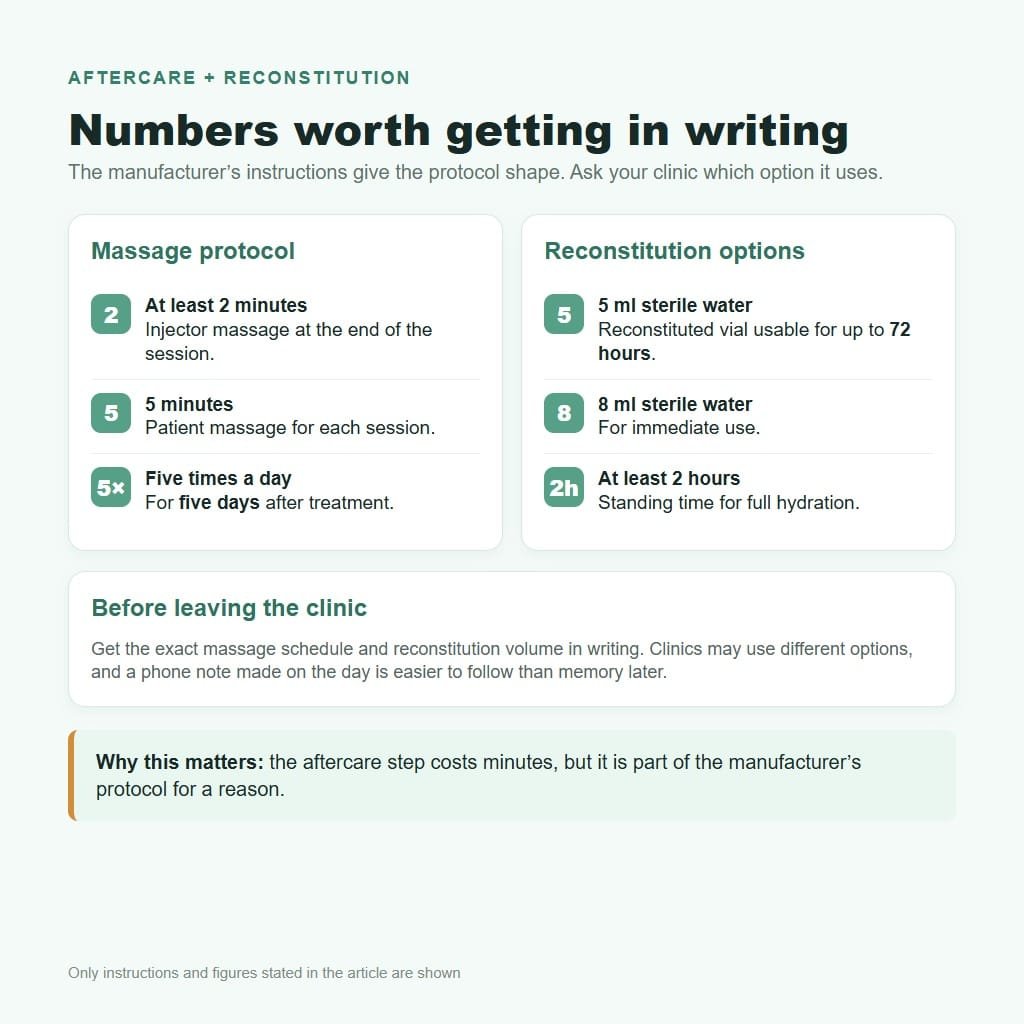
The vial contains powder, and someone decides how much water it meets. That decision is one of the few things a patient can ask about that is directly linked to a reported complication. Early practice reconstituted with about 3 ml, and the literature associates concentrated preparations with non-inflammatory subcutaneous nodules. Injectors have raised reconstitution volumes since. The instructions for use allow two options: 5 ml of sterile water, with the reconstituted vial usable for up to 72 hours, or 8 ml for immediate use. Injectors also use higher volumes off-label, and often add lidocaine at the time of treatment. The number is a fact about your treatment, and it should be available on request.
A higher dilution spreads the particles more evenly through the tissue, and even distribution is what keeps them from clumping into something you can feel. However, the manufacturer’s own five-year post-approval study complicates the simple version. It links an increased risk of papules and nodules to larger injected volume and to a higher wrinkle severity at baseline. Dilution is therefore one variable among several, which is why the number a clinic uses belongs in the consultation as information. The instructions also tie timing to volume: a 5 ml reconstitution can stand up to 72 hours, an 8 ml reconstitution is for immediate use, the vial must stand at least two hours for full hydration, and lidocaine goes in just before injection. Clinics differ on which of those options they use, and the choice is recorded on their protocol.
3.2 Massage, and What It Is For
Clinics usually ask you to massage the treated area on a schedule for several days, and the manufacturer’s instructions put numbers on it. The injector massages the area for at least two minutes at the end of the session. The patient then massages the treated areas for five minutes, five times a day, for five days. It costs nothing, and the guidance ties it directly to the most frequently reported complication. The instruction is not a formality that clinics add for caution. It is one of the few things within your control after the needle, and skipping it removes a step the manufacturer built into the protocol for a documented reason.

Get the specific protocol in writing before you leave, since clinics differ on duration and frequency. And treat any instruction you were given verbally, but cannot recall, as an instruction you never received. A note on your phone on the day beats a confident memory three days later. By then the swelling has gone and the routine feels optional. Ask for it on paper or in a message you can search later. A clinic that will not put its own aftercare in writing has made your compliance harder to prove, and easier to blame. A note made in the building beats a reconstruction made at home.
4. Risks Around a Sculptra Collagen Stimulator
Expected effects and complications are different categories, and clinics sometimes blur them. Swelling at the injection site is expected and settles. The reported adverse events that matter are papules and nodules, with swelling and areas of firmness. Most of these resolve with time. Knowing which timeline a lump belongs to tells you most of what you need to know about it. That distinction is worth holding onto through the first months. Swelling that settles in days sits in one category, while a firm area appearing in month five sits in another. Reporting the second promptly beats waiting to see whether it settles on its own.
4.1 Early and Delayed Nodules
Early subcutaneous nodules appear at the injection site within roughly three to six weeks. Reviews attribute them mainly to dilution and injection technique. The labelling adds a timing figure worth knowing: after the first session, median onset was 55 days for papules and 160 days for nodules. In contrast, reports of delayed nodules run from one to fourteen months after injection. Their duration has sometimes stretched to two years. Those two windows explain why a lump at week four and a lump at month nine are treated as different events. The first points towards technique and preparation; the second raises different questions entirely. Tell your injector the date it appeared, since the timing narrows the diagnosis.
That two-year figure is worth carrying into the consultation, together with the fourteen-month window in which such a nodule can first appear. It turns a treatment with a slow upside into one with an occasional slow downside too. Consequently, the choice of injector is not a matter of price or convenience. Ask what volume of these treatments they perform and what dilution they use. Then ask what their plan is should a nodule show up at month eight. An injector who has managed nodules before will answer that question calmly and specifically. One who has never seen one, or says they never occur, is telling you either that their volume is low or that their account is incomplete. Both are worth knowing before you book.
| Finding | Typical timing | What the literature associates it with |
|---|---|---|
| Early nodules | Three to six weeks | Dilution and injection technique |
| Delayed nodules | One to fourteen months | Reported duration sometimes up to two years |
| Firmness or induration | Variable | Commonly resolves over time |
4.2 Who Should Think Harder Before Booking
Anyone who needs a defined result by a fixed date is a poor candidate. No approved method compresses the timeline. A wedding in eight weeks argues for a different treatment entirely. Similarly, weigh irreversibility seriously if you want the option to change your mind. No enzyme dissolves this material once collagen has formed around it. The permanence cuts both ways, and that permanence is why a cautious first course is usually the better opening move. You can always add at month six. Removing what is already there is not on the menu, and no amount of clinic reassurance changes that.
Some findings belong in a consultation, where someone can examine you. Active infection in the area, a history of keloid scarring, and known sensitivity to the constituents are three of them. Your injector needs your full medical history, autoimmune conditions and previous injectables included. What already sits in the tissue affects what happens next. Ultimately, a practitioner who does not ask these questions has just revealed something about their practice. Bring a written list of everything injected into your face in the past two years, with approximate dates. Most patients underestimate how much this matters, and most cannot recall it accurately under questioning in a consultation room.
5. Choosing a Clinic for a Sculptra Collagen Stimulator
The product is standardised and the hands are not. Two clinics quoting the same price for the same vials can be offering different things. The differences are visible before you commit, if you know where to look. Patients can identify those differences by asking specific questions before treatment. Price comparison is the least informative thing you can do at this stage. Two quotes that differ by a third may describe the same vials placed by people whose experience differs by an order of magnitude, and the cheaper one is not automatically the worse choice. The more informative figure is how many of these treatments the injector performs in a typical month.
5.1 Questions Worth Asking Out Loud
Ask who performs the injection and what they are qualified in. The owner’s name matters less. Ask what the vial count is for your plan, and over how many sessions. The quoted price should map onto a course, not a visit. Furthermore, ask what dilution they use per vial. The useful answer is a number. A clinician comfortable with the material answers that instantly. Answers written down inside the consultation stay exact; answers reconstructed afterwards do not. A number given confidently in the room has a way of becoming approximate in memory, and you will want the exact figure if you compare clinics or if a problem arises later.
Then ask the awkward one. Should a firm area turn up months later, who assesses it, and is that visit included? The answer separates a clinic selling a course from a clinic managing a treatment. Similarly, ask what they would advise if you decide after two sessions that you want to stop. Cosmetic decisions made under sunk-cost pressure are rarely good ones. Our guide to reading what a serum label leaves out applies the same instinct to a smaller purchase. Ask, too, what happens if you move city or the clinic closes mid-course. Vials are standardised, but records and photographs are not, and a course interrupted without documentation is difficult for the next injector to continue sensibly.
5.2 Verify the Sculptra Collagen Stimulator Vial, Not the Website
Ask to see the vial and packaging before reconstitution, and read the batch information yourself. Hesitation is a reason to leave; compliance alone is not proof. Injectables bought through unofficial channels are a known concern across aesthetic medicine. A price well below the local market is a reason to verify the vial’s source and batch information. Photograph the packaging with your phone before it is opened. It costs nothing, takes seconds, and gives you the batch number if you ever need to report an adverse event or let another clinician know exactly what was used. An image filed with your treatment records stays findable; one buried in a camera roll does not.

The regulator-facing documents are public and worth a glance. The manufacturer publishes the official instructions for use, and a separate patient guide that describes the post-treatment massage. Read whichever one your clinic works from. It gives you a reference no clinic controls. Reading the instructions once also makes the consultation easier, because you will recognise the terms your injector uses. Reconstitution volume, hydration time and the massage schedule all appear there in plain language, and none of it requires a medical background to follow. A saved copy lets you check a later claim without relying on the clinic’s version of it.
6. Getting the Best From a Sculptra Collagen Stimulator
Some disappointment comes from judging the outcome before new collagen has had time to form. A treatment that works on a six-month horizon will usually look like a failure at week three. Booking extra sessions before the planned assessment treats an outcome that is still developing. As a result, the most useful habit is a fixed way of assessing progress. The bathroom mirror at night is not one. Set the assessment date at the time of booking and write it in your calendar. A date chosen in advance is much harder to bring forward in a moment of impatience, and impatience is what produces most of the unnecessary extra sessions in this category.

6.1 Photograph on a Schedule
Photograph the face before your first session, in daylight and from three angles. Keep the expression neutral and skip the makeup. Repeat it in the same place at the same time of day every month. The comparison you care about is month zero against month six. Nobody can reconstruct month zero afterwards. Use the same room, the same window and the same distance each time. Consistency matters more than photographic quality here, since you are comparing one image against another and not producing anything anyone else will see. A dated folder keeps the sequence intact, and nothing in it is lost to a phone upgrade.
Daily mirror checks work against you here. Gradual change is easy to miss when you watch continuously. That is why other people notice first. In addition, note your weight at each photograph, so a later review is not confused by it. Ask someone who does not see you daily to look at the month-zero and month-six images side by side. Their reading carries more weight than yours, for the same reason a daily mirror check does not. Show them the pair without saying which is which, and note what they say before you explain anything. A second opinion from someone outside the house cuts through the slow drift of daily looking.
6.2 The Mistakes That Cost Money
Stacking sessions closer together than advised is the expensive one. The interval exists so the clinician can assess a result that has not yet arrived. Compressing it means treating before anyone can assess the previous session. Similarly, adding other injectables into the same area makes a later problem hard to attribute. Attribution is exactly what you need if something goes wrong. Keep a simple log of dates, vials and areas treated, and add the name of anything else injected into your face in the same period. If a nodule appears at month nine, that log is what turns a guess into a usable clinical history.
Skipping the massage protocol is the cheap mistake with the worst ratio. It takes minutes a day. Chasing a second course too early is how people end up overfilled. Wait, photograph, then decide. Booking a second course before the first has been assessed is the mistake that compounds. It adds cost, it adds material, and it removes your ability to say what produced the result you eventually see. Nothing about waiting costs you anything except time. Booking the assessment first turns any earlier appointment into a conversation. Patience here is free; every alternative to it carries a price. Nothing about the interval is arbitrary; it exists so that a judgement has something to judge.
Sculptra Collagen Stimulator FAQ
How soon will anything be visible?
Any fullness in the first days is the mixing water. It leaves. Real change accumulates over months, slowly and unevenly. The trial measured its outcome thirteen months after treatment. A verdict at week three means nothing, however tempting it is. Take the day-one images anyway. The comparison you want at month six is impossible to construct later. An image, kept from day one, also makes the temptation to judge early much easier to resist. Setting the review date at the same time gives the comparison a fixed point. A date entered on the day of booking survives the impatience of month three. The images taken on day one are the only version of month zero that will ever exist.
Can it be dissolved if I dislike it?
No. Hyaluronidase reverses hyaluronic acid fillers and does nothing here. The resulting tissue change cannot be dissolved with hyaluronidase. That irreversibility is the strongest argument for a conservative first course and an experienced injector. This is the point that most deserves a slow decision. A cautious opening course leaves room to add later, whereas an ambitious one leaves no route back. Ask your injector what they would do differently if they were treating themselves. Their answer to that question is usually more candid than their answer to any other, and the awkwardness pays for itself. Most injectors answer it honestly, and the honest answer tends to be more cautious than their brochure.
Is one vial enough?
That depends on the area and the degree of volume loss. It is a clinical judgement, not a shopping decision. The structure is fixed: manufacturer guidance describes up to four sessions, weeks apart. A quote covering one visit covers part of a course. Ask for the vial count in writing along with the intervals, and confirm whether review appointments are included. Clinics differ on this, and a course that looked competitive per visit can end up costing considerably more once the full schedule is on paper. Clinics also differ on whether unused vials from a paid course carry forward if you pause treatment.
Conclusion: What to Weigh Before a Sculptra Collagen Stimulator
The evidence supports a real effect. The trial the manufacturer reported found the effect still measurable at month thirteen. The same evidence indicates that visible improvement takes weeks to months, and that hyaluronidase cannot reverse the result. Reported risks also include nodules that may persist for an extended period. Both halves are true. A clinic presenting only the first has told you half a story. Reading both halves is what makes the decision yours. A treatment can be genuinely effective and still be the wrong choice for a particular face, a particular timeline or a particular tolerance for waiting. Both of those are real conclusions, and either can be the right one.
If you go ahead, choose the injector before the price. Get the dilution and the massage protocol in writing. Take those images before any needle goes in. Then leave it alone until your course finishes and months have passed. This treatment requires patience, despite the emphasis on rapid results in aesthetic marketing. A timeline that does not suit you is a reasonable ground for declining. Other treatments work faster, reverse more easily, and suit a fixed date; a good injector will say so, instead of talking you into the one on their own price list. That answer is worth more than a discount, and it gives you the clearest signal available about how a clinic works.