
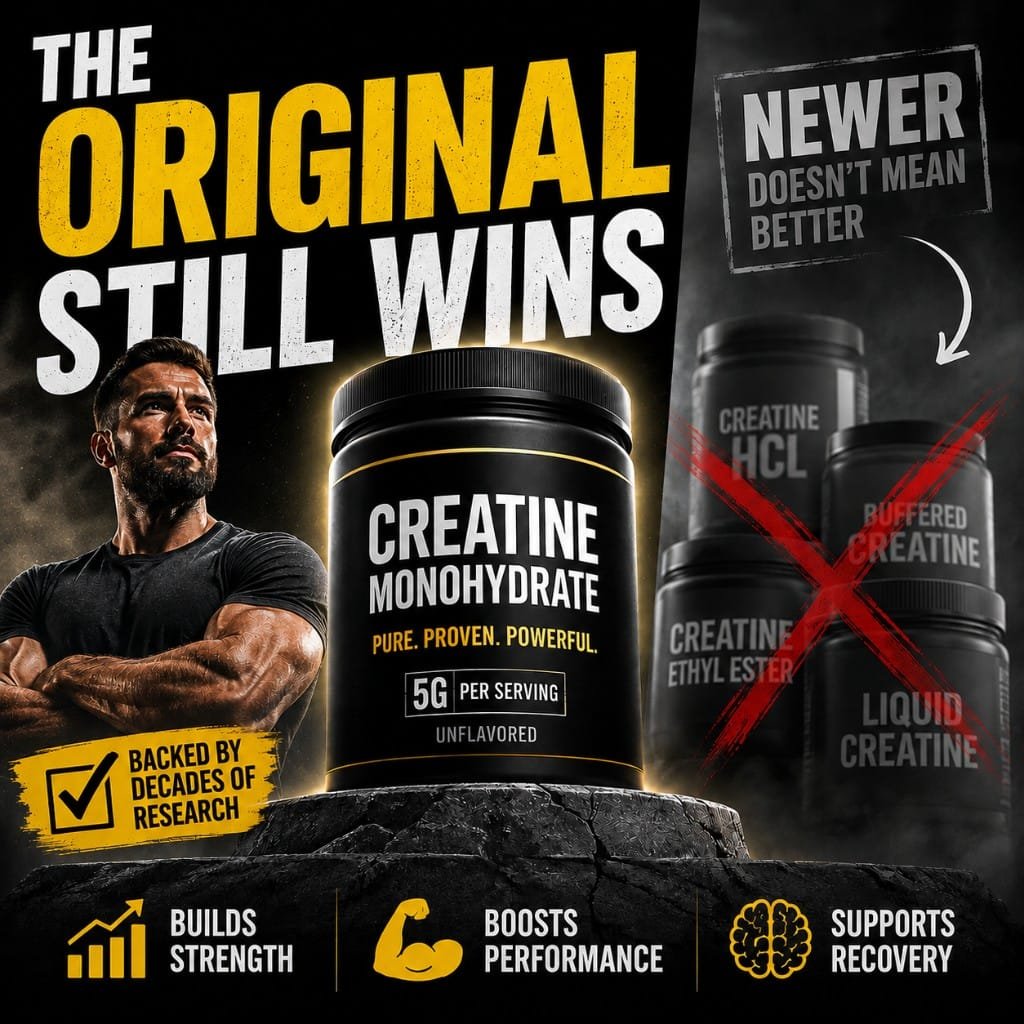
Walk down a supplement aisle and the newer creatine tubs cost two or three times what the plain one does. The plain one is creatine monohydrate, and it is the form the research was actually done on. The newer forms arrive in better packaging, promising faster absorption and no water retention. Those promises have been tested. They did not hold.
This article sets out what creatine monohydrate actually does inside a muscle. The article covers what the research supports and what it does not. You will also see how the newer formulas compare when someone measures them rather than markets them. Dosing gets its own section, because that is where most people go wrong, along with the handful of situations where a doctor should be asked first.
One thing is worth saying at the start. Creatine is not a stimulant and it does not work in a single session. It fills a store, and a filled store changes what a hard set feels like. Understanding that mechanism makes every practical decision below obvious rather than arbitrary.
1. What Creatine Monohydrate Actually Does
Your body already makes creatine, and you eat some in meat and fish. Most of it is stored in muscle as phosphocreatine. That store exists to do one job: rebuild ATP, the molecule your muscles spend during brief, hard effort. A set of heavy squats or a short sprint drains ATP within seconds. Phosphocreatine is what puts it back fastest. Supplementing simply raises how much of that store you carry. As a result, the last repetitions of a set come slightly easier, and the next set starts from a better place.
1.1 The Energy System It Refills
Three systems power movement, and they hand over to each other by duration. The phosphocreatine system covers roughly the first ten seconds of maximal effort. Glycolysis takes the middle range. Aerobic metabolism carries everything longer. Creatine monohydrate works on the first system only. Consequently it helps a five-rep set, a sprint, or a jump far more than it helps a long run.
This is also why the benefit compounds rather than appears. One better set is trivial. However, a slightly better set repeated across every session for months adds real training volume, and volume is what drives adaptation. The supplement does not build muscle. It lets you do more of the work that does.
1.2 Why the Early Weight Gain Is Not Fat
Almost everyone gains one to two kilograms in the first week. That figure is consistent across the literature, and it frightens people who are watching the scale. The gain is water, and specifically water drawn inside the muscle cell rather than under the skin. Creatine is osmotically active, so raising the store pulls fluid in with it.
Intracellular water does not look like bloating. In fact it usually makes a muscle look fuller rather than softer, which is the opposite of what people fear. The confusion comes from older marketing for competing products, which sold “no water retention” as though all water were the same. According to the International Society of Sports Nutrition position stand on creatine, this early mass change reflects the loading mechanism itself and is expected.
2. The Evidence Behind Creatine Monohydrate
Few supplements have been studied this heavily, and that is the strongest argument in its favour. Hundreds of controlled trials have run on creatine monohydrate across decades. They cover trained and untrained people, men and women, and ages from adolescents to the elderly. That volume of work matters because it lets a reader separate a real effect from a small promising study. It also sets a standard the newer formulas have never been held to.
2.1 Strength, Power and Training Volume
The clearest and most repeated finding is improved performance in short, high-intensity work. Strength goes up. Repetitions at a given load go up. Sprint and jump measures improve modestly. Those effects are consistent enough that creatine is treated as the reference case for an effective sports supplement.
Size gains follow indirectly, through the extra work performed. Recovery between sessions also appears to benefit, which matters more than it sounds: a lifter who recovers better trains more often. Furthermore, research in older adults suggests creatine paired with resistance training helps preserve muscle. That is a different goal from athletic performance, and a more important one for many readers.
2.2 What the Research Does Not Support
An honest article names the limits. Creatine is not a fat loss aid, and it will not replace a calorie deficit. Its effect on endurance events is small to absent, because those events do not run on the system it refills. Nor does it work equally for everyone. People who already eat a lot of red meat start with fuller stores and notice less. A minority respond barely at all.
Two persistent myths deserve retiring. The first is kidney damage, which has not appeared in healthy people across long-term studies. The second is hair loss, which traces to a single small study that has not been replicated and is repeated far beyond what it can support. Neither claim is settled by a supplement label, in either direction, which is why the sources at the end of this article matter more than any brand’s marketing.
3. Creatine Monohydrate Against the Newer Forms
Every few years a new form arrives with a story about superior absorption. Hydrochloride, ethyl ester, buffered, liquid, nitrate, magnesium chelate. Each is sold at a premium against the same argument: monohydrate is old, poorly absorbed, and causes bloating. The premium is real. The advantage is not. When these forms have been compared directly against monohydrate, they have matched it at best.
3.1 Hydrochloride, Buffered and Liquid Creatine
Creatine HCl dissolves more readily in water, and that part is true. Solubility in a glass is not the same as uptake into muscle, though, and the second is what matters. Buffered forms make a similar argument about stomach acid degradation, which turns out to be a smaller problem than claimed because monohydrate survives digestion largely intact.
Liquid creatine is the weakest of the group, since creatine degrades to creatinine in solution over time. A pre-mixed bottle sitting on a shelf is losing the compound you paid for. The position stand cited above puts it plainly: claims that other forms are degraded less, or taken up better, than creatine monohydrate are unfounded.
3.2 Why the Original Form Keeps Winning
There is a reason the evidence sits with the old form. Monohydrate is what researchers used, so decades of trials describe it and not its rivals. A newer form does not inherit that evidence by being chemically related. It would need its own trials, and the companies selling it have rarely funded them.
Price then decides it. Monohydrate is manufactured at scale and costs very little per serving, while the alternatives cost several times more for an unproven difference. Therefore the practical rule is simple. Buy the form the research used, and spend the difference on food.
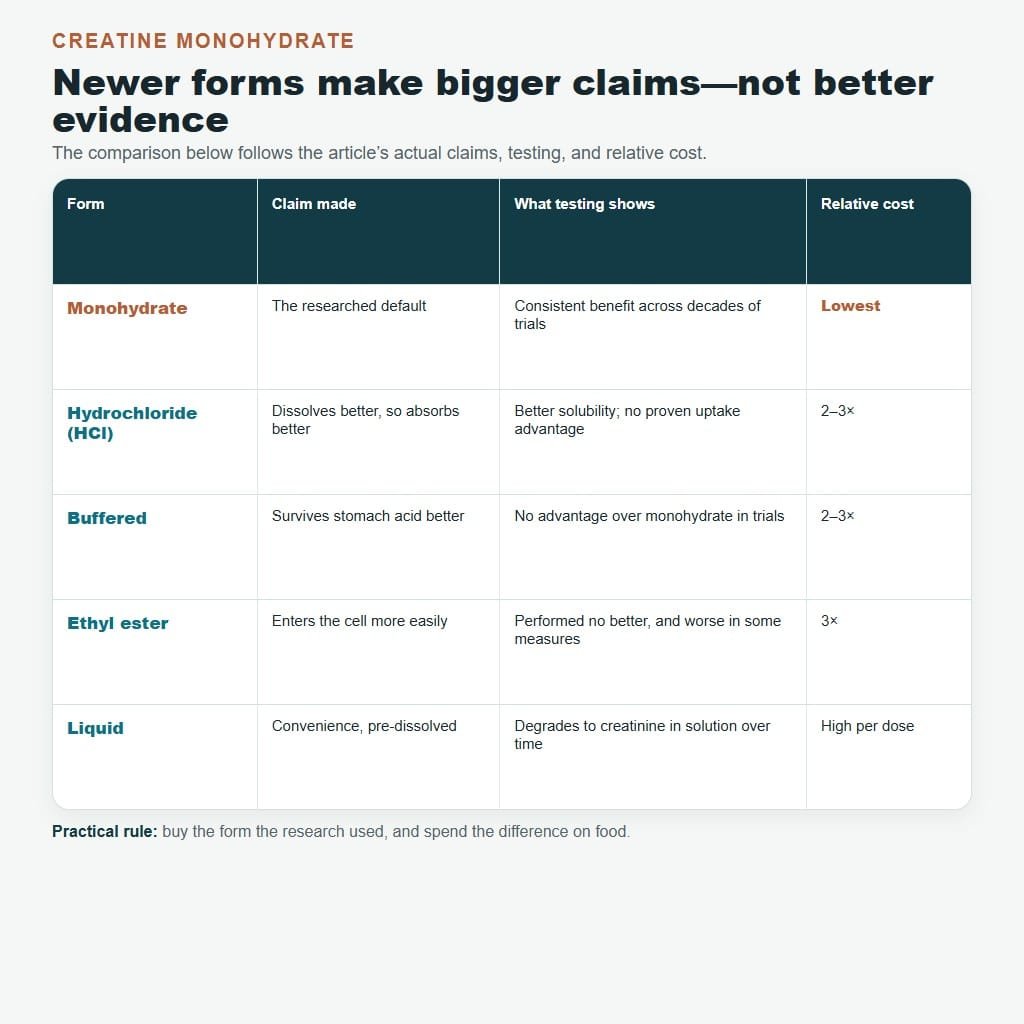
| Form | The claim made for it | What testing shows | Relative cost |
|---|---|---|---|
| Monohydrate | None needed — the researched default | Consistent benefit across decades of trials | Lowest |
| Hydrochloride (HCl) | Dissolves better, so absorbs better | Better solubility; no proven uptake advantage | 2–3× |
| Buffered | Survives stomach acid better | No advantage over monohydrate in trials | 2–3× |
| Ethyl ester | Enters the cell more easily | Performed no better, and worse in some measures | 3× |
| Liquid | Convenience, pre-dissolved | Degrades to creatinine in solution over time | High per dose |
4. How to Take Creatine Monohydrate
Dosing is where most of the confusion lives, and it is simpler than the internet suggests. The goal is to fill a store and then keep it full. Two routes reach the same place, differing only in how fast they get there. Neither route requires cycling on and off, and neither depends on precise timing. What both require is consistency, because an empty day drains a little of what you built.
4.1 Loading Against a Steady Daily Dose
The loading route takes roughly twenty grams a day, split into four servings, for five to seven days. It fills the store fastest, in about a week. The steady route takes three to five grams a day from the start and reaches the same saturation in three to four weeks. Both end at the same place.
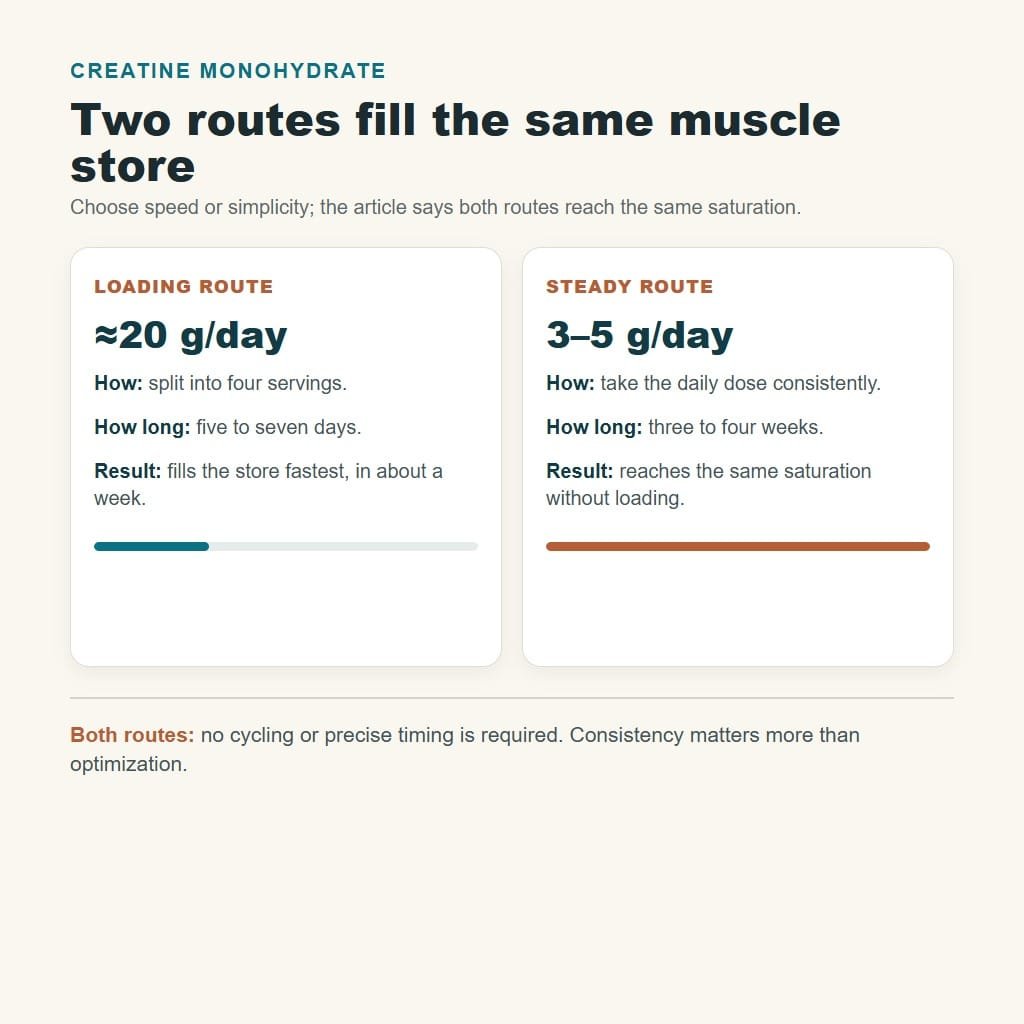
A review in Nutrients on creatine for exercise and recovery concludes that a loading phase is not necessary, while noting it remains the fastest way to raise muscle stores. In practice, load only if you have a competition or a training block in three weeks. Otherwise take the steady dose, since larger single servings are also the ones most likely to upset a stomach.
4.2 Timing, Food and Fluids
Timing matters far less than people are told. A filled store is filled all day, so the hour you take it barely registers. Taking it with a meal containing carbohydrate or protein may modestly help uptake, and it certainly helps tolerance. Otherwise, take it whenever you will reliably remember, because adherence beats optimisation here.
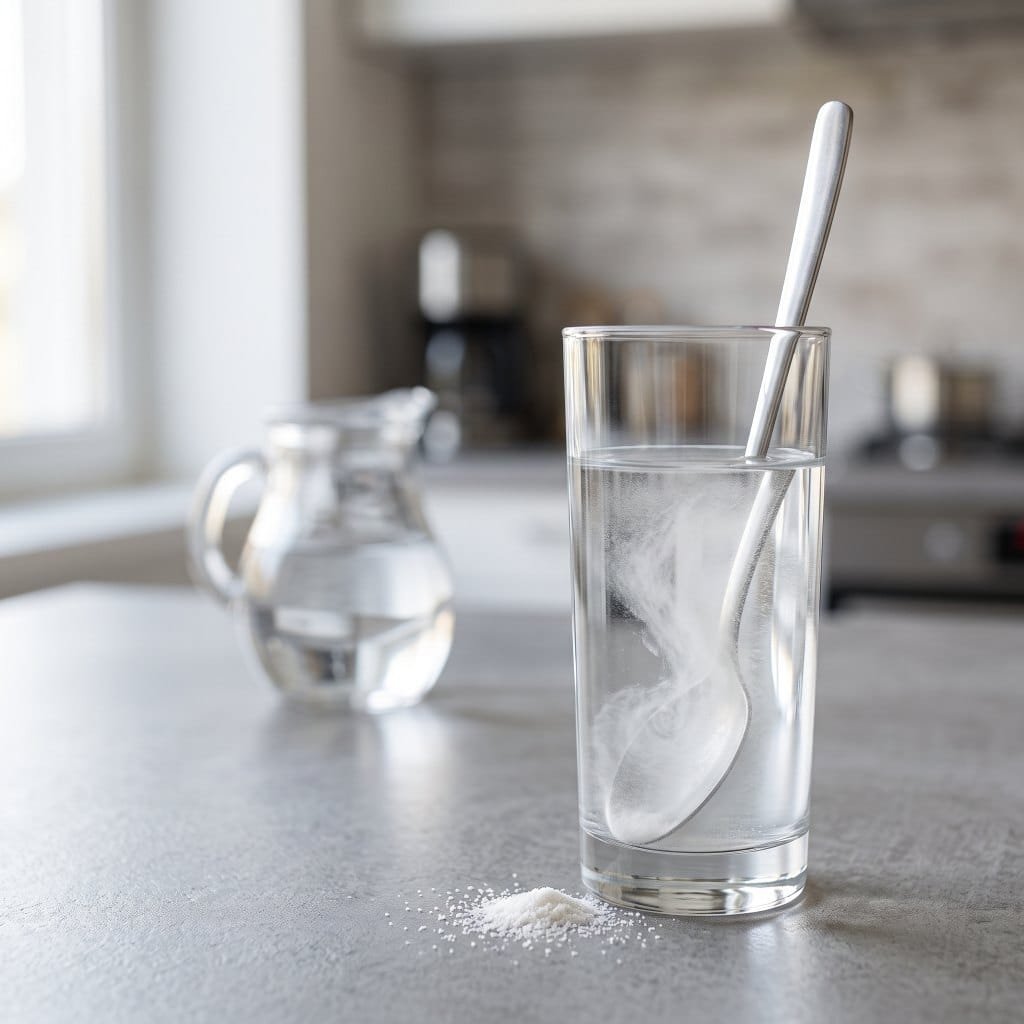
Fluids deserve a mention. Creatine pulls water into muscle, so drinking normally matters more than usual, particularly in heat. Stir the powder into a full glass rather than a mouthful, and drink the grit at the bottom instead of leaving it. Stomach discomfort almost always comes from too much at once in too little water, and splitting the dose fixes it.
5. Choosing a Creatine Monohydrate Product
Because the compound is a commodity, the product decision is narrower than in most supplement categories. You are not choosing between formulas. The real choice is between a pure powder and one carrying flavourings, fillers or a premium format. A second choice sits behind it: a manufacturer that tests its batches, or one that does not. Those two questions cover almost everything worth checking on a label.
5.1 Purity and Independent Testing
The ingredient list on a good tub is short. Creatine monohydrate, and nothing else, is the ideal. Micronised simply means milled finer, which improves mixing and is a genuine convenience rather than a performance claim. Creapure is a branded German-produced monohydrate with tight purity control, and it costs a little more for that assurance.
Third-party testing is the signal that matters most, especially for anyone subject to drug testing. Certifications such as Informed Sport or NSF mean batches were checked against contamination. Meanwhile a tub with a long ingredient list, a proprietary blend, or no testing marks is asking you to trust a claim nobody verified. In a category this cheap, there is no reason to accept that.
5.2 Powder, Capsules and Gummies
Powder is the cheapest per gram and the easiest to dose precisely, which is why most people should start there. Capsules solve one real problem, which is travel and taste, but they cost considerably more and a five-gram dose can mean swallowing several. Neither works better than the other inside the body.
Gummies are the format to look at hardest before buying. They carry sugar and they cost the most per gram. Independent testing has also repeatedly found less creatine in them than the label states, because creatine is not stable in that matrix. If you buy them, buy a brand with recent third-party results. Otherwise the convenience is bought with an unknown dose.
| Question | What to look for | Walk away if |
|---|---|---|
| What is in it? | Creatine monohydrate as the only ingredient | A proprietary blend hides the amount |
| Who checked it? | Informed Sport, NSF, or published batch tests | No testing mark anywhere on the label |
| What format? | Powder for value, capsules for travel | Gummies with no recent third-party result |
| What dose per serving? | 3–5 g of actual creatine, stated plainly | The serving is under 3 g at a premium price |
6. Creatine Monohydrate Safety and Who Should Ask First
The safety record is unusually strong for a supplement, and it is strong because it has been examined for so long. The position stand cited earlier reports no compelling evidence of harm in healthy people using it for extended periods, across doses well above what anyone needs. That is a meaningful statement, and it is also a bounded one. It describes healthy people, and it does not replace a doctor who knows your history.
6.1 The Side Effects That Do Occur
Stomach upset is the common one, and it is a dosing artefact rather than a reaction to the compound. Large single servings taken with little water cause it; splitting the dose and drinking properly resolves it in most people. Some report mild cramping, though controlled studies have generally not found a higher cramp rate than placebo.
The weight change discussed earlier is real and worth planning around. An athlete in a weight class should know a kilogram or two is coming, and should not start a fortnight before a weigh-in. For everyone else it is simply the store filling, and it stops once it has.
6.2 When to Speak to a Doctor First
Anyone with existing kidney disease should ask before starting, not because creatine has been shown to cause damage, but because an already impaired system deserves a clinician’s judgement rather than an article’s. The same applies to anyone taking medication that affects kidney function.
Pregnancy, breastfeeding and adolescence are the other three. Evidence in those groups is thinner, and thinner evidence is a reason for a conversation rather than a reason for confidence in either direction. One practical note also helps: creatine supplementation raises blood creatinine, a marker used in kidney tests, without kidney injury being present. Tell your doctor you take it, so a routine result is read correctly.
7. Getting the Best Results From Creatine Monohydrate
A supplement that improves training only pays out if the training happens. That sounds obvious, yet it is the most common reason people conclude creatine did nothing for them. The store fills either way; what turns a filled store into a result is the extra work it lets you do. What follows is how to give it a fair test rather than a vague one.
7.1 Giving It a Fair Trial
Take it daily for at least eight weeks, including rest days, and log your training. Record the load and the repetitions on two or three main lifts. Then compare month two against month one. That comparison answers the question; a feeling after a single session does not.

Change one thing at a time, too. Starting creatine, a new programme and a calorie surplus in the same week makes the result uninterpretable. In addition, keep protein adequate across the day. Creatine supports the work; protein supplies the material. Our article on choosing a whey protein isolate covers that side of the equation.
7.2 Who Benefits Most
People who eat little or no red meat start with lower stores. They typically notice the most. That makes creatine one of the more worthwhile supplements on a plant-based diet, a point covered further in our article on making the switch to a vegan diet. Older adults training for strength are the second group, since preserving muscle becomes the goal rather than adding it.
Who benefits least is equally clear. Someone eating a large amount of red meat already carries fuller stores. An endurance athlete gains little, because the events do not draw on that system. And anyone training inconsistently will see nothing at all, since the supplement can only amplify work that actually happens.
Creatine Monohydrate FAQ
Do I need to cycle creatine monohydrate?
No. Cycling was borrowed from compounds where receptors downregulate, which does not apply here. Stopping simply lets the store drain over several weeks, and you then have to refill it. Continuous daily use is the straightforward approach.
Can women take creatine monohydrate?
Yes, and the mechanism is identical. Women often start with lower baseline stores, so the response can be noticeable. Dosing does not differ meaningfully, although body size makes the lower end of the range appropriate for many.
Does it work without training?
Barely. The store fills regardless, but its purpose is to fuel hard effort. Without training there is nothing for the extra capacity to do, so the visible result is the initial water gain and little else.
Conclusion: Creatine Monohydrate Is Still the Answer
The case is unusual in how little it has changed. Creatine monohydrate was the form the research used, it remains the form the research supports, and it is still the cheapest thing on the shelf. Newer formulas have had years to prove a difference and have not produced one. Paying more here buys packaging.
So the decision is small and the execution is simple. Buy a plain, tested monohydrate powder. Take three to five grams a day, every day, with water and preferably with a meal. Train properly for two months, write down what the bar did, and judge it on that. If a kidney condition, a pregnancy, or a medication is part of your picture, make the doctor’s call the first step rather than the last.
Verified Creatine Monohydrate Products
As an Amazon Associate, BeIN ADVISOR earns from qualifying purchases.
These are supplements, not medical treatment or a guarantee of strength, muscle gain, or recovery. Check the current Amazon listing, ingredients, serving size, seller, delivery terms, and price before buying. Ask a clinician first if you have kidney disease, are pregnant or breastfeeding, are under 18, or take medicines that affect kidney function.
Sports Research Creatine Monohydrate: The Amazon listing identifies a 5g creatine monohydrate powder in blue raspberry flavor, 14.18 oz, with 60 servings. Use it as a comparison point for dose and format, not as a guarantee of athletic results.

Wellah Creatine for Women: The listing identifies 30 single-serve stick packs in six flavors, with 3g of creatine monohydrate per serving plus dandelion and cranberry extracts. Compare the serving size and ingredients with your needs before buying.

Choose the format you can dose consistently, and treat the article’s safety section as part of the buying decision.