
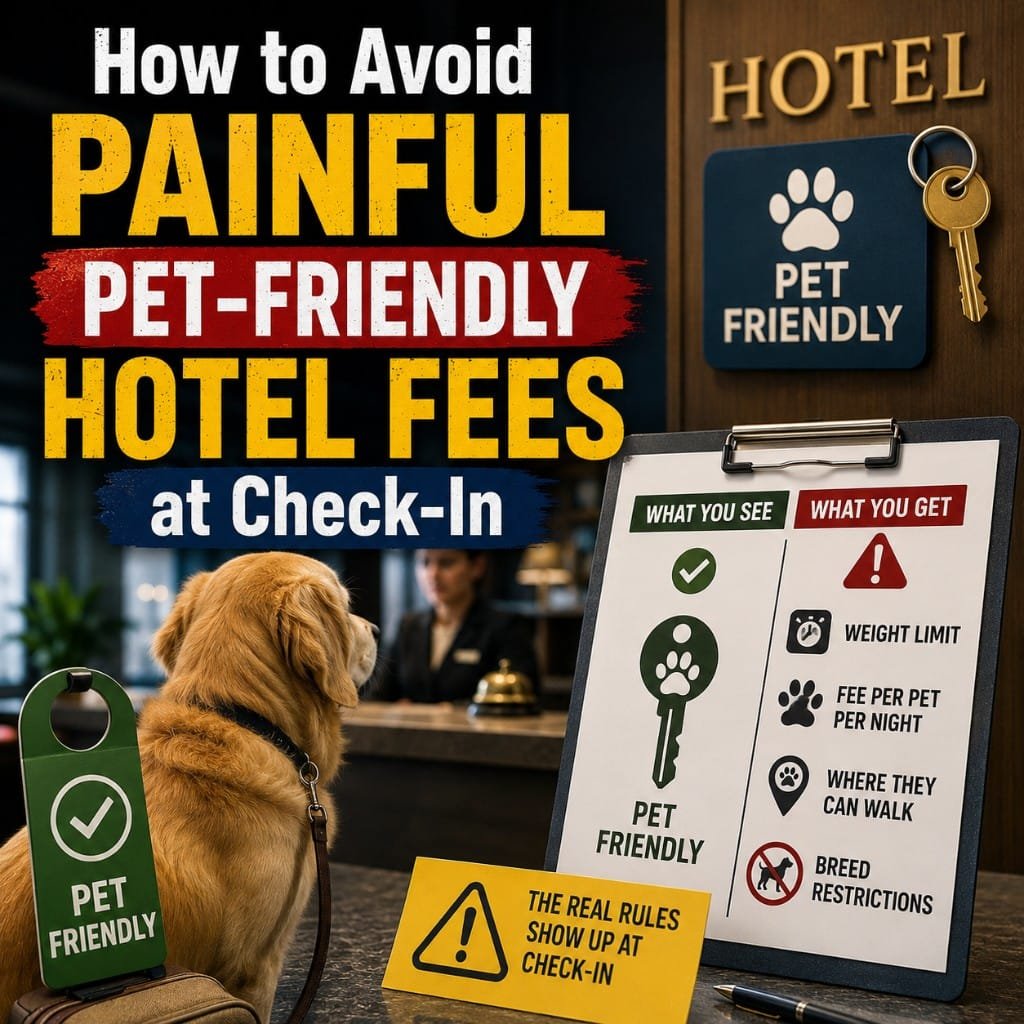
A booking confirmation that says “pets welcome” can still cost you an extra ninety dollars at check-in. Pet friendly hotels vary enormously in what that phrase actually covers, and the gap only shows up once you arrive. One property hands your dog a bed and a bowl. Another charges a nightly fee, caps the weight at twenty pounds, and forbids leaving the animal alone in the room. Both use the same two words in their listing.
This article sets out what the label means in practice and where the real costs hide. It covers the fee structures you will meet. It also covers the limits placed on size and breed, and the areas your dog may never enter. Additionally, it explains how to verify a policy in writing before any money changes hands. Each section is built around the questions that decide whether a stay works.
The aim is not to talk you out of travelling with an animal. Millions of stays go smoothly every year. However, the ones that go badly almost always fail at the same point: an assumption made at booking that the property never agreed to. Reading a policy takes ten minutes. Consequently, it is the cheapest insurance available to anyone travelling with a pet.
1. What Pet Friendly Hotels Actually Mean by the Term
No regulator defines the phrase. A property applies it to itself, and the meaning stretches from genuine welcome to grudging tolerance. In practice the label answers only one question: will the hotel refuse your booking outright. Everything else — cost, access, room type, supervision rules — sits in a separate policy document that most travellers never open. As a result, two properties with identical badges can deliver completely different stays. The distinction matters most on longer trips, where a restriction you shrugged at on night one becomes the reason the week does not work.
1.1 Where Pet Friendly Hotels Draw the Line
A genuinely welcoming property builds the animal into its operation. Staff expect dogs in the lobby. There is a designated relief area outside, and housekeeping knows which rooms hold pets. Furthermore, the front desk can name a nearby vet without looking it up. These are operational details, not marketing, and they take effort to put in place. A property that has done that work usually says so specifically in its listing. Look for the concrete noun rather than the adjective — a bed, a bowl, a walking route, a named relief area. Specificity is the tell.
A merely tolerant property does the opposite. It accepts the booking and then confines it. Pets are limited to a handful of ground-floor rooms beside the service entrance. The animal may not cross the lobby, use the lift, or sit on the terrace while you eat. In contrast to the first type, nothing here was designed for the guest with a dog. A rule was simply written to contain them. Neither approach is dishonest. Both, though, wear the same two words in the search results, which is exactly why the badge cannot be your deciding factor.
1.2 Why the Badge Alone Tells You Nothing
Booking platforms show the filter as a single toggle. Switch it on and the map fills with results. That interface is useful for narrowing a list, yet it flattens every difference described above into one binary. The filter cannot tell you that a property allows one dog and you are travelling with two. Meanwhile, it also cannot tell you that the fee is charged per animal per night rather than once per stay. Those two facts alone can double a budget, and neither appears on the card you clicked.
Review text fills part of the gap, though carefully. A guest who travelled with a small quiet dog in low season had a different experience from the one you are planning. Therefore, read reviews for facts rather than verdicts. Note the fee somebody actually paid and the floor they were placed on. Note whether the animal could be left while they went out. Facts transfer between travellers; satisfaction does not. Specialist directories such as the BringFido travel directory are built around exactly these details. As a result, they beat a general filter as a starting point.

2. What Pet Friendly Hotels Charge and When
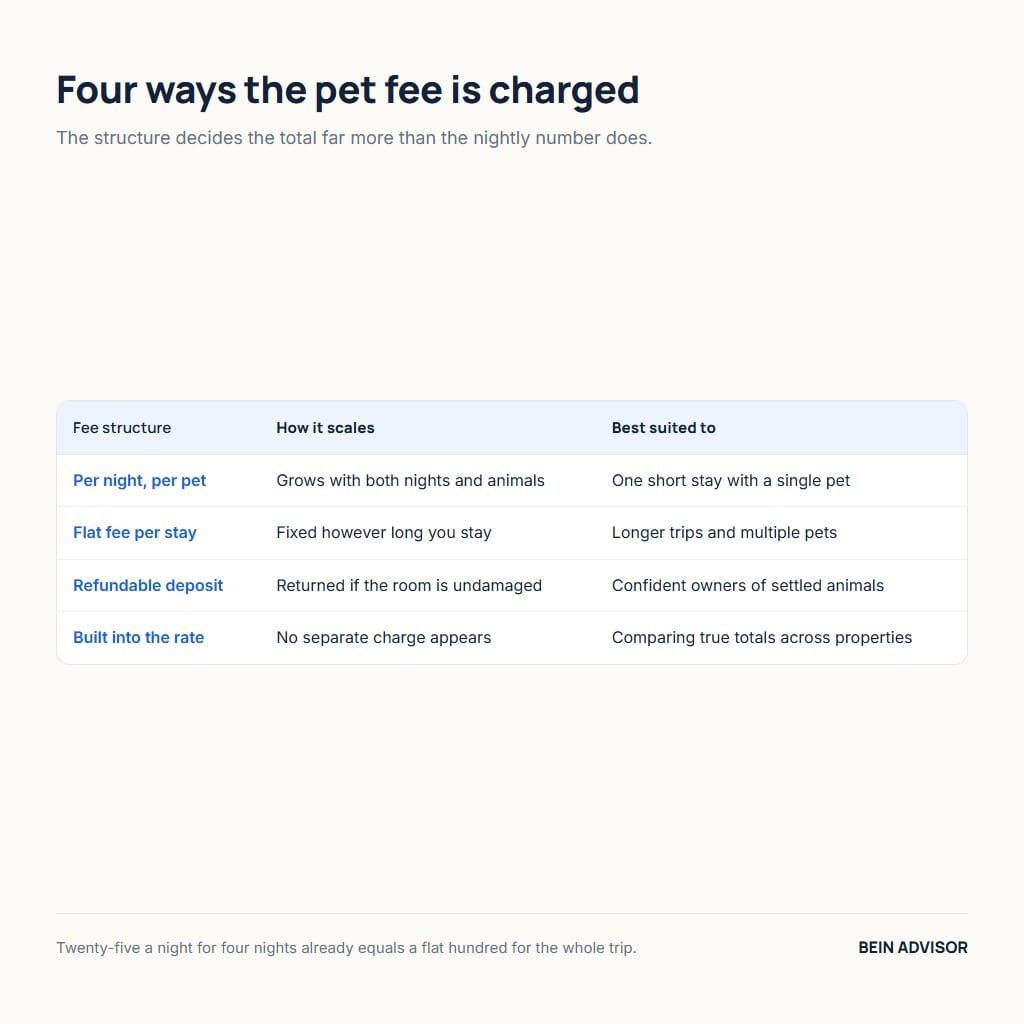
Money is where most unpleasant surprises live. The headline room rate almost never includes the animal, and the supplement can be structured in at least four different ways. Each structure behaves differently as the trip gets longer or the party gets bigger. A charge that looks trivial for two nights can outgrow the room rate across a fortnight. Consequently, the only sensible comparison is total cost for your actual stay, not the nightly figure on the search page. The table below sets out the common structures and how each one scales.
2.1 The Fee Structures Pet Friendly Hotels Use
A per-night, per-pet fee is the most common and the most expensive over time. It is also the easiest to underestimate, because the number quoted is small. A flat fee per stay behaves in the opposite way: painful on a single night, excellent value across a week. Some properties take a refundable deposit instead, holding an amount against damage and returning it at checkout. In addition, a minority charge nothing at all, usually because the animal is already priced into a higher room category. Knowing which model applies changes which property is genuinely cheapest for you.
Work the arithmetic before you compare. A property charging twenty-five per night per animal costs the same over four nights as a flat hundred-per-stay property costs in total. Beyond that point the flat fee wins, and it keeps winning. For instance, a ten-night trip with two dogs turns a modest nightly fee into a figure most travellers would never have accepted upfront. Similarly, a deposit is not a cost at all if the room comes back clean. It should not be compared against a fee as though the two were equivalent.
| Fee structure | How it scales | Best suited to |
|---|---|---|
| Per night, per pet | Grows with both nights and animals | One short stay with a single pet |
| Flat fee per stay | Fixed however long you stay | Longer trips and multiple pets |
| Refundable deposit | Returned if the room is undamaged | Confident owners of settled animals |
| Built into the rate | No separate charge appears | Comparing true totals across properties |
2.2 What the Fee Does and Does Not Buy
In most cases the fee is a cleaning charge and nothing more. It pays for the deeper turnover a room needs after an animal has stayed in it. That is a reasonable cost and worth paying without complaint. However, travellers routinely assume it buys services it does not: a bed, bowls, a walking service, or permission to leave the dog alone. None of those follow automatically. Ask what the fee includes, and ask in the same message where you ask the price.
Damage sits outside the fee almost everywhere. A chewed chair leg or a scratched door is billed separately at cost. The amount is not capped by what you have already paid. For example, a single damaged mattress can exceed the entire accommodation bill for a week. That is not a reason to leave the animal at home. It is a reason to bring a crate. It also helps to know how your dog behaves in a strange room. Ultimately the fee covers the ordinary, predictable mess, and you remain responsible for the rest.
3. The Limits Pet Friendly Hotels Set
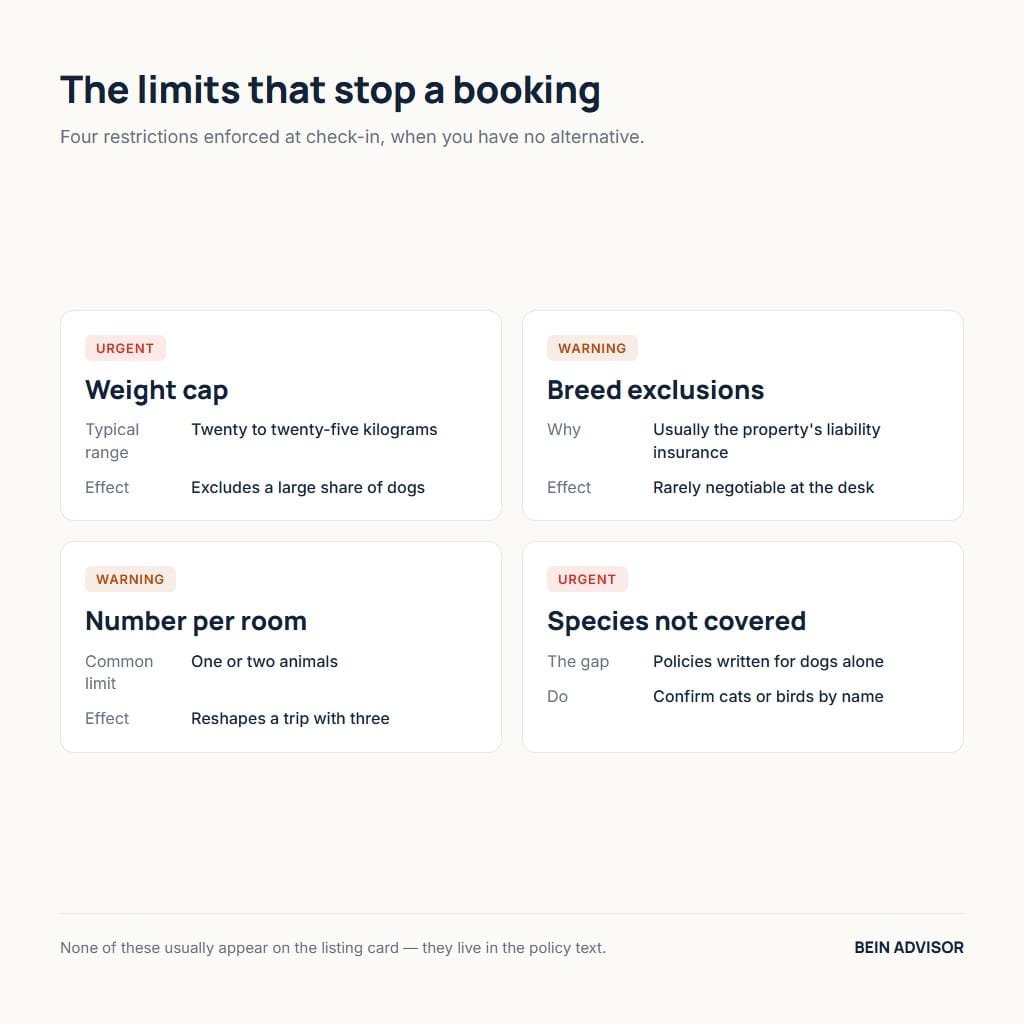
Restrictions are the second place bookings fail, and they are rarely visible on the search card. A property may accept animals in principle while excluding yours in particular. Weight caps, breed lists, counts per room and species limits all appear routinely. Moreover, these rules are enforced at check-in, when you have already travelled and have no realistic alternative. The traveller with a thirty-kilogram dog and a twenty-kilogram cap is not negotiating from strength. Reading the restriction list is therefore more urgent than reading the fee.
3.1 Weight, Breed and Number Caps
Weight caps are the most common single restriction. They are set in kilograms or pounds and applied strictly, because they exist to limit the size of animal moving through public areas. A cap in the region of twenty to twenty-five kilograms excludes a large proportion of dogs. In addition, many properties limit the number of animals per room to one or two, which reshapes the trip for anyone travelling with three. Neither limit is usually stated on the listing card; both live in the policy text underneath.
Breed restrictions are more variable and more contentious. Some properties exclude specific breeds outright, often following the terms of their own liability insurance rather than any judgement about your particular animal. That distinction is worth understanding, because it explains why the answer is so rarely negotiable at the desk. Furthermore, species matter: a policy written for dogs may not cover cats, birds or rabbits at all. If your animal is not a dog, confirm it by name rather than assuming the category includes you.
3.2 Where the Animal May and May Not Go
Access rules shape the day far more than most travellers expect. Restaurants, breakfast rooms, spas and pools exclude animals almost universally, and food-safety rules rather than preference drive that. Lifts and lobbies vary by property. Some ask that dogs cross public areas only at quiet hours; others have no restriction at all. As a result, a hotel that is technically open to your dog can still leave you eating every meal separately from your travelling companion.
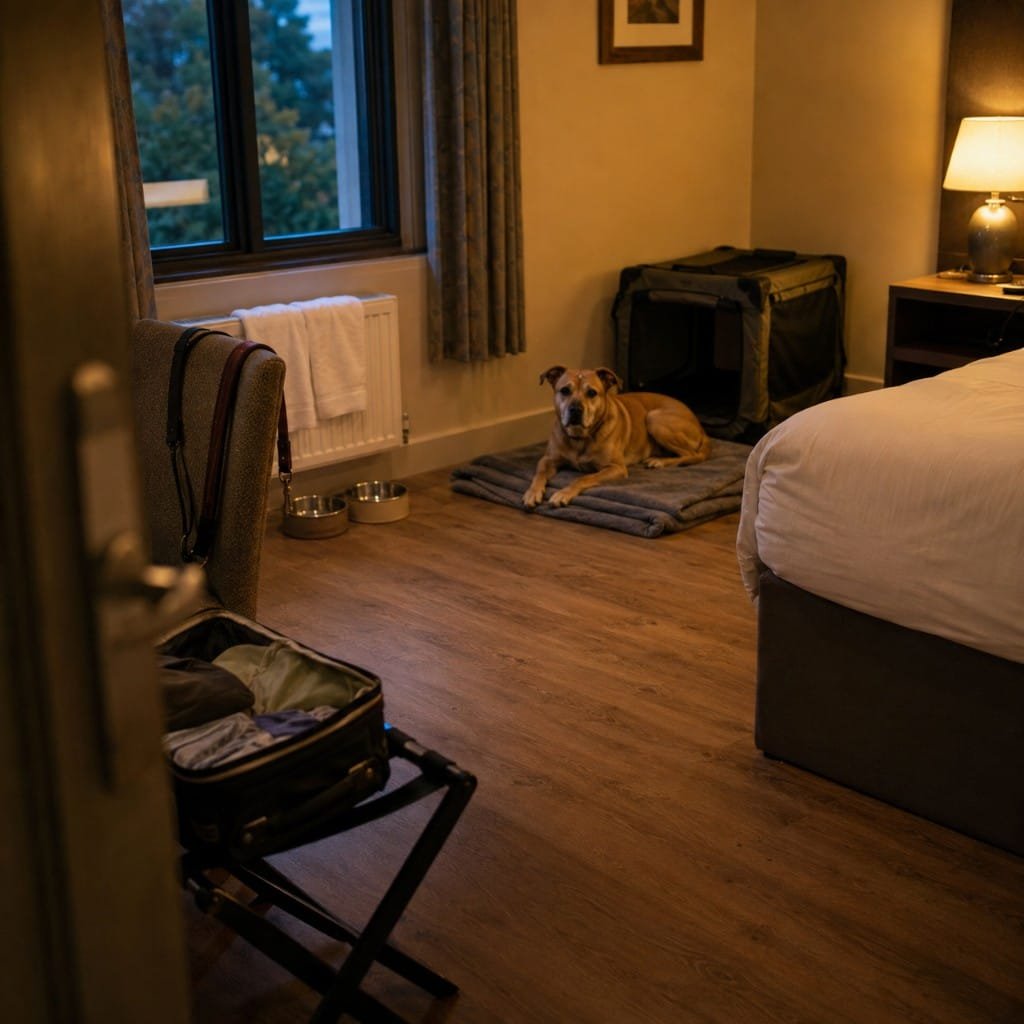
The rule that catches people hardest concerns leaving the animal alone. Many properties forbid it entirely, and a good number require a crate if it is permitted at all. That single line determines whether you can go out for dinner, take a tour, or spend a day away from the room. Therefore it belongs at the top of your questions rather than the bottom. Suppose the answer is no and your plans assume otherwise. The property is then wrong for this trip, however good the rest of the policy looks.
4. How to Verify Pet Friendly Hotels Before You Pay
Verification is a short, mechanical process, and it is the single highest-value step in the whole booking. The goal is to convert assumptions into written statements from the property itself. Written matters: a phone call leaves you with nothing to show a different staff member at check-in three weeks later. Additionally, writing forces the property to answer the specific question rather than the general one. Ten minutes of messaging removes almost every failure mode described in this article.
4.1 Reading the Policy Rather Than the Listing
Every booking platform carries a house-rules section beneath the photographs and the reviews. That section, not the badge, is the contract. It states the fee, the caps, the room types available and the supervision rule. Read it in full before comparing prices, because a cheaper property with a lower weight cap is not actually an option for you. In contrast, a property that costs slightly more but takes two large dogs without restriction may be the only real candidate on the page.
Cross-check the platform text against the property’s own website. Discrepancies are common, usually because one of the two has not been updated. Where they disagree, treat the stricter version as the one you will meet at the desk and confirm it directly. Meanwhile, note that third-party and direct bookings sometimes carry different pet terms entirely. Booking direct occasionally unlocks a room type the platform never lists, and that is worth one email to find out.
4.2 The Questions to Send Pet Friendly Hotels in Writing
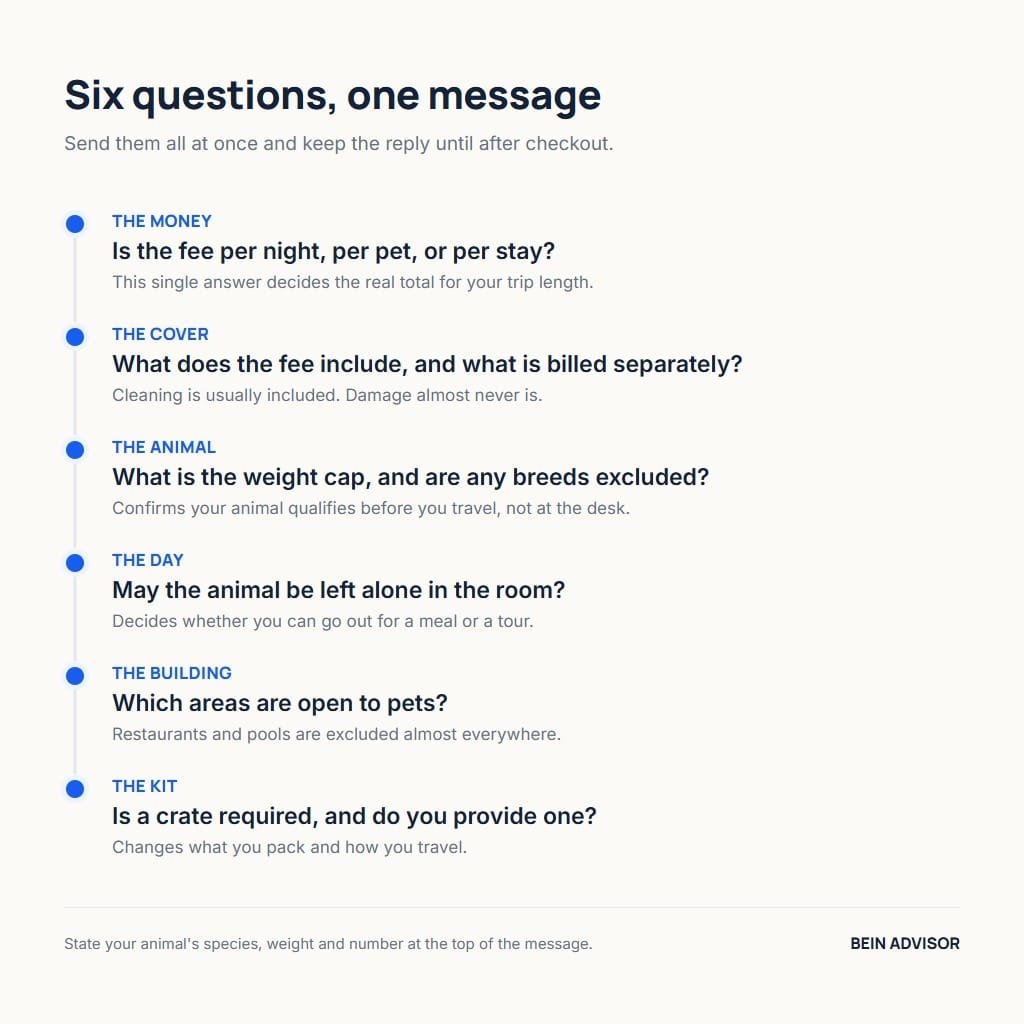
Send one message containing every question at once. A single reply then becomes your record, and you avoid a slow exchange that stalls the booking. State your animal’s species, weight and number plainly at the top, because a vague enquiry produces a vague answer. For instance, “we have one twenty-eight-kilogram labrador” gets a usable reply where “we have a dog” does not. The table below lists the questions that matter, and the reason each one earns its place.
| Ask this | Why it matters |
|---|---|
| Is the fee per night, per pet, or per stay? | Decides the real total for your trip length |
| What does the fee cover, and what is billed separately? | Separates cleaning from damage liability |
| What is the weight cap, and are any breeds excluded? | Confirms your animal qualifies at all |
| May the animal be left alone in the room? | Determines whether you can leave for meals or tours |
| Which areas are open to pets? | Shapes the daily routine more than any other rule |
| Is a crate required, and do you provide one? | Affects what you pack and how you travel |
5. Choosing Pet Friendly Hotels for the Trip You Are Taking
The right property depends on the shape of the journey rather than on any general ranking. A single overnight on a long drive asks for something completely different from a week in a city. Location, room type and ground access matter in different proportions in each case. Consequently, a property that suits one trip perfectly can be an awkward choice for the next. Deciding what the trip actually demands, before opening any search, saves more time than filtering ever will.
5.1 City Stays Against Road Trips
On a road trip the priorities are simple: quick parking, a ground-floor room, and grass within sight of the door. Nobody wants a long corridor and two lifts at eleven at night with a restless dog. Roadside properties tend to serve this well and price it modestly. In addition, they usually place pet rooms near an exterior door by design. What reads like a limitation turns into an advantage.
City stays invert almost all of that. Here the deciding factor is what sits within a short walk: a park, a quiet street for early mornings, and cafés with outdoor seating. A room three floors up matters far less than a green space two minutes away. Similarly, noise becomes a real consideration, since a dog that reacts to corridor traffic will not settle in a busy property. Ask which floor pet rooms sit on and how close they are to the lift.
5.2 Matching the Room to Your Animal
An anxious animal needs a room it can retreat into. In practice that means space for a crate and a corner away from the door. A confident older dog may need nothing more than a quiet floor. Cats have a separate set of requirements again, and many properties that accept dogs do not accept them. For instance, a cat needs somewhere secure for a litter tray. An unfamiliar room with a balcony is a hazard rather than a feature.
Think about the room as your animal will experience it rather than as the photographs present it. Hard floors are easier to clean and less likely to hold odour, which can matter for a deposit. Meanwhile, a room facing an internal courtyard is usually quieter than one facing a street. Does your animal already struggle at home with unfamiliar noise? Our article on managing a multi-cat household calmly covers settling techniques that transfer straight to a hotel room.
6. Getting the Best Results From Pet Friendly Hotels
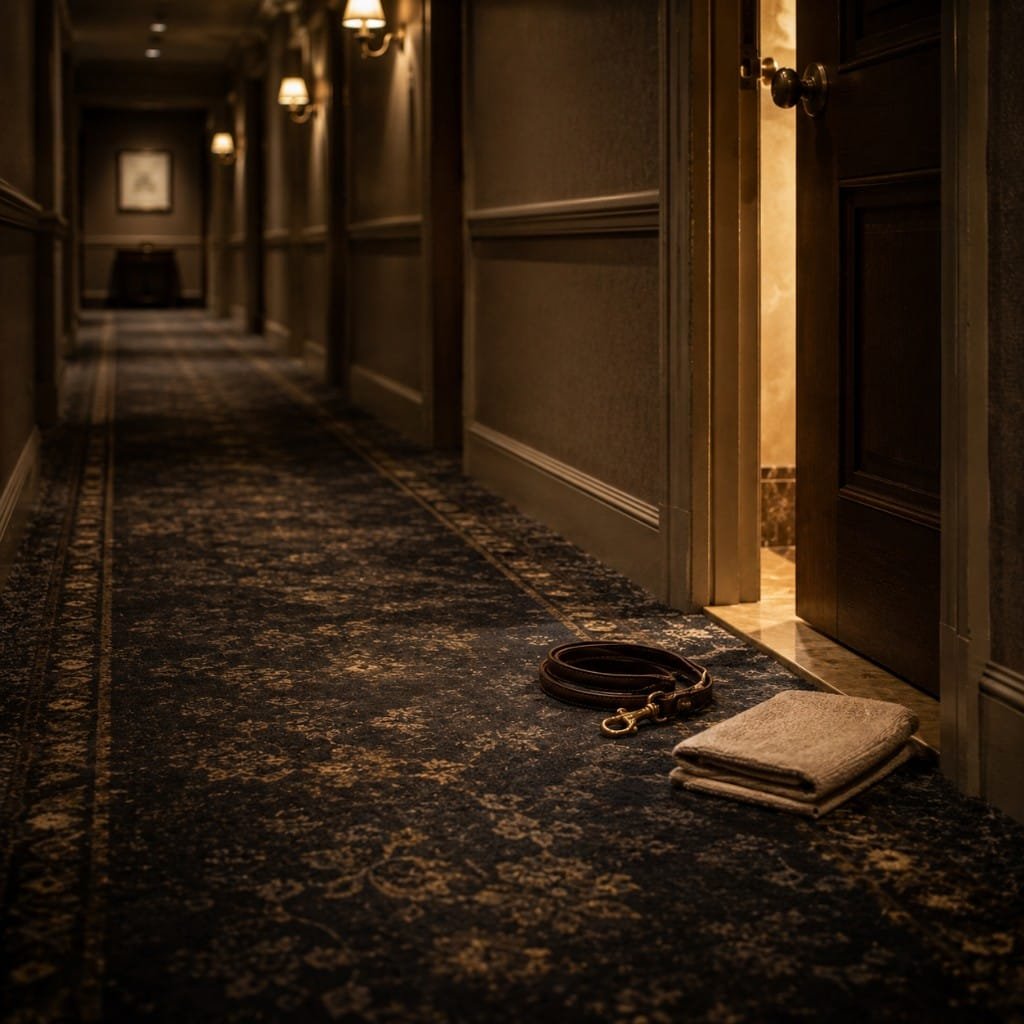
A good stay is mostly decided in the first hour and the last. Arrival sets whether the animal settles, and departure decides whether the deposit comes back. Neither takes long, and both reward a small amount of preparation done before you leave home. Furthermore, the habits below travel with you to every future booking, which makes them worth building once. Properties remember guests who leave rooms in good order, and the difference shows in how flexible they are next time.
6.1 What to Pack and Set Up on Arrival
Bring the animal’s own bedding, bowls and a familiar toy. Scent does more to settle a dog in a strange room than anything the property can supply. A crate earns its space in the car for the same reason, and it satisfies the supervision rule at properties that require one. In addition, pack a roll of waste bags, a towel for wet paws, and enough food for the trip plus one day. Sudden food changes on the road cause exactly the mess you are trying to avoid.
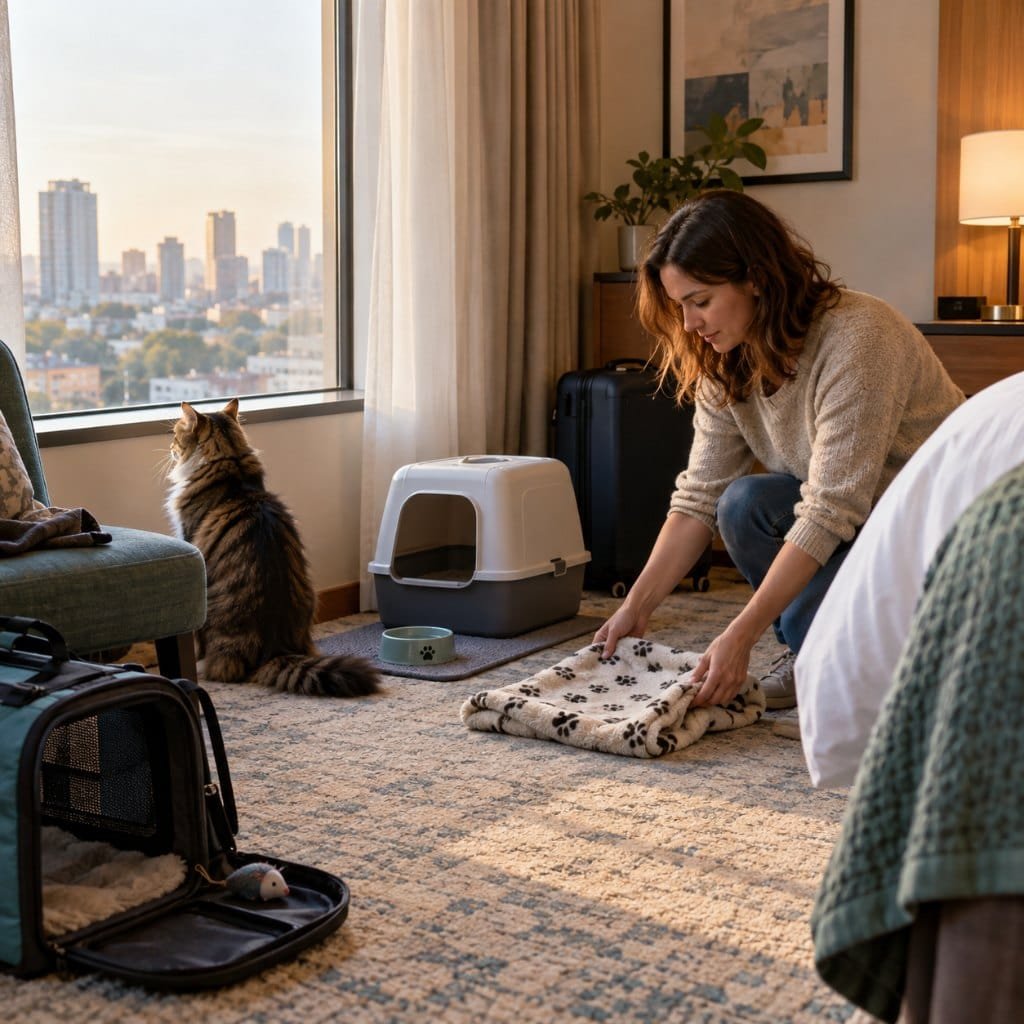
Set the room up before you unpack yourself. Put the bed in a corner away from the door, the bowls on a hard surface, and the crate where the animal can see you. Walk the dog before going up rather than after, so the first experience of the room is rest instead of restlessness. Meanwhile, note where the nearest exit is. You will want it at six in the morning. A pet camera pointed at the room also helps at properties that allow an animal to be left. Animal-welfare bodies including the ASPCA travel safety guidance also recommend carrying vaccination records, which some properties ask to see.
6.2 Leaving Without a Complaint or a Charge
Hair is the single most common source of a cleaning dispute, and it is the easiest to fix. Run a rubber brush or a lint roller over soft furnishings before you leave. Check under the bed and along the skirting, where shed hair collects out of sight. Additionally, report any damage yourself at the desk rather than leaving it to be found. Owners who declare a problem are treated very differently from those whose problem is discovered after checkout.
Keep the written policy reply until the final charge has cleared your account. If a fee appears that the property never mentioned, that message is the whole of your case. For instance, a per-stay fee billed per night is easy to correct with the reply in hand. Without it, the same error is nearly impossible to argue. Ultimately the record you built at booking is what protects you at the end. That is why the ten minutes spent on it pays twice.
Pet Friendly Hotels FAQ
Do pet friendly hotels allow cats as well as dogs?
Often, but never assume it. Many policies are written for dogs alone and say nothing about other species. Confirm cats by name in writing, and ask specifically where a litter tray may go. A property that hesitates on that question is telling you something useful.
Can I leave my dog alone in the room?
It depends entirely on the property, and a large number forbid it outright. Where it is allowed, a crate is frequently required. Ask before booking rather than at check-in, because the answer decides whether your plans for the trip are possible at all.
Is a deposit better than a fee?
Usually yes, provided your animal is settled and the room comes back undamaged. A deposit is returned; a fee never is. However, a deposit ties up money during the trip, which matters if the amount is large relative to your budget.
Practical Pet-Travel Supplies for a Hotel Stay
Disclosure: This section contains affiliate links. If you buy through them, BeIN ADVISOR may earn a commission at no extra cost to you.
These Amazon options can help you prepare before arrival. Check the fit for your animal, read the manufacturer’s instructions, and remember that no product replaces the hotel’s written policy or direct supervision.
Henkelion Pet Carrier: The product title describes a collapsible carrier for small or medium cats and dogs up to 15 pounds. Confirm your animal’s weight and the carrier dimensions before booking, because hotel acceptance does not guarantee a suitable fit.

Two-Pack Silicone Travel Bowls: The product title describes two collapsible bowls for food and water with carabiners. A familiar bowl can make a hotel routine easier, but wash it before use and check that its capacity suits your animal.

Sherpa Original Deluxe: The product title describes a medium pet carrier marketed as airline approved. Check the airline, hotel, and animal-size requirements before relying on it, because policies and measurements differ.

Conclusion: Pet Friendly Hotels Reward the Reader Who Checks
The phrase on the listing is a starting point, not an answer. Pet friendly hotels differ on fees, caps, access and supervision, and every one of those differences is written down somewhere you can read before paying. The traveller who opens the house rules and sends six questions in a single message removes almost all of the risk. Meanwhile, the one who trusts the badge finds out at the desk, when there is nothing left to do about it.
Build the habit once and it costs nothing thereafter. Read the policy, ask the six questions, keep the reply, and pack the animal’s own bedding. Do that and pet friendly hotels stop being a gamble and become an ordinary part of planning a trip. Your next journey with an animal should feel like any other journey. Book it with confidence, and remember it for the destination.