
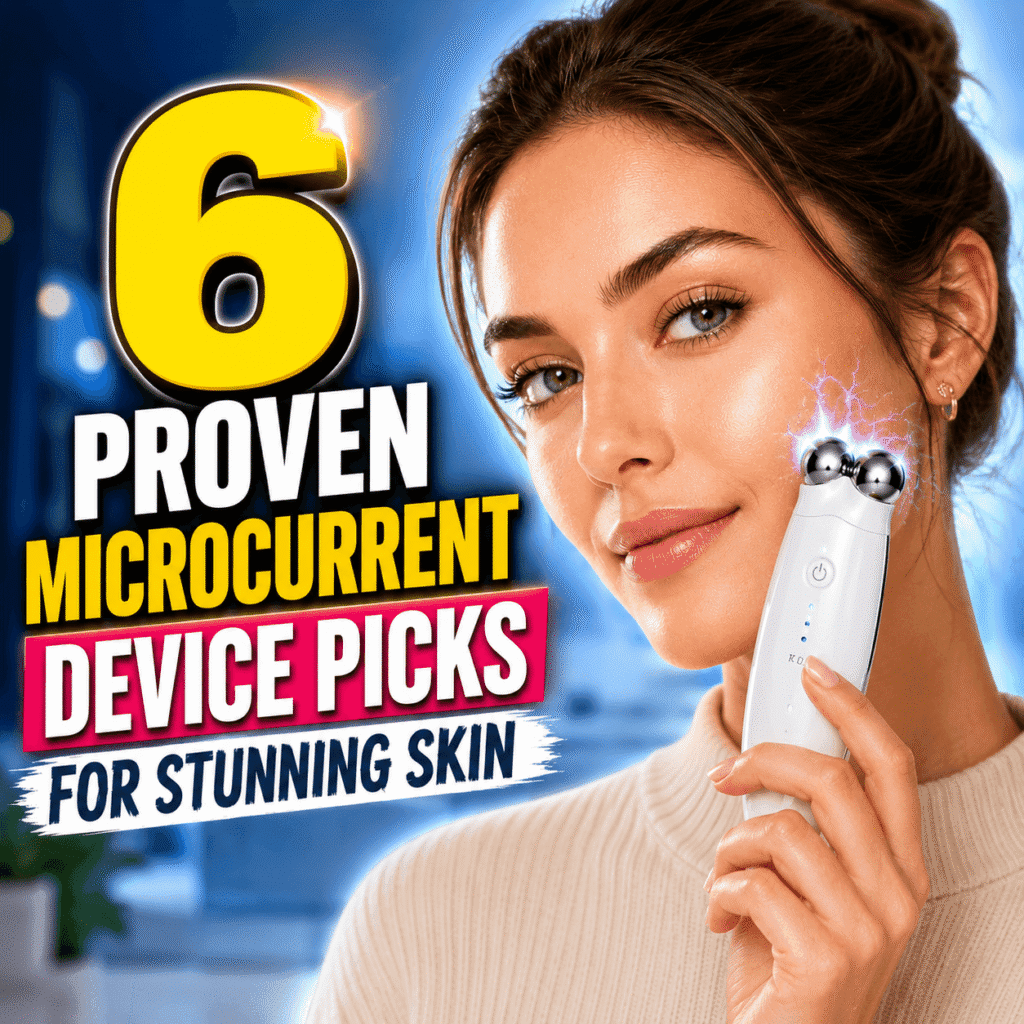
Fine lines, sagging contours, and a gradual loss of facial definition signal that the muscles beneath the skin have weakened over time. For those who prefer a non-invasive approach, a microcurrent device offers a clinically supported path to visible lifting — without needles, surgery, or recovery time. By delivering low-level electrical pulses that mirror the body’s own bioelectric signals, a microcurrent device activates facial muscles, increases adenosine triphosphate (ATP) production, and stimulates collagen synthesis at the cellular level.
Clinical studies confirm that consistent use of a microcurrent device improves facial contour, reduces fine lines, and restores lift in the jaw, brow, and cheekbones within four to six weeks. Originally developed in physical therapy to treat facial paralysis, this technology has since moved into professional aesthetics clinics and, with FDA clearance, into consumer-grade home devices that deliver measurable results on a daily schedule.
This guide reviews six of the most effective options on the market, assessing each for current output, electrode design, companion products, ease of use, and overall value. By the end, you will have a clear framework for choosing the microcurrent device best matched to your skin goals and budget.
1. How a Microcurrent Device Works
A microcurrent device generates electrical pulses measured in microamperes — too subtle to perceive, yet powerful enough to interact with the body’s cellular environment. These pulses work through two primary mechanisms that together produce the lifting and firming effects the technology is known for.
1.1 Muscle Re-education Through Microcurrent Stimulation
Facial muscles attach directly to the overlying skin, so when those muscles weaken with age, the skin loses its structural support and begins to descend. A microcurrent device delivers precisely timed electrical pulses that cause each targeted muscle to contract and relax in a controlled sequence — effectively a passive workout for facial musculature. Over repeated sessions, the muscles retain a lifted position, and the skin above them appears firmer and more defined. This principle applies the same logic as resistance training for body muscles: progressive stimulation builds and sustains tone.
1.2 ATP Production and Collagen Renewal
Research published in peer-reviewed dermatology journals has demonstrated that microcurrent stimulation increases ATP synthesis by up to 500 percent in treated tissue. Elevated ATP levels accelerate protein synthesis, boost collagen and elastin production, and speed cellular repair — the same processes that give youthful skin its elasticity and resilience. When a microcurrent device is used consistently, this cellular energy advantage compounds session by session, producing the visible smoothing and plumping that regular users report after four to eight weeks of treatment.
2. Key Criteria for Selecting a Microcurrent Device
Technical variables — not marketing language — determine how much lift a device actually delivers. Four criteria separate effective tools from cosmetically positioned gadgets, and understanding them makes side-by-side comparison straightforward.
2.1 Technical Evaluation Criteria
| Criterion | Why It Matters | What to Look For |
|---|---|---|
| Current output | Determines depth of muscle activation | 200–400 µA for facial use |
| Waveform type | Affects current distribution through tissue | Biphasic preferred for safety and balance |
| Electrode design | Coverage area and precision of contact | Two-point probes for deeper reach |
| Companion gel | Required conductivity medium for full current delivery | Proprietary gels outperform generic alternatives |
| Frequency settings | Allows customization by skin concern | Multiple levels for lifting vs. firming goals |
2.2 Consumer vs. Professional Grade
Professional devices used in aesthetics clinics operate at 600–800 µA with programmable multi-channel outputs targeting individual muscle groups. Consumer devices work at lower intensities to comply with safety regulations, but the best models compensate with optimized waveforms, precision electrode placement, and clinical-grade gels. A consumer microcurrent device used three to five times per week on a structured schedule produces lifting results comparable to monthly professional sessions — at a significantly lower cost per treatment.
As an Amazon Associate, BeIN ADVISOR earns from qualifying purchases.
3. NuFACE Trinity Pro: The Benchmark Microcurrent Device
NuFACE established the consumer microcurrent device category, and the Trinity Pro remains its most comprehensive offering. The device operates at up to 335 µA using FDA-cleared biphasic current and a modular design that accepts interchangeable attachment heads — including the standard ELE attachment for face and neck, plus optional add-ons for eye treatment and advanced firming protocols.
3.1 Clinical Performance and Electrode Advantage
An independent clinical study found that 85 percent of Trinity Pro users reported visible facial contour improvement after 60 days of consistent use. The flat, dual-head ELE attachment maintains reliable contact across the curved surfaces of the jaw, brow, and cheeks — a technical advantage over spherical single-point probes that risk losing conductivity on rounded facial contours. The Trinity Pro pairs with NuFACE Aqua Gel, a hyaluronic acid-based conductor that maximizes current penetration during each session.
3.2 Protocol and Long-Term Value
The recommended protocol calls for five-minute sessions five days per week during the first 60 days, followed by a maintenance schedule of two to three sessions per week. Because the Trinity accepts expansion attachments sold separately, users can evolve their routine without replacing the base unit — making this the most cost-effective long-term investment in the microcurrent device category for users committed to ongoing at-home facial care. It suits users with early to moderate volume loss who want a versatile tool that adapts as skin concerns change over time.
4. NuFACE Mini: A Compact Microcurrent Device for Precision Lifting
The NuFACE Mini delivers the same FDA-cleared microcurrent technology as the Trinity in a smaller, single-piece design with a fixed spherical head. Its compact form is purpose-built for targeting defined contours — the jawline, cheekbones, and brow arch — where precise placement matters more than broad surface coverage.
4.1 Practical Advantages for Daily Use
The Mini’s rechargeable battery delivers up to 30 hours of use between charges, making it the most travel-ready option in the NuFACE range. Its reduced size fits in any toiletry bag without requiring a wall outlet during treatment. At 200 µA, the current output is sufficient for maintenance lifting and early-stage facial tone improvement in users who supplement with occasional professional treatments or who are new to the technology.
4.2 Limitations to Consider
The Mini cannot accept interchangeable heads, which limits its precision for fine periorbital lines or deep submental areas. Its fixed output also reduces usefulness for users with significant volume loss, where higher current intensity produces better results. The NuFACE Mini is best understood as an entry point for users new to microcurrent treatment, or as a portable companion for Trinity users who want to maintain results while traveling.
5. CurrentBody Skin: A Research-Validated Microcurrent Device
CurrentBody Skin entered the market with a direct clinical validation strategy, submitting its device to peer-reviewed testing before broad commercial release. The trial, published in the Journal of Cosmetic Dermatology, documented significant improvements in skin firmness and hydration at eight weeks — the most independent clinical comparison to NuFACE available in published literature.
5.1 Technology and Current Delivery
CurrentBody Skin uses two gold-plated spherical electrodes to deliver consistent biphasic current across the face and neck, with three adjustable intensity levels that allow gradual progression as the skin adapts to treatment. At maximum output, the current intensity is comparable to the NuFACE Trinity, providing lifting stimulation on par with the category leader. The device pairs with CurrentBody Conductive Gel, a hybrid aloe vera and hyaluronic acid formula that provides conductivity while delivering a light skin-care benefit during each session.
5.2 Value and Trade-offs
CurrentBody Skin typically retails below the NuFACE Trinity Pro price point, making it the strongest value proposition for users seeking peer-reviewed performance without a premium attachment ecosystem. The main trade-off is the absence of expansion heads — unlike the Trinity, there are no optional attachments for specialized treatment areas. For users who want one validated microcurrent device that reliably covers face and neck without ongoing accessory investment, CurrentBody Skin represents a compelling, evidence-backed alternative to the NuFACE lineup.
6. FOREO Bear and ZIIP HALO: Smart Microcurrent Device Formats
The final two devices pair microcurrent technology with digital connectivity and multi-frequency approaches, targeting users who want a guided or technologically enriched treatment experience.
6.1 FOREO Bear: App-Guided Microcurrent
The FOREO Bear delivers alternating T-Sonic microcurrents via two gold electrodes and connects to the FOREO app, which provides structured treatment programs designed around 69 individual facial muscles. The device’s anti-shock system monitors skin resistance in real time and adjusts current output to prevent discomfort as the electrodes move between muscle groups. In clinical testing, 80 percent of Bear users reported visible lifting at eight weeks. The FOREO Bear is the most guided microcurrent device in this review and suits users who prefer structured, app-assisted routines rather than self-directed protocols.
6.2 ZIIP HALO: Multi-Current Microcurrent Device Technology
The ZIIP HALO combines nano current, microcurrent, and femtocurrent in a single handset, treating different tissue depths in one session. Its companion app delivers categorized programs for lifting, brightening, calming, and energizing, enabling a broader range of skin goals than a standard microcurrent device can address. The HALO is best suited to experienced users managing complex concerns — such as simultaneous volume loss and hyperpigmentation — who want multi-current versatility beyond basic facial lifting. Its higher price reflects that expanded capability.
7. Full Comparison: Microcurrent Device Side by Side
| Device | FDA Cleared | Max Output | App Guided | Expandable | Best For |
|---|---|---|---|---|---|
| NuFACE Trinity Pro | Yes | 335 µA | No | Yes | Complete modular treatment |
| NuFACE Mini | Yes | 200 µA | No | No | Travel and entry-level use |
| CurrentBody Skin | Yes | ~300 µA | No | No | Value-focused, research-backed |
| FOREO Bear | Yes | Variable | Yes | No | Guided routines, tech users |
| ZIIP HALO | Yes | Multi-current | Yes | No | Complex, multi-concern treatment |
Select the device that matches your commitment level, budget, and how much guidance you want during treatment. A straightforward microcurrent device used consistently will always deliver better outcomes than a sophisticated model used irregularly.
Conclusion: Which Microcurrent Device Is Right for You
A microcurrent device is among the most evidence-backed tools available for at-home facial lifting and firming. The six options reviewed here span entry-level accessibility to advanced multi-current technology, but all share a clinically supported foundation: consistent use produces measurable improvement in facial muscle tone, skin texture, and contour.
The NuFACE Trinity Pro remains the most versatile and expandable choice for users committed to a long-term home treatment system. CurrentBody Skin delivers peer-reviewed performance at a competitive price. FOREO Bear and ZIIP HALO reward users who want guided, technology-enriched protocols for complex skin goals. Whatever model you select, commit to the recommended schedule for a full 60 days — consistent use is what transforms any microcurrent device from an interesting tool into a measurable skin investment.