
An AC cleaning business sells a job that comes back. Filters clog again, coils collect dust again, and drain lines slow down again. However, the work happens inside a stranger’s home, above their bed, and next to live wiring. The customer is paying for clean coils, and also for a technician who shows up on time and leaves no water mark on the wall.
Two decisions shape everything else. The first is scope: where cleaning ends and licensed repair begins. The second is price: what one visit costs you once travel, setup, and cleanup are counted. Settle both before the first advert. As a result, an AC cleaning business avoids two common ways to lose money: damaged equipment and underpriced visits.
An AC cleaning business earns its money in a set order. Repeat visits come first, then local customers and the price. The legal line, the visit itself, the kit, the claims you can make, and the slow season follow. None of these rules promises an income. In most markets demand rises with the heat and falls after it, and your plan has to survive both.
Rule 1: Why an AC Cleaning Business Runs on Repeat Visits
The first visit to a new customer is the expensive one. For example, you paid for the advert or the flyer, you drove to an address you did not know, and you spent extra time learning the layout. In contrast, the second visit to the same home costs none of that. Therefore, the customer list is the real asset of an AC cleaning business, more than the sprayer or the van.
Maintenance guidance supports the repeat cycle. The U.S. Department of Energy says in its home cooling guide that annual maintenance can help improve comfort and the efficiency of an air conditioner. Additionally, it advises owners to check the evaporator coil every year and clean it as necessary. It also says that routinely replacing or cleaning filters can lower an air conditioner’s energy consumption by 5 to 15 percent. However, that figure belongs to filters alone, so quote it as written and do not turn it into a promise about anyone’s bill.
Book the next visit before you leave the home. A date agreed at the door costs nothing, while a lapsed customer has to be won again. For example, a household with three units can sign a yearly plan with a fixed number of visits at a known price. As a result, the customer gets a predictable cost, and you get work in the months when new enquiries slow down.
An AC cleaning business also grows through referrals inside one building. For example, a neighbour who watched a tidy job on the same floor already knows your face and your work. Therefore, ask each satisfied customer for one introduction, and thank them when it leads to a booking.
Rule 2: Find Local Customers for Your AC Cleaning Business
Customers open their homes to people they know, or to people a neighbour has tried. Therefore, start with your own building and street. The U.S. Small Business Administration also notes that market research helps you find customers, while competitive analysis helps you make a business unique. For example, call three local providers, ask what their visit includes, and note what they leave vague. Then make your own offer clearer on exactly those points.
List your AC cleaning business on local map and directory pages, with the districts you cover and your working hours. People who need this service usually search with the name of their town or area. In addition, reply to every message the same day. A household with a dripping or musty unit will often call the next provider instead of waiting. Additionally, use real photos from your own jobs, and ask each homeowner for permission first.

Group visits by district. Three jobs in one area use less fuel and time than three jobs across town. For instance, you can assign each district a weekday and offer that day first. Additionally, offices, clinics, and building managers are a second market for an AC cleaning business. They have many units and want invoices and off-hours appointments. Our dog walking business guide covers the same route discipline for another service that travels to the customer.
Rule 3: Price the Whole Visit, Not Only the Wash
An AC cleaning business that prices on washing time alone leaves most of its costs out of the price. Count the whole visit: travel both ways, setup and sheeting, the wash, and the cleanup. In addition, count cleaner, fuel, and a share of the gear that wears out. The U.S. Small Business Administration notes that calculating startup costs helps you estimate profits and conduct a break-even analysis. The table below uses plain cost points to show the method. It does not describe any real market.
| Cost line | Illustrative points | Note |
|---|---|---|
| Technician time, travel included | 10 | Largest line; grows with distance |
| Fuel and transport | 3 | Falls when visits are grouped by area |
| Cleaner and consumables | 2 | Depends on the state of the unit |
| Wear on covers, sheets, and hoses | 2 | Gear that is replaced over time |
| Payment fees and advertising | 1 | Varies by channel |
| Total per visit | 18 | Cost of one visit in this example |
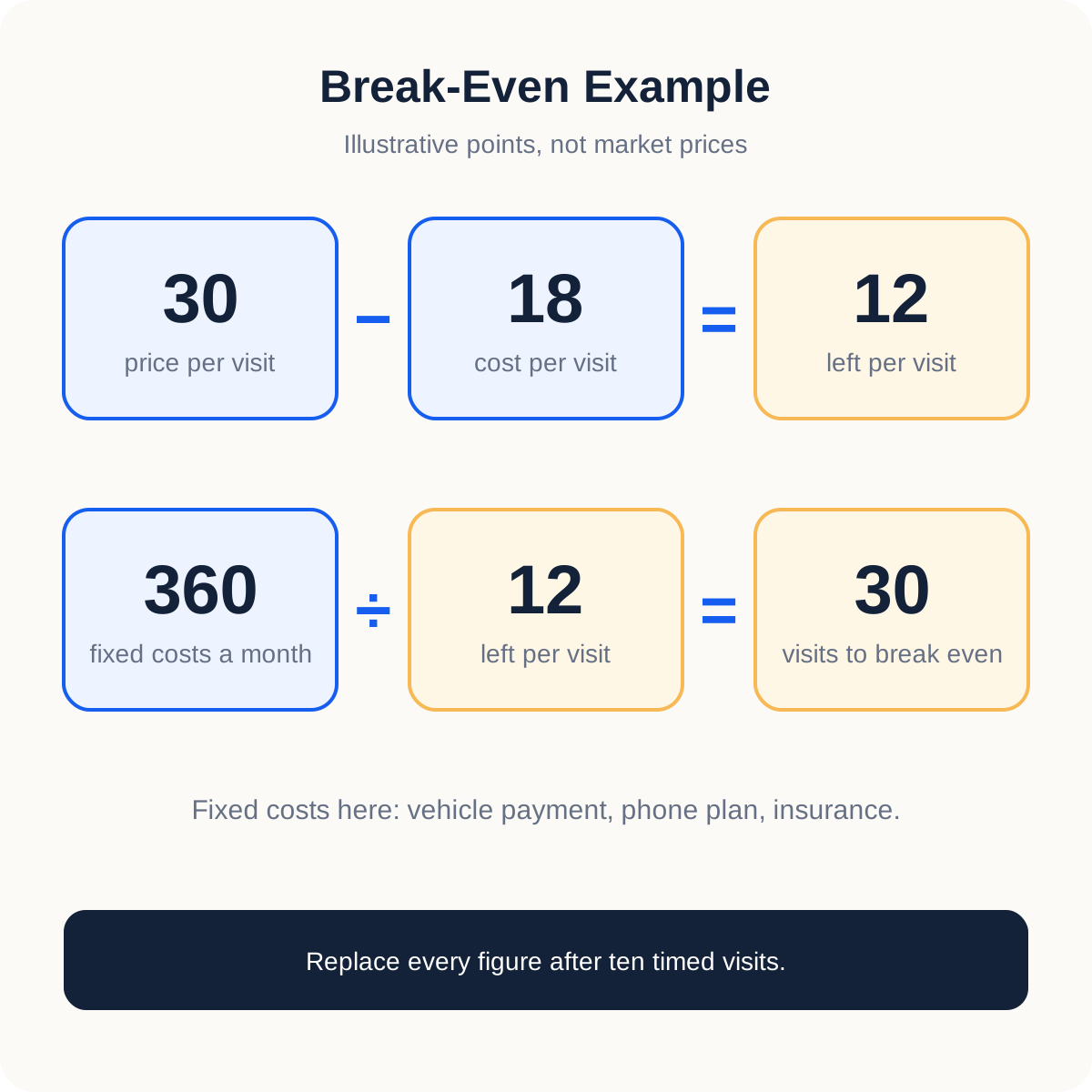
In this example, one visit costs 18 points. At a price of 30 points, each visit leaves 12 points before fixed costs. If fixed costs such as a vehicle payment, a phone plan, and insurance come to 360 points a month, 30 visits cover them. Replace every figure with your own after you have timed ten real visits. For a fuller method, see our feasibility study guide.
Ask three questions before you quote. How many units are there? When were they last cleaned? Where is the outdoor unit? For example, a unit left untouched for years takes longer than one cleaned every season. Similarly, an outdoor unit on an open roof is a different job from one in a tight corner. Therefore, put the price in writing with what it covers and what it leaves out. A written scope heads off most arguments at the door.
Review prices after every season. An AC cleaning business that records travel and working time for each visit can see which districts pay and which do not. Consequently, the next price list rests on your own records.
Rule 4: Know the Line Between Cleaning and Refrigerant Work
Cleaning does not open the refrigerant circuit, and repair often does. In the United States, the EPA’s Section 608 certification page states that technicians who maintain, service, repair, or dispose of equipment that could release refrigerants into the atmosphere must be certified. The page names the activities that count. For example, it lists attaching and detaching hoses and gauges to measure pressure, and adding or removing refrigerant. In addition, it lists four certificate types, from small appliances to a universal certificate, and says the credentials do not expire.
Other countries set their own rules for refrigerant handling and electrical work. Therefore, ask the licensing body where you operate before you advertise anything beyond washing. Meanwhile, until you hold the right licence, state in writing that your AC cleaning business offers cleaning only. If you notice weak cooling, ice on the pipes, or an oily stain at a joint, record it for the customer and recommend a licensed repair technician. The Department of Energy guide treats a refrigerant leak as a job for a professional.
Electrical safety is your job even on a cleaning-only visit. Switch the unit off at the breaker before you open the cover, because the remote control does not isolate the power. In addition, shield the control board of the indoor unit before any water is sprayed. A wet board can fail, and a replacement can cost more than you earn from several visits. Similarly, decline an outdoor unit that you cannot reach safely, and clean the indoor unit alone.
Rule 5: What a Standard Cleaning Visit Includes
A written visit standard keeps every job the same across an AC cleaning business. In addition, it gives the customer something to check. The Department of Energy guide names the parts that need attention: filters, the evaporator coil, the coil fins, and the drain channels. For example, it notes that a clogged filter restricts airflow through the unit. Additionally, it suggests a fin comb for bent fins and a stiff wire for drain channels. Therefore, your standard can follow the same parts in a fixed order.
| Part | What you do | Why it is on the list |
|---|---|---|
| Filters | Remove, wash, dry, refit | A clogged filter restricts airflow |
| Evaporator coil | Brush off loose dust, then rinse at low pressure | The guide advises a yearly check and cleaning as necessary |
| Coil fins | Straighten bent fins with a fin comb | Bent fins block the path of the air |
| Drain channel and pan | Clear and flush | A blocked drain can let water drip indoors |
| Outdoor unit | Clear debris and rinse the coil | Debris on the outdoor coil blocks airflow; only where access is safe |
| Work area | Wipe, vacuum, and remove covers | The room is left as it was found |
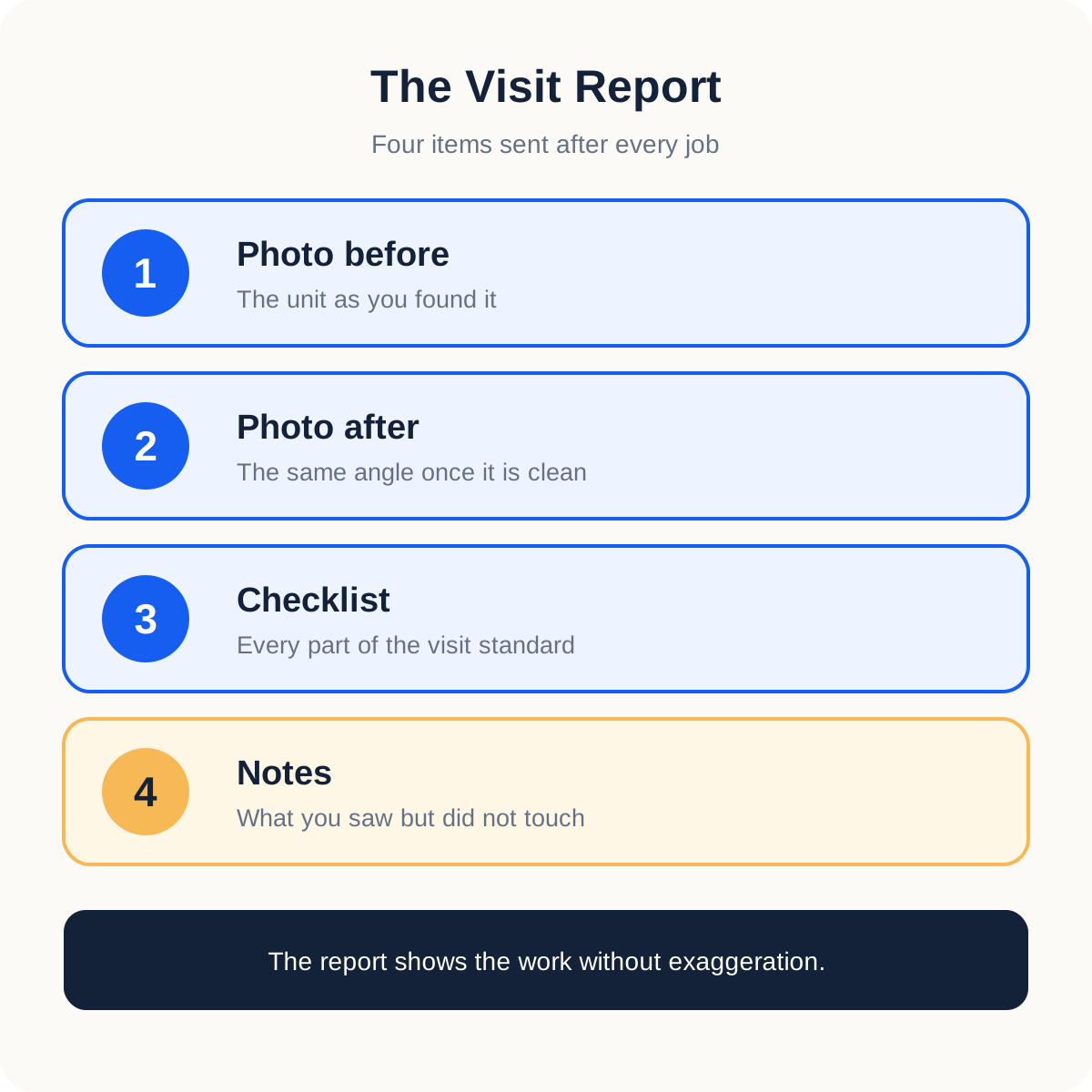
Finish each visit with a short report. Take one photo before the wash and one after, and send both with the checklist. In addition, write down anything you saw but did not touch, such as a cracked drain pan or a loose bracket. The photos show the work, so you do not have to describe it. As a result, the customer has a record to compare at the next visit, and you have evidence if a dispute arises.
Rule 6: Build a Starter Kit That Protects the Home
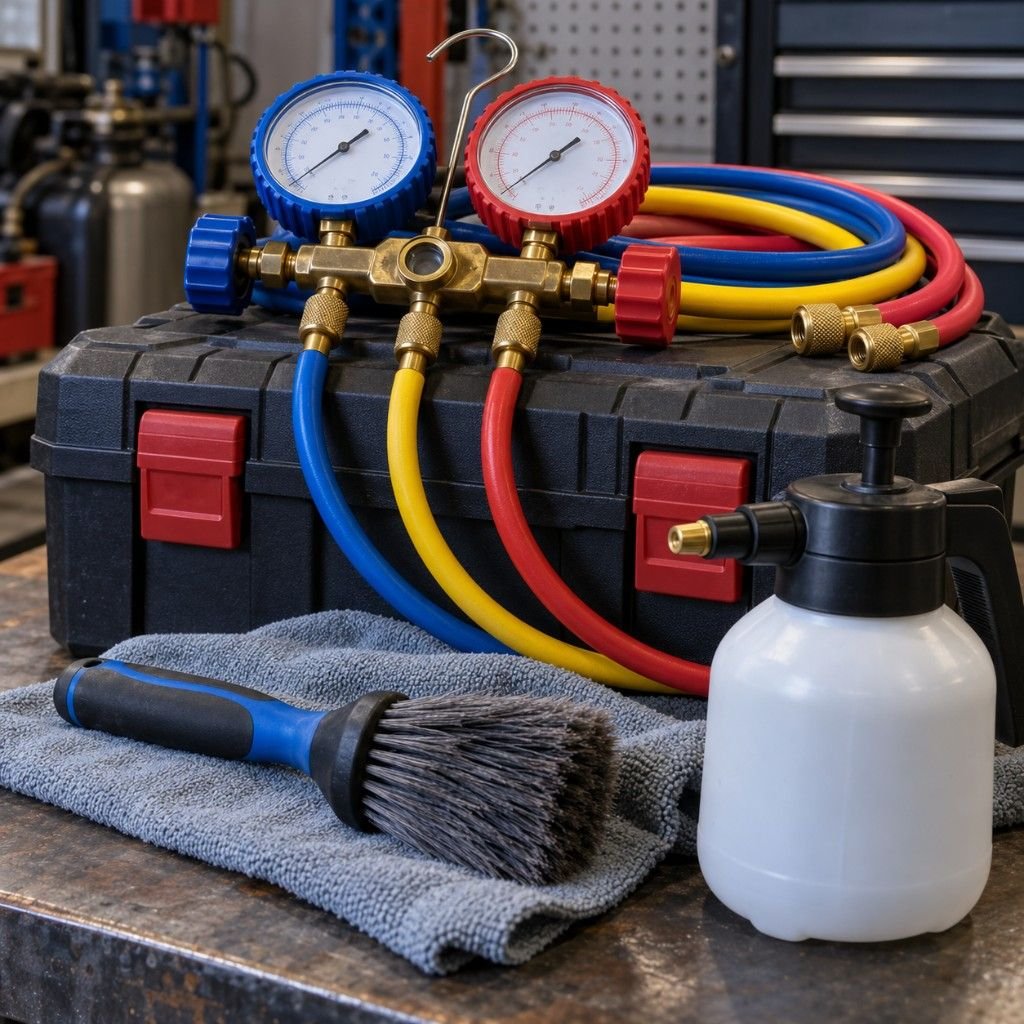
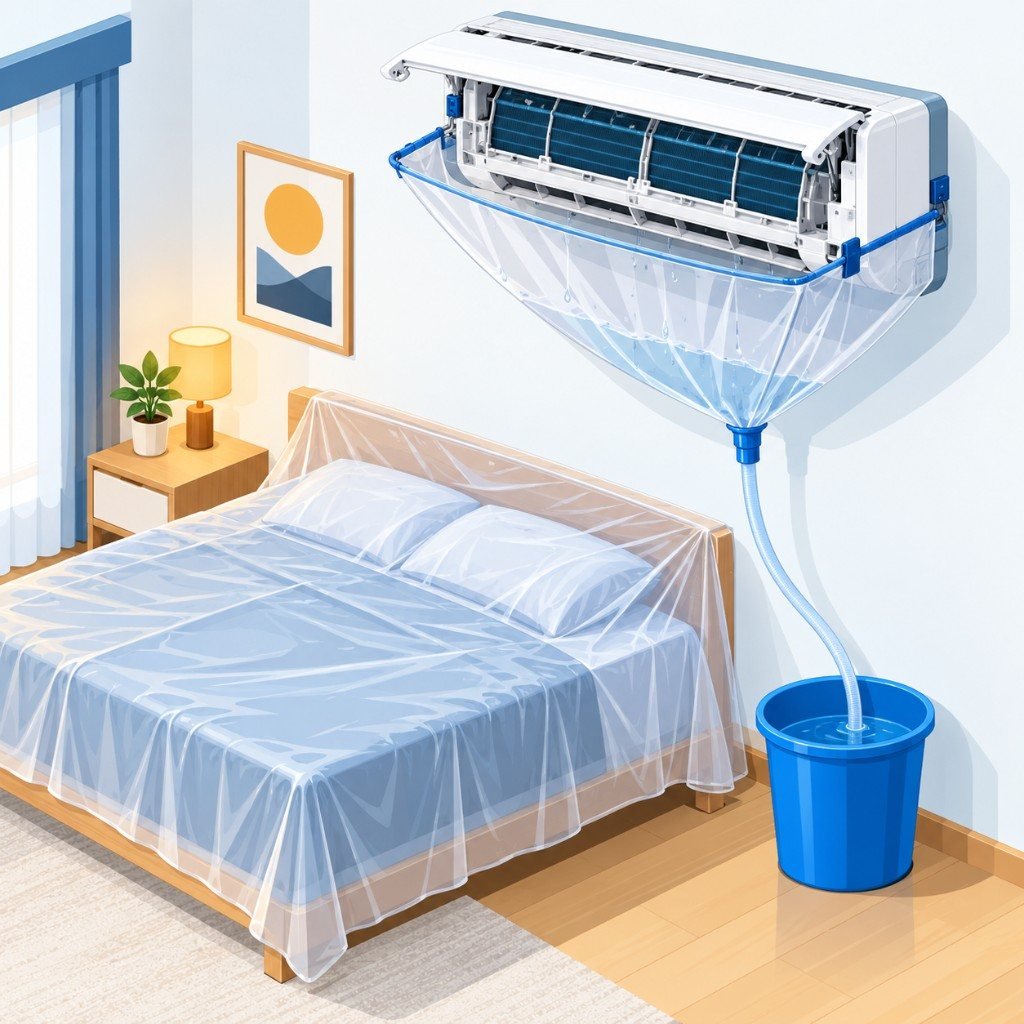
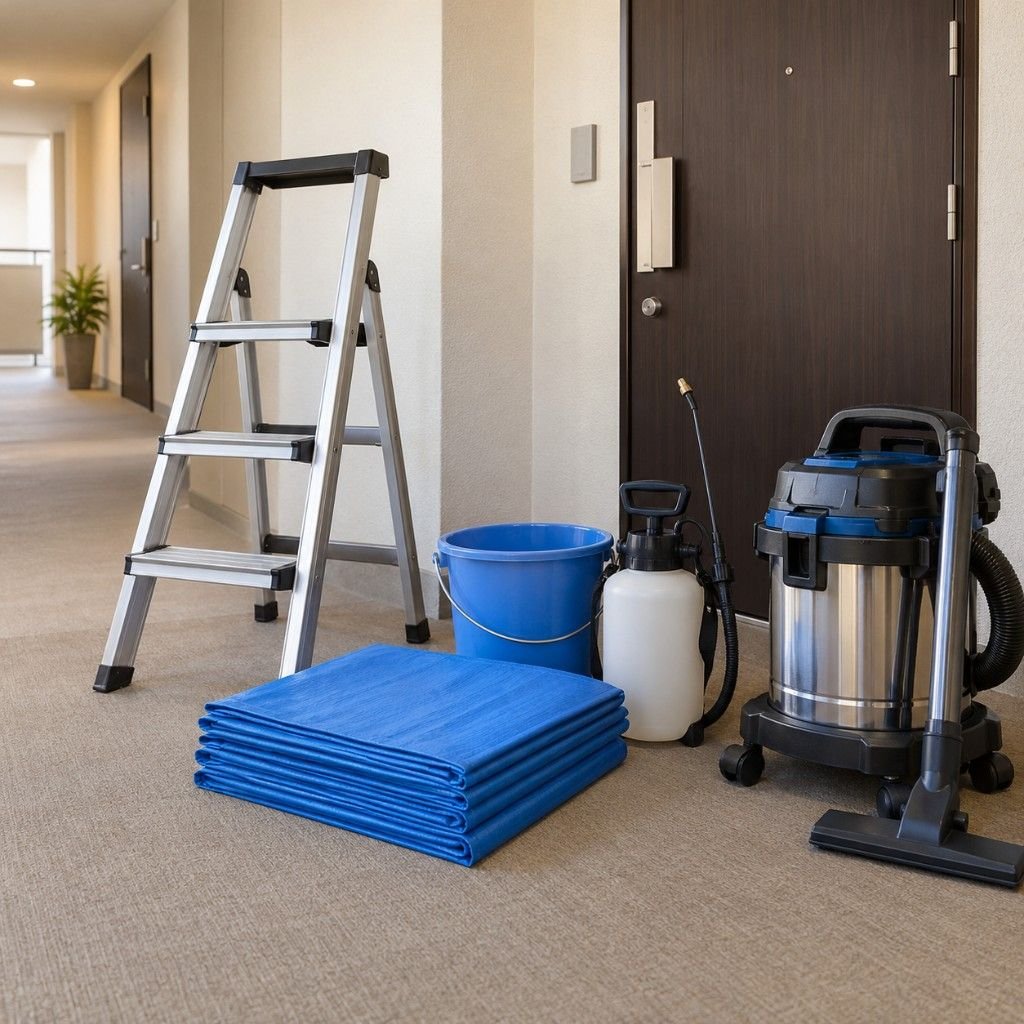
The kit an AC cleaning business needs for a wall-mounted split unit is small, and its first job is to protect the room. A cleaning cover wraps around the indoor unit and funnels dirty water into a bucket. A low-pressure sprayer rinses the coil. High pressure, in contrast, can bend the thin fins, so keep it away from indoor units. In addition, floor and furniture sheets, a stable ladder, gloves, and eye protection complete the basics.
Choose a coil cleaner made for air conditioners, and read the maker’s instructions before the first use. Some products need rinsing and others are left on the coil. In contrast, a harsh general cleaner may harm the metal or leave a smell in the room. Furthermore, do not buy everything at once. Work with the split-unit kit for a month, then add the one tool whose absence slowed you down.
Order matters in the vehicle as well. Load the floor sheets last so that they come out first. Rinse covers and brushes after each job, and wash them fully at the end of the day. As a result, you do not carry one home’s dust into the next. Customers see clean sheets go down in the first minute. They judge an AC cleaning business by that before the unit is even open.
Starter Supplies for an AC Cleaning Business
As an Amazon Associate, BeIN ADVISOR earns from qualifying purchases.
These supplies suit an AC cleaning business that starts with split units. Match sizes to the units common in your area, and compare reviews and return policies before you buy.
- Split AC cleaning cover: it wraps the indoor unit and drains dirty water into a bucket.
- AC fin comb: it straightens bent coil fins so that air can pass again.
- Soft coil cleaning brush: it lifts loose dust before rinsing without scratching the metal.
- Wet/dry shop vacuum: it clears water from the drain line and cleans the floor afterwards.
Rule 7: Make Honest Claims Your Selling Point
Describe the work, and leave health out of it. You can say that you will clean the filters, the coil, and the drain, and that a clean filter lets air pass. However, you cannot say that cleaning treats allergies or prevents illness. The EPA’s guidance on air duct cleaning states that duct cleaning has never been shown to actually prevent health problems. Moreover, it tells homeowners not to hire duct cleaners who make sweeping claims about health benefits, because such claims are unsubstantiated. That guidance is about ducts. Similarly, the same caution fits coil washing: describe the work and promise no health result.
The same guidance says when duct cleaning is worth considering. The cases are substantial visible mold inside hard-surface ducts, ducts infested with vermin, and ducts clogged with excessive dust and debris. In addition, it says a provider should use vacuum equipment that exhausts particles outside the home, or HEPA equipment if the vacuum exhausts indoors. These details matter if you later add duct cleaning for central systems. They also show what an honest offer sounds like. It names the conditions and the equipment, and it promises no health result.
Honesty also covers what cleaning cannot fix. For instance, if the smell or the weak cooling remains after the wash, say so and point to a likely repair. A customer who hears the truth on the first visit is more likely to trust the next quote. In contrast, a customer who was promised cold air and did not get it will tell the neighbours, and an AC cleaning business lives on those neighbours.
Rule 8: Plan the Slow Season of an AC Cleaning Business
Cooling demand is seasonal in most markets. The calendar fills before the hot months and empties after them. Consequently, a team hired for the peak may have nothing to do later. Therefore, spread the yearly-plan visits across the quiet months, and offer a lower price to customers who book ahead of the season. Meanwhile, set aside part of the peak income to cover fixed costs when the phone is quiet.

Once you hire a helper, the quality of a visit in your AC cleaning business no longer depends on you alone. Therefore, train that person on your written visit standard, and work side by side for the first ten jobs. In addition, agree in writing who pays if a part is broken or a wall is stained. Some customers ask about insurance for damage inside the home, so ask an insurer in your country what cover suits home services.
Start With a Scope Sheet
An AC cleaning business needs little equipment and a great deal of discipline. Its value sits in the repeat customer, and that customer returns for three reasons: the room stayed clean, the price matched the quote, and the claims were true.
Before your AC cleaning business buys a sprayer, write one page. List what your visit includes, what it excludes, and which problems you refer to a licensed technician. Then open a customer sheet with three columns: the home, the number of air conditioners, and the date of the next visit. Ultimately, that sheet is what turns a single job into the repeat work this business depends on.