

Most guides that tell you to start a travel blog promise free flights and a laptop on a beach. The honest version is more useful. A travel blog is a small publishing business. It earns when other people book trips through your links, and that income arrives only after your pages earn enough traffic to be found. Understanding that order — audience first, commissions second — separates a blog that pays for itself within a year from the thousands that go silent after four posts. This guide walks through the real mechanics: what the site costs, how the money moves, what a network like Travelpayouts pays for a flight versus a hotel, and why traffic, not writing, decides whether you earn at all.
What a travel blog really is as a business
A travel blog earns nothing for the travel itself. It earns because it publishes pages that answer a specific question a traveler types into a search box. “Is the Cairo airport hotel worth it during a long layover?” “Which Nile cruise lines allow a solo traveler?” Inside that answer sits a link to book the thing being discussed. When the reader books, the platform pays a commission. The trip you took is the raw material. The content is the asset, and it earns again and again, long after the trip ends.
That distinction reorders your priorities. A vacation photographer optimizes for the trip. A travel blogger optimizes for the page. Is it the most complete answer to a question people actually ask, and does it reach them? A beautiful post about a place nobody searches for earns the same as no post at all. So the niche you choose and the traffic you attract decide your income far more than how well you write or how far you travel.
Choosing a travel blog niche you can win
The instinct of every beginner is to cover “travel.” That is the one niche you cannot win. It puts you against sites with a decade of history and thousands of pages. A defensible travel blog picks a corner small enough to own, becomes the most useful source in it, then expands from strength.
The corner can be a region you know deeply, a type of traveler, or a recurring problem. A blog about budget travel across Egypt for first-time Arab visitors is winnable. “World travel tips” is not. You can answer the concrete questions — visa rules, realistic daily costs, which trains actually run — that a generalist site covers badly or skips. A narrow angle also makes your income more coherent. A reader who trusts you on Egyptian hotels is far likelier to book one through your link than someone who landed on a generic listicle. So pick an angle you can write about for two years without running out of specific, first-hand things to say. Make sure that audience books things — accommodation, flights, tours — and does not only read.
What a travel blog costs to set up
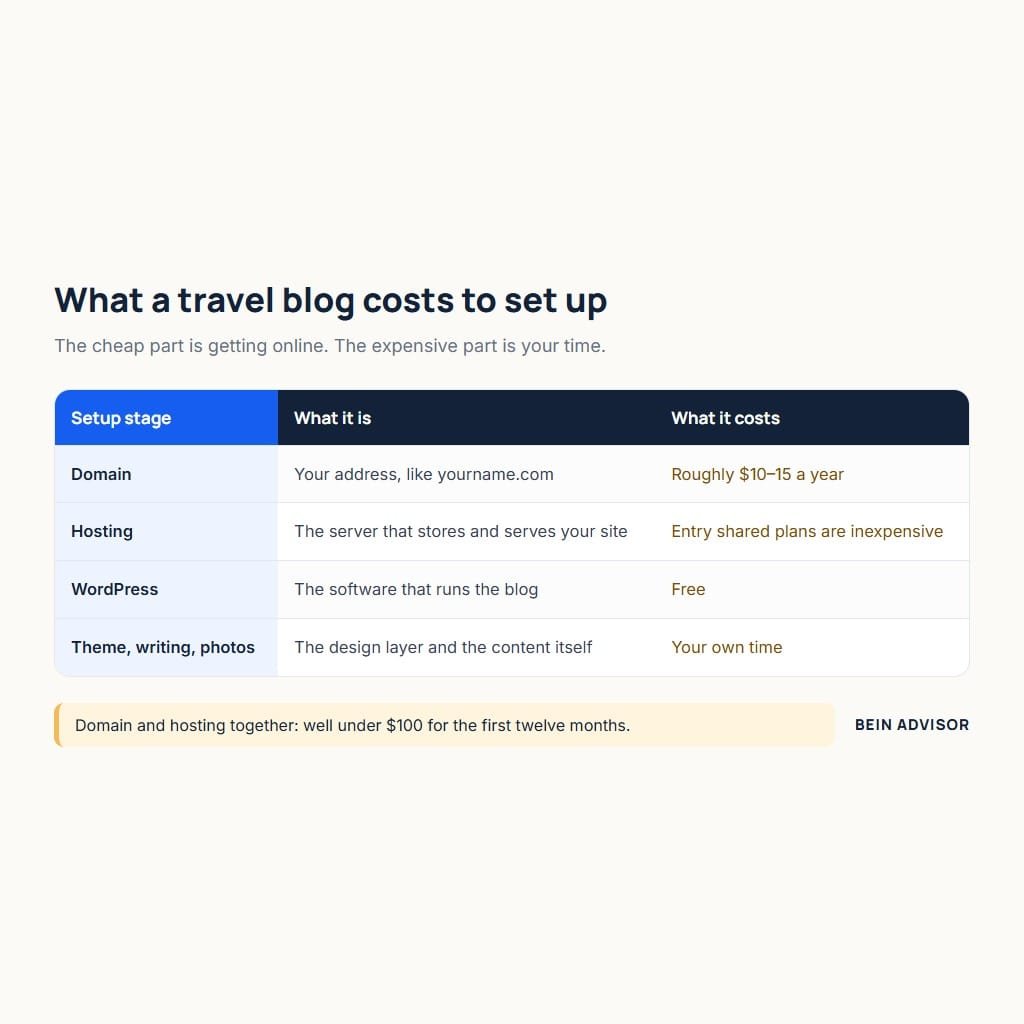
Getting online is the easy part, and cheaper than most guides imply. You need three things: a domain, hosting, and WordPress. A domain — your address, like yourname.com — costs roughly ten to fifteen dollars a year. Hosting is the server that stores your site and serves it to visitors. For a new blog, a shared plan from a provider such as Hostinger is enough to start. The entry plans are inexpensive, and most install WordPress for you automatically. WordPress itself, the software that runs the blog, is free.
WordPress matters because serious blogs are built on it. You own your content. The software is also built for the search-optimized publishing that earns affiliate income. And it never leaves your business at the mercy of a social platform’s algorithm. Once it is installed, you choose a theme, which is the design layer. Here the sensible choice is a fast, lightweight theme, not a heavy template loaded with animations. Page speed affects how readers behave and how search engines rank you. The same logic behind choosing web hosting for a fearless start applies to themes. Pick the option that stays fast and out of your way. A reader who waits four seconds for your hotel review has often left before the affiliate link even loads.
Budget honestly for the first year of your travel blog. Domain and hosting together cost well under a hundred dollars for twelve months. Everything else — the writing, the photos, the setup — is your time. That low cost is both the good news and the trap. Because a travel blog is so cheap to start, most people begin with no plan for the far harder job of getting read.

How a travel blog actually earns
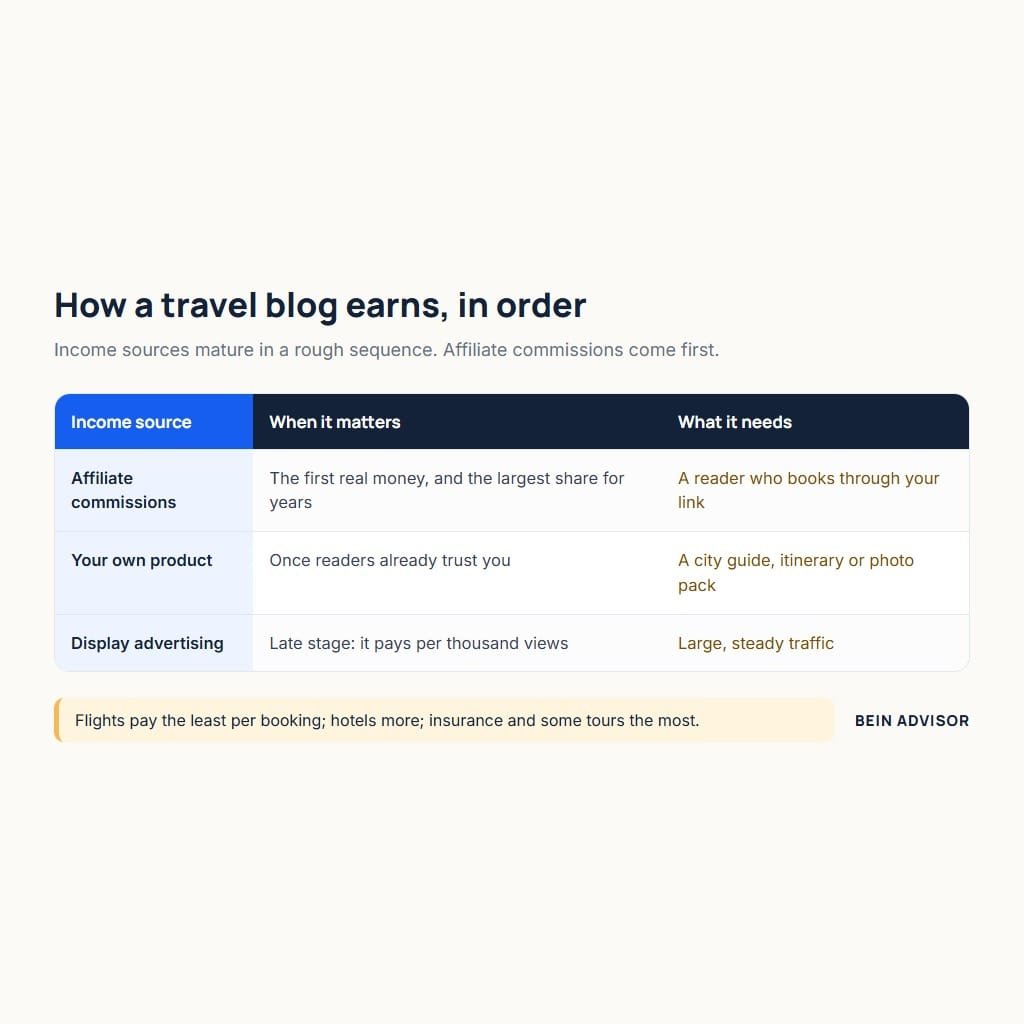
A travel blog has a few income sources, and they mature in a rough order. Display advertising pays per thousand views. It only matters once traffic is large, so it is a late-stage income, not a starting one. Selling your own product — a city guide, an itinerary, a photo pack — can pay well, but it needs an audience that already trusts you. For most travel blogs, the first real money comes from affiliate commissions, and it stays the largest share for years. You recommend a hotel, a flight search, a tour, or travel insurance. The reader books through your link. The provider pays you a percentage.
Affiliate income suits travel unusually well. Travel is researched online and bought online, at prices high enough that a small percentage is still worth having. A single booked family holiday can carry a commission worth more than a month of ad revenue on a small blog. The catch returns you to the same bottleneck. A reader has to decide to book while still inside your content. The commission is real, but it exists only if the traffic and the trust exist first.

Travelpayouts: what it pays, and for what
Rather than sign up separately with every airline and hotel chain, most travel blog owners join a network that bundles them. Travelpayouts is the one built specifically for travel. It aggregates roughly a hundred travel brands — flight search through partners like Aviasales, hotels through Booking.com and Hotellook, plus car rental, tours and insurance — into one dashboard with a single payout. You place links from many providers and get paid once.
Your commission depends entirely on which underlying brand made the sale, because Travelpayouts passes through each brand’s own rate. That is the most important fact to internalize, and the one the “earn 50%” headlines get wrong. Flights pay the least, often only low single-digit percentages, because airlines run on thin margins. Hotels pay more, commonly mid-single digits and up, because accommodation carries a larger markup. Travel insurance and some tours pay the most, sometimes above ten percent. That is why bloggers who cover insurance and experiences often earn more per booking than those who only chase flight clicks. Cookie windows — the period after a click during which a booking still credits you — are set per brand and commonly run about thirty days. A reader who clicks today and books next week still counts.

The “50% commission” figure that circulates about Travelpayouts means something different, and it is worth separating cleanly. It refers to the refer-a-partner program, where you earn a share of the platform’s own earnings from other affiliates you bring in. It is not half of a traveler’s booking. Treating it as your booking rate will wreck every travel blog income projection you make. Plan around the real per-booking percentages. They are modest on any single sale, so build for volume, not for a jackpot on one link.
How approval and tracking actually work
A network wants to see a real travel blog before it approves you. Applying on day one with an empty site usually fails. The practical order is to publish a handful of genuine, useful pages first, then apply with a site that already looks like a going concern. Once approved, you generate a unique tracking link for each brand and place it inside the relevant content. The hotel link goes in the hotel review. The insurance link goes in the “is travel insurance worth it” piece. You do not scatter them everywhere.
The tracking is automatic, but it helps to understand it, because it explains why some travel blog earnings never appear. When a reader clicks your link, the network stores a cookie that names you as the referrer. If they complete a qualifying booking within that brand’s cookie window, the sale is attributed to you. It shows in your dashboard first as pending, then as confirmed once the trip is completed and the refund window has passed. Cancelled bookings do not credit. Neither do bookings made after the cookie expires, or on a different device where your cookie never landed. This is another reason single links rarely make anyone rich, while steady traffic across many pages does. Payouts run on the network’s schedule, usually monthly once you clear a minimum balance, through methods such as PayPal or bank transfer. The exact minimum and options are set by the network, so check them before you count on a payout date.
The real bottleneck: traffic
Here is where most travel blogs quietly fail. Your site is live, the links are placed, and nothing happens. Being published is not the same as being found. Search engines take months to trust a new travel blog enough to rank its pages. Until a page ranks, almost no one reads it. An unread page earns nothing, however good the affiliate offer inside it.
This is the real work, and it is unglamorous. It means writing pages that answer questions people demonstrably search for, not diary entries about your trip. It means making each page the most complete answer available, so a search engine has a reason to prefer it. And it means doing this steadily for the six to twelve months it usually takes before organic traffic becomes meaningful. The travel blogs that earn are rarely the ones with the best photos. They are the ones that treated the blog as a search-answering business from the first post, chose questions with real demand, and kept publishing through the long stretch when traffic, and therefore income, was still near zero.

Finding topics people actually search for
Because traffic decides income, the most valuable habit a travel blog can build is choosing each post’s subject from real search demand, not from what you feel like writing. The method is simple, even without paid tools. Start with the questions your own trips left you asking. Then test whether other people ask them too. Type the start of the question into a search engine and read the autocomplete suggestions. Scan the “people also ask” boxes on the results page. Look at the “related searches” at the bottom. Each of those is a real query with demand behind it, handed to you free.

From that list, favour questions with booking intent over pure curiosity. “Best time to visit Luxor” is useful but broad. “Cheapest way to get from Cairo to Luxor” sits closer to a decision, and a post answering it can naturally recommend the train or tour that solves the reader’s problem. A page built around a specific, high-intent question does two jobs at once. It is the kind of page a search engine can rank, because it matches a real query. And it is the kind of page where an affiliate link feels like help, not an interruption. Do this for twenty or thirty pages, and you have built the one thing that turns a travel blog from a hobby into income.
A realistic first-year travel blog plan
Put the pieces in the order that respects how income actually arrives. First, settle the angle of your travel blog and confirm that people search for the questions it answers. Everything downstream depends on writing about demand rather than about yourself. Second, do the cheap travel blog setup — domain, hosting, WordPress, a fast theme — in an afternoon. Resist spending weeks perfecting a design nobody is visiting yet. Third, publish enough real content to look like a genuine platform, then apply to Travelpayouts. Fourth, spend the bulk of the year on the only thing that grows traffic: publishing thorough, search-driven answers and improving them. By the time you have twenty or thirty strong pages, some begin to rank, and the affiliate links inside them finally sit in front of readers who are ready to book.
Held in that order, a travel blog is a slow but genuine business. It is cheap to run, honest in how it earns, and able to pay for itself and more once the traffic arrives. Rushed in the wrong order — design and gear first, traffic as an afterthought — it becomes another abandoned site with four beautiful posts and no readers. The setup is the part you can finish this week. The audience is the part that decides whether you earn. Build it deliberately from the first page: write for questions people are really asking, and let the booking commissions follow the readers you earn.