

A side income can feel like the obvious answer to a job that pays too little or feels uncertain. The risk is in how people start. Some spend months building a website, buying equipment and designing a logo. Not one stranger has paid them yet. Others quit too early, betting their rent on an idea that was never tested. Both paths can cost money and confidence.
A better approach treats a side income as an experiment. You keep your salary, choose one small offer, and test it for a few weeks with a fixed budget and a clear question: will real people pay for this, and is the money worth the hours? Your job still covers the bills. So a failed test costs little, and a successful one gives you evidence instead of hope.
This guide walks through that experiment step by step. It covers your employment contract, how to choose an offer you can test quickly, how to check demand before spending, how to land the first paying customer, and how to measure what the work really pays per hour. It also lists the warning signs of offers that ask you to pay first. Every figure below is an illustration, not a promise of income.
Why Test a Side Income Before You Build One
Building first and selling later feels productive, but it hides the most important question until the money is spent. The U.S. Small Business Administration (SBA) makes the point in its guide to market research: research “lets you reduce risks even while your business is still just a gleam in your eye.” The cheapest time to learn that nobody wants your offer is before you have built it.
A test also protects your main income. Give the experiment an end date and a spending limit. Then it cannot quietly grow into a second job that eats your evenings and savings and wears down your performance at work. Before the first sale, write down the target that will count as success: how many paying customers, the lowest net pay per hour you accept, and a spending limit. Then stop or adjust when the test ends.

Read Your Employment Contract Before Anything Else
Many employment contracts and staff handbooks contain rules about outside work. Look for clauses on secondary employment, conflicts of interest, confidentiality and intellectual property. Some employers simply ask you to disclose outside work; others restrict work for competitors or clients. Reading the rules first costs an hour and can prevent a problem that costs far more.
Whatever your contract says, a few rules always apply. Never use your employer’s time, equipment, software licenses, clients or confidential information for your side income. Keep the two separate in your calendar and in your files. If anything is unclear, ask human resources in writing before you start, and keep the reply.
- Outside work: is it allowed, and does it need approval?
- Conflict of interest: does your idea compete with your employer or serve its clients?
- Confidentiality: would the work use anything you learned on the job that is not public?
- Intellectual property: who owns what you create, and on whose time?
Choose One Side Income Offer You Can Test in Weeks
A good first offer is small, specific and quick to deliver. It uses a skill you already have, serves a group of people you can reach, and needs little money to start. Editing CVs for graduates, tutoring one subject, repairing bicycles on weekends or baking for local events are all easier to test than an online store with hundreds of products.
| Question | A strong test idea | A weak test idea |
|---|---|---|
| Skill | You can do it well today | You must learn it first |
| Audience | You can name where to find buyers | “Everyone” might want it |
| Start-up cost | A small, fixed budget | Equipment or stock up front |
| Time to deliver | Hours or days | Months of building |
| Clear price | You can quote one price | Price depends on many unknowns |
Pick one idea, not three. Testing several offers at once splits your limited evening hours and makes the results hard to read. If the first test fails, you will have learned enough to choose the second idea faster.
Check Demand Before You Spend Money
The SBA’s guide frames the central question plainly: “Is there a desire for your product or service?” It notes that existing sources can save time, while “asking consumers yourself can give you a nuanced understanding of your specific target audience.” For a small side income, direct conversations are usually the fastest and cheapest research you can do.
Talk to ten people who fit your audience, not to friends who want to be kind. Ask what they do about the problem today, what it costs them, and what would make them switch. Listen for complaints you could solve. If none of the ten has the problem, the idea needs to change before you spend anything.

Pre-sell before you build
The strongest evidence of demand is a payment. Describe the offer in one short paragraph, set a price, and ask a few interested people to book or pay a deposit before you create anything elaborate. A tutor can sell a first package of four sessions; a baker can take orders for one event. If nobody commits money, you have learned something valuable for the cost of a few messages.
Price the Side Income Offer So the Test Means Something
A test with a price that is too low proves very little. If you charge almost nothing, people may buy out of kindness or curiosity. Then the test ends, and you still do not know whether the work can pay. Set the price you would need if the side income grew.
Start from your costs. Add materials, travel and any platform fee to each job. Then add the hourly rate you would accept for your evenings. Compare the result with what similar services charge nearby. If your price lands far above what similar services charge, or below what covers your hours, adjust the offer now, before you sell.
Land the First Paying Customer
Your first customer will most likely come from people who already know you or from one focused place where your audience gathers. A local community group, a professional network, a notice board at a gym or a short message to former classmates can all work. Choose one channel and use it consistently for the length of the test.
Make buying easy. Give one clear price, one way to pay and one way to book. Deliver the first jobs carefully, then ask each customer for honest feedback and, if they are happy, a short testimonial or a referral. Those first reviews are often worth more than any advertising you could afford.

Track Hours, Costs and Your Real Side Income
Revenue alone tells you very little. A side income is only worth keeping if the money left after costs is worth the hours it takes. Keep a simple log of every hour you spend, including messages, travel and preparation, and every cost, from materials to platform fees.
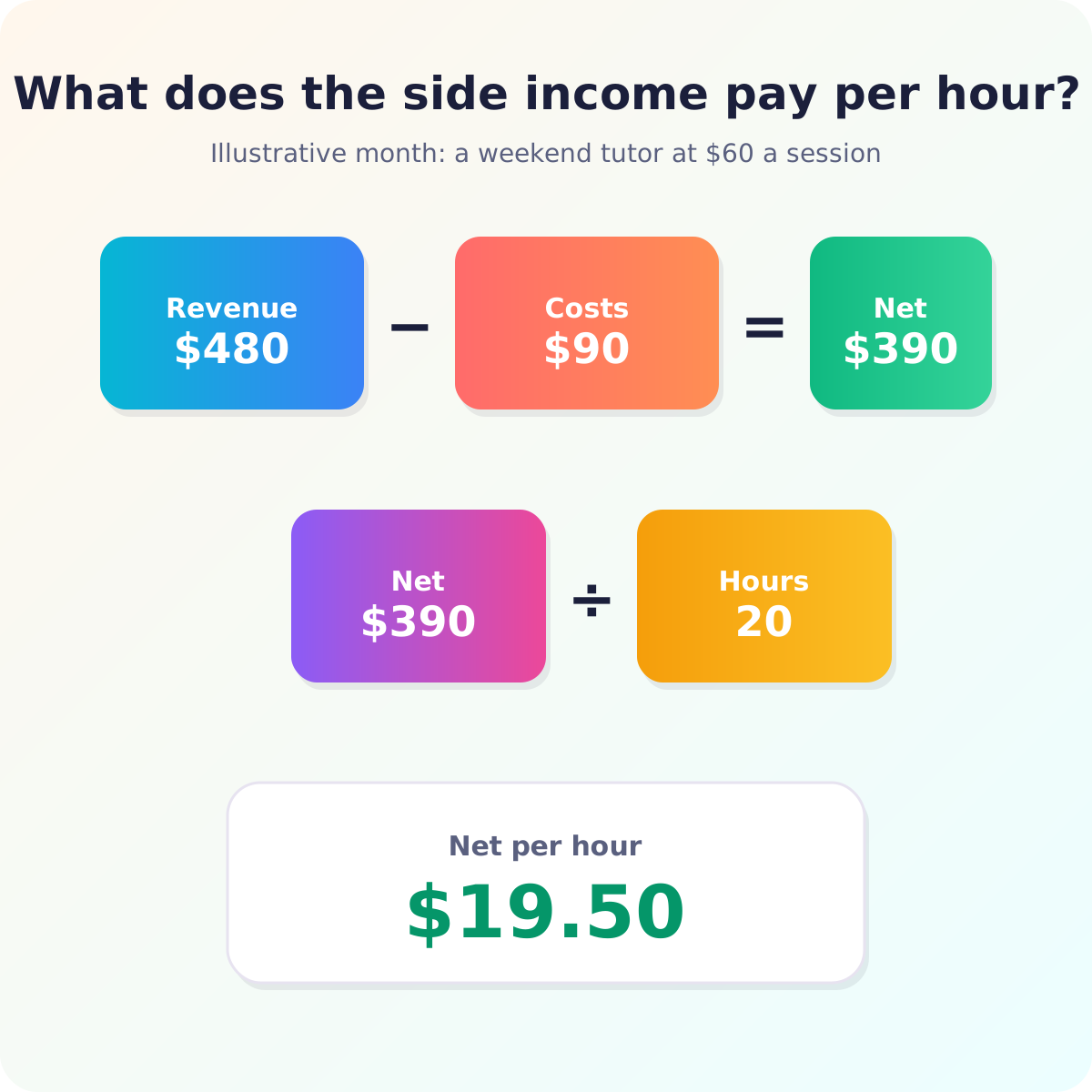
Here is an illustrative month for a weekend tutor who charges $60 per session. Eight sessions bring in $480. Materials, travel and a booking tool cost $90, leaving $390. The tutor spent 20 hours, counting preparation and travel. That is $19.50 per hour, a number the tutor can compare with overtime, a part-time job or simply rest.
| Item | Amount |
|---|---|
| Revenue (8 sessions × $60) | $480 |
| Costs (materials, travel, booking tool) | −$90 |
| Net income | $390 |
| Hours spent, including preparation and travel | 20 |
| Net per hour | $19.50 |
Protect Your Day Job While the Side Income Grows
Your salary is the safety net that makes the experiment possible. Protect it. Set fixed hours for the side income, such as two evenings and one weekend morning. Keep those hours, and stop when they end. Tired mornings at your main job are a hidden cost of the test.
Keep the two worlds apart. Do not answer side clients during working hours. Use a separate phone number or email address if you can. Tell the people you live with what the test involves and how long it will last. A clear end date makes the extra hours easier for everyone to accept.
Watch your energy as closely as your income. If sleep, health or family time starts to slip, shrink the test. A side income that costs your health costs too much.

Red Flags: Side Income Offers That Cost You Money
Many offers sold as side income opportunities are designed to take your money. The Federal Trade Commission (FTC) warns in its consumer guide to job scams that scammers claim “you can make thousands of dollars a month working from home.” It also describes victims who “end up paying for starter kits, so-called training, or certifications that are useless.”
- Upfront fees: the FTC’s advice is direct: “Don’t pay for the promise of a job.”
- Big income claims: a promise of fast money for little work is a warning sign.
- Recruiting over selling: if your income depends on signing up other people rather than selling to customers, ask where the money really comes from before you join.
- Pressure to decide today: genuine opportunities survive a night of thinking.

Taxes and Records for Side Income
Extra income usually has tax consequences, even when it is small. In the United States, the IRS states on its gig economy tax center that “gig economy income is taxable.” You must report it even when it comes from side work, is paid in cash, or never appears on an information return such as a Form 1099. Rules differ by country, so check what applies where you live before your first sale.
Good records make taxes and decisions easier. Open a separate account or wallet for the side income, keep every receipt, and record each payment with the date and the customer. Set aside a share of every payment for tax until you know the exact amount you will owe.
At the End of the Test: Stop, Adjust or Grow
When the test period ends, compare the results with the target you wrote down at the start. The decision is simpler if you set that target before the first sale.
| What the test showed | Decision |
|---|---|
| No one paid, even after changes | Stop and keep what you learned |
| People paid, but net per hour is too low | Adjust the price, the offer or the delivery |
| People paid, and net per hour is worth it | Grow slowly, still alongside the job |
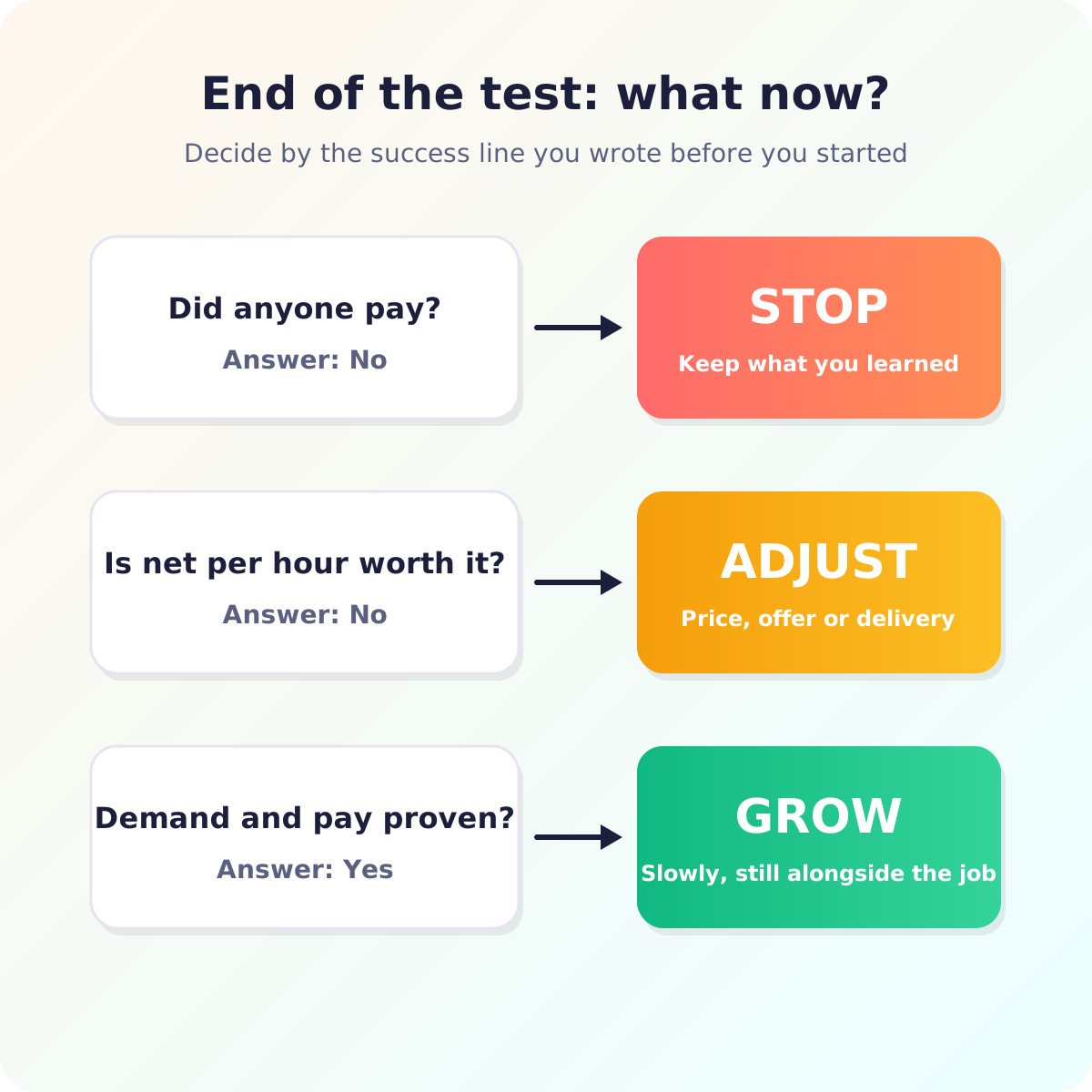
Growing slowly means raising prices, adding a second channel or a second offer, while your salary still pays the bills. A side income that has covered your essential expenses for several months in a row is very different from one that worked for a few weeks. Keep your emergency fund intact until that track record exists.
Frequently Asked Questions
How long should a side income test last?
Four to eight weeks is long enough to reach real customers and short enough to stop without regret. Set the end date before you start.
How much should I spend on the test?
Choose an amount you could lose without touching your emergency fund or missing a bill. Many service ideas can be tested with almost no spending at all.
Should I tell my employer about my side income?
Follow your contract and handbook. Where disclosure is required, or where there is any chance of a conflict of interest, ask in writing before you start.
Conclusion: Evidence Before Effort
A side income works best when it starts as a small, honest experiment. Check your contract, choose one offer, test demand with real conversations, and treat the first payment as your proof. Then measure net income per hour and decide by the numbers.
Keep your salary and your emergency fund in place while the side income proves itself. A tested income needs a longer track record before it can support a major change in your work.