

A raise arrives, and for a month it feels like breathing room. By the third month the extra money has disappeared, yet nothing dramatic happened. The phone plan moved up a tier, takeout became a weekly habit, and a nicer apartment started to look reasonable. That slow drift has a name: lifestyle creep. Spending rises to meet each new income, so the raise never turns into savings or security.
Lifestyle creep is hard to notice because each step looks small and sensible on its own. A better laptop for work, a gym closer to home and a streaming bundle are all easy to justify. The trouble is the total. When every raise is absorbed by new monthly costs, your safety margin stays the same size while your fixed bills grow, and a job loss would hurt more than it did before the raise.
This guide shows how to spot lifestyle creep on your own statements, how to decide where the next raise goes before it lands, and how to automate that decision on payday. It also covers subscriptions, bonuses and tax refunds, and the upgrades that are genuinely worth paying for. The amounts below are illustrations; your own pay stubs and statements supply the real figures.
What Lifestyle Creep Looks Like on Your Statements
On your statements, lifestyle creep shows up as a pattern in your recurring payments. Pull your bank and card statements from just before your last raise and from three months after it. Then list every payment that repeats each month, and mark the ones that are new or more expensive than before.

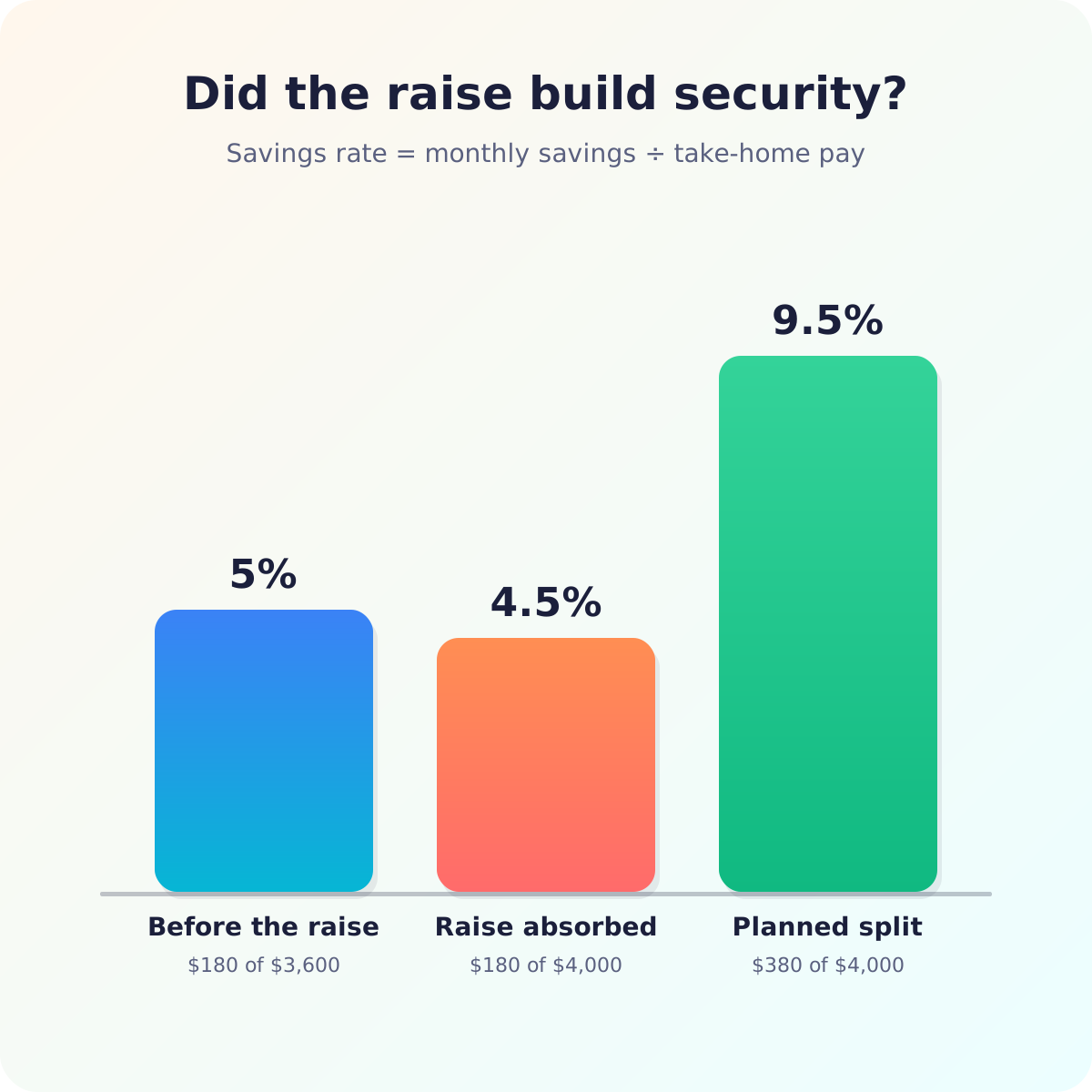
The second check is your savings rate: the share of take-home pay that goes to savings each month. Say you took home $3,600 and saved $180, which is 5%. After a raise, you take home $4,000. If you still save $180, your savings rate has fallen to 4.5%, even though you earn more. That falling percentage is the clearest sign that the raise was absorbed, and you can calculate it in two minutes.
| Check | Before the raise | Three months after | What it tells you |
|---|---|---|---|
| Take-home pay | $3,600 | $4,000 | The raise is real |
| Monthly savings | $180 | $180 | Savings did not move |
| Savings rate | 5% | 4.5% | Lifestyle creep took the raise |
| New recurring payments | — | $240 | Where most of the money went |
| Occasional extra spending | — | $160 | The rest of the raise |
Why Lifestyle Creep Hides Inside a Raise
A raise is also smaller than it first looks, for two reasons people forget. Offers usually quote a raise before tax, while you live on what reaches your account. A raise that sounds large on paper can shrink noticeably after tax and deductions. Plan with the take-home figure from your first new pay stub, not with the number in the offer letter.
Inflation takes another share. The International Monetary Fund describes inflation as the rate at which prices rise over time, which means a fixed amount of money buys less each year. If your raise only keeps pace with rising prices, it buys the same life you already had. Treat that part as protection for your current budget, and count only the remainder as new money you can direct.
Stop Lifestyle Creep by Deciding Before the Raise Arrives
A strong defense against lifestyle creep is a decision made in advance. Once extra money sits in your everyday account, it starts to feel like part of normal spending. A plan written before the raise arrives removes that temptation, because the money already has a job.
Behavioral economists Richard Thaler and Shlomo Benartzi tested this idea with a program called Save More Tomorrow. Employees agreed ahead of time to send part of their future pay raises into retirement savings. In the first company to use it, 78% of those offered the plan joined, and 80% stayed in it through the fourth raise. Their average savings rate rose from 3.5% to 13.6% over 40 months. That was one employer’s result, so treat it as evidence for the method, not a promise of numbers.
A worked split for a $400 raise
Here is one way a household might divide a raise that adds $400 a month to take-home pay. These shares are one option. What matters is setting them before the first larger paycheck lands.
| Destination | Share | Monthly amount | Why |
|---|---|---|---|
| Emergency fund or savings | 50% | $200 | Builds runway that protects the new income |
| A named goal or extra debt payment | 25% | $100 | Turns the raise into progress you can see |
| Lifestyle upgrade | 25% | $100 | Lets you enjoy the raise without losing it |
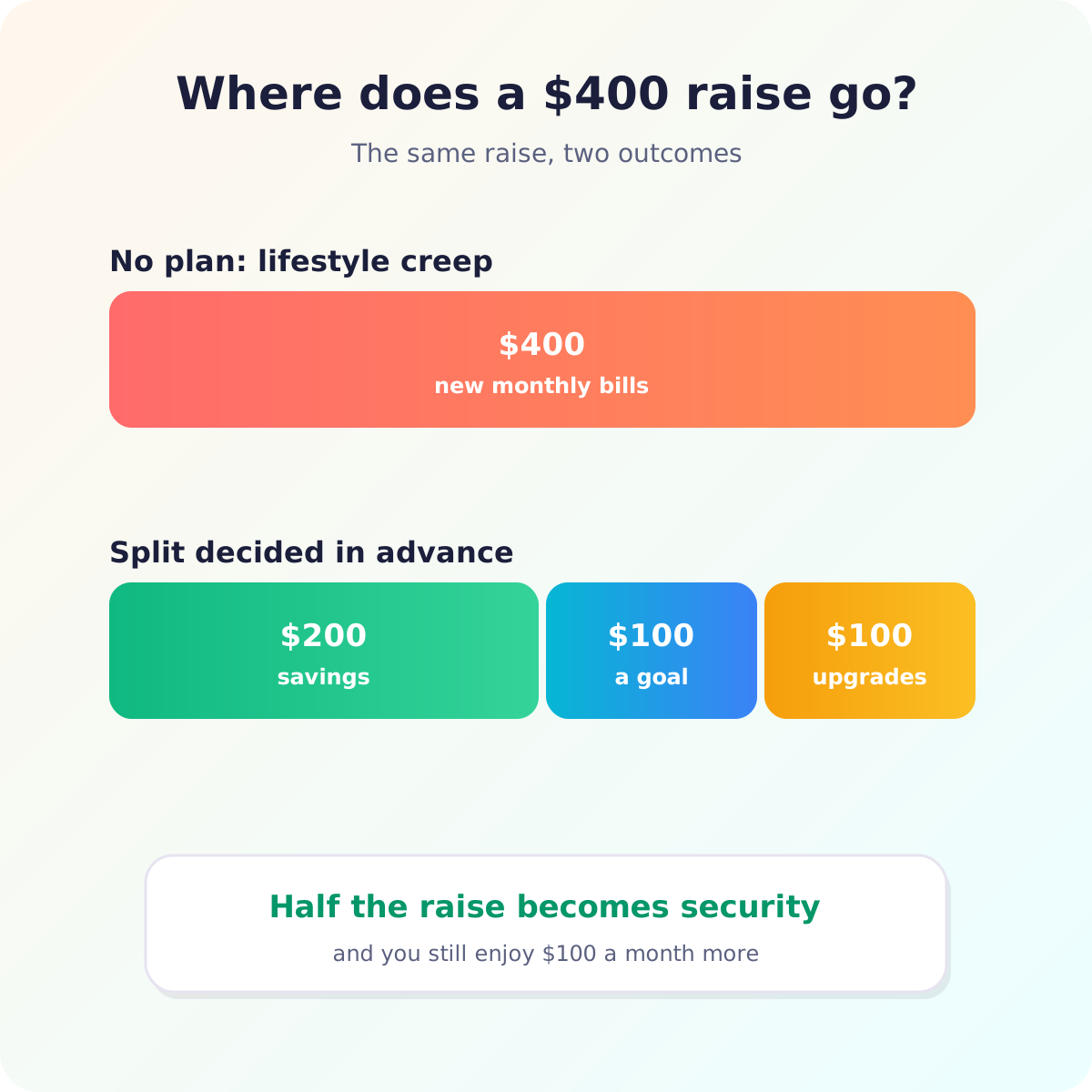
With that split, the household in the earlier example saves $380 of $4,000, a savings rate of 9.5%. Its lifestyle still improves by $100 a month, so the plan does not feel like punishment. Leaving room for a visible reward is what makes a split last beyond the first few months.
Automate the Split So Lifestyle Creep Cannot Start
A plan that depends on willpower each month tends to fade. Automation removes the monthly decision. The Consumer Financial Protection Bureau (CFPB) explains in its guide to making saving automatic that you can schedule transfers from checking to savings, choosing the amount and the date, often weekly or monthly. It also suggests checking whether your bank has a minimum for automatic transfers, and notes that you can start with the minimum and adjust over time.
Schedule the transfer for the day after your pay arrives, so the savings leave before any spending decision. The CFPB also notes that some employers let you split direct deposit across more than one account. Your savings share then goes to its own account before it ever reaches checking. Either way, the raise is divided within a day of reaching your account.
One caution from the same guide: an automatic transfer can trigger an overdraft fee if checking runs short. Keep a small buffer in checking for the first two months, turn on balance alerts, and raise the transfer only after you see how the new budget behaves.
Subscriptions: The Quietest Form of Lifestyle Creep
Subscriptions are lifestyle creep in its purest form. Each one is small, renews without a decision, and adds to a monthly total nobody planned. A streaming service at $15, a music plan at $11, a cloud storage tier at $10, two apps at $8 each and a premium delivery membership at $13 add up to $65 a month, or $780 a year.

Once a quarter, list every recurring charge from your statements and ask two questions about each one. Did I use it in the last month? Would I sign up for it today at this price? Cancel anything that fails both questions, and downgrade anything that fails one. Put the date of the next audit in your calendar so the review does not depend on memory.
- Cancel: services you have not opened in a month and would not buy again at the current price.
- Downgrade: premium tiers you chose for a feature you no longer use.
- Rotate: keep one streaming service at a time and switch when you finish a series.
- Redirect: move each canceled amount into the same savings transfer.
Upgrades Worth Paying For
Fighting lifestyle creep does not mean refusing every upgrade. Some spending increases protect your income, your health or your time, and those can be good uses of a raise. The useful test is whether the upgrade lowers a future cost or protects the income that pays for everything else.
Good candidates include work tools that help you earn more, health and dental care you had been postponing, a reliable car repair instead of a risky delay, or childcare that lets a second earner keep a job. Weaker candidates are upgrades that raise fixed costs for a long time, such as a larger car payment or a more expensive lease, because they are hard to reverse if income falls.
Before you approve an upgrade, write down its monthly cost and how long you are committing to it. A one-time purchase that pays for itself, such as a repair that prevents a bigger repair, leaves no monthly bill to cut in a bad month. A two-year contract or a new lease keeps billing you every month until it ends. If the upgrade still makes sense once you see the full commitment on paper, approve it.

Bonuses and Tax Refunds: Plan the Lump Sums
Lump sums invite lifestyle creep because they feel like found money. The CFPB points out in its tax time saving tips that a refund may be the single biggest lump sum you receive all year. It recommends planning in advance to save part of it, perhaps 25%, and notes that you can deposit part of the refund directly into a separate account when you file.
Apply the same idea to a bonus or a large overtime payment. Decide the split before the money arrives, move the savings share the same day, and spend the rest without guilt. A one-time payment is best used for one-time purposes, such as topping up your emergency fund or clearing a debt, rather than starting a new monthly bill.

Lifestyle Creep in a Two-Income Household
When two people earn, lifestyle creep can grow faster, because each partner sees only part of the spending. One raise covers a pricier phone plan while the other quietly pays for more dining out. Neither change looks large, yet together they can absorb both raises.
Agree on one shared rule for raises, such as the split above, and apply it to both incomes. Review the joint recurring payments together once a quarter, and keep a single list of what each raise is meant to fund. When both partners see the same list, neither raise disappears unnoticed.
Frequently Asked Questions
Is lifestyle creep always bad?
No. Spending more as income grows is normal, and some upgrades are worth it. Lifestyle creep becomes a problem when it absorbs every raise and your savings rate falls, because your fixed costs then grow faster than your safety margin.
How much of a raise should I save?
There is no single correct share. The worked example above is one reasonable choice: half to savings, a quarter to a goal and a quarter to upgrades. If your emergency fund is still thin, a larger savings share for the first raise or two will build security faster.
What if my raise only matches rising prices?
Then it protects the life you already have and is not new money. Keep your budget as it is, and save any part of the raise that is left after higher prices are covered.
Does lifestyle creep work differently with irregular income?
The same pattern appears, but it is triggered by good months instead of raises. A strong month makes a new monthly bill feel affordable, and the bill stays when the weak months return. If your income varies, base every recurring commitment on your weakest typical month, and treat the surplus from strong months as a lump sum to split, not as a raise.
Conclusion: Keep Lifestyle Creep From Taking the Next Raise
Lifestyle creep goes unnoticed because no single step requires a decision. The cure is to make the decision early. Measure your savings rate before and after each raise, choose a split before the money arrives, and automate it for the day after payday. Then audit subscriptions each quarter and plan every bonus and refund the same way.
Start with your next pay increase. Write down where it will go, schedule the transfer and send the savings share to your emergency fund. A separate guide to financial security shows how an emergency fund fits into the rest of your plan.