
Picture two coworkers with savings in the bank. One is single and holds $6,720. The other supports a partner and two children on one salary and holds $9,000. Most people would credit the second with more financial security. The arithmetic, however, points the other way. If both paychecks stopped, the single employee’s reserve would cover three months of essential bills, while the family’s would cover two and a half.
The difference sits on the spending side of the ledger. The family must spend $3,600 a month just to keep the essentials paid, against $2,240 for the single employee. A balance on its own, therefore, says little about financial security. Runway depends on what the household must spend each month, and few households have that figure written down.
This guide measures your financial security with five numbers. Your survival cost comes first: the monthly total that must be paid even in a crisis. Second comes your months of runway, and third comes the runway target that fits your household. The last two belong to a Plan B: the result of a small income test, and the threshold at which leaving a job becomes a calculation rather than a leap. Every amount below is a hypothetical example.
Illusions of Financial Security
Some feelings of financial security do not survive the arithmetic. Each one below sounds reasonable until a paycheck stops.
- One large balance. A savings figure means little until you divide it by survival cost, as the two coworkers show. It also mixes emergency money, test money, and investments, so nobody can tell which dollar has which job.
- A high salary. If spending rises with pay, runway does not move. For example, a household that earns $9,000 a month and spends all of it has no more runway than one earning half as much.
- A credit limit. Available credit feels like a reserve. However, it is a loan with interest, taken exactly when income is gone.
- One good side-income month. A single strong month proves little, since the next one may bring nothing. Consequently, the quit threshold later in this guide asks for several months in a row.
- Long-term investments. Their value can be down at the moment you need cash, and selling may carry costs. As a result, this guide keeps them in a pot of their own.
When a paycheck does stop, the first thing to fail is often small: an automatic payment nobody was watching, such as an insurance premium or a loan installment. One bounced payment, in turn, brings a fee that lands while income is frozen. Meanwhile, the household keeps spending at its usual pace, because nobody has agreed on what to stop.

A good salary is the engine that funds every reserve. However, the trouble starts when a salary, a credit limit, or an investment account stands in for measured runway and a separate reserve. Real financial security, therefore, shows up as numbers you can check on paper, and the five that follow all come from your own statements.
Number One: The Survival Cost Behind Your Financial Security
Every plan for financial security starts with two monthly totals. Survival cost covers what must be paid even in a crisis. Full cost, in contrast, covers everything the household spends in an ordinary month. The gap between them, the spending you can pause, is your first cushion.
Survival cost covers housing, utilities, basic groceries, transport to work, medicine and insurance, minimum debt payments, and school fees that cannot stop. It also includes annual and seasonal essentials, divided by 12. For example, a car registration or a yearly insurance bill belongs in the monthly figure, even though you pay it once.
| Expense line | Example amount (hypothetical) | Essential or can pause |
|---|---|---|
| Rent | $1,100 | Essential |
| Utilities and phone | $180 | Essential |
| Basic groceries | $420 | Essential |
| Transport to work | $160 | Essential |
| Medicine and insurance premiums | $140 | Essential |
| Minimum debt payments | $150 | Essential |
| Annual essentials ÷ 12 (registration, school fees) | $90 | Essential |
| Eating out and delivery | $220 | Can pause |
| Streaming and app subscriptions | $45 | Can pause |
| Clothing beyond basics | $80 | Can pause |
| Gifts, outings and hobbies | $160 | Can pause |
| Gadget and home upgrades | $95 | Can pause |
| Survival cost (essential lines) | $2,240 | — |
| Full cost (all lines) | $2,840 | — |
In this example, the household could cut $600 a month within days. If nothing pauses, the reserve drains $600 a month faster than it needs to. The “Can pause” column also gives the household a list to agree on now, before a crisis turns it into an argument.
Build the List From Real Statements
Download the last three months from your bank and card accounts. Mark each line E for essential or P for can pause. Memory tends to shrink the grocery bill and forget small subscriptions. In contrast, statements catch irregular items, such as a pharmacy refill every eight weeks. As a result, you get a survival cost you can trust, and every later number in your financial security plan rests on it.

Income needs the same honesty when it varies. Commission, freelance work, and seasonal pay, for example, make averages misleading. The CFPB’s income and benefits tracker asks you to label each source as regular, irregular, seasonal, or one-time, and it reminds readers that bills continue even when income is irregular. Therefore, compare survival cost with your lowest realistic month, not the average. For example, a salesperson whose pay ranges from $2,500 to $5,000 a month plans around $2,500, not the $3,600 average. In turn, surplus months refill the emergency fund, and a weak month is already part of your financial security plan.
Number Two: Months of Runway
Runway converts savings into time. Time, in turn, is the most practical form of financial security an employee can hold. The formula has one line: liquid reserve ÷ monthly survival cost = months of runway. Liquid means reachable within days, without a penalty or a sale. For example, retirement accounts, a car, or money a friend owes you stay out of this figure.
Next, calculate a second, harsher figure: the same reserve divided by your full monthly cost. That number shows how long the money lasts if the household changes nothing. The distance between the two figures measures how much time a quick decision to pause spending would buy.
Return to the two coworkers from the opening, this time with both cost figures in view.
| Item (hypothetical) | Single employee | Employee supporting a family |
|---|---|---|
| Liquid reserve | $6,720 | $9,000 |
| Survival cost per month | $2,240 | $3,600 |
| Full cost per month | $2,840 | $4,500 |
| Runway at survival cost | 3.0 months | 2.5 months |
| Runway at full cost | 2.4 months | 2.0 months |
The family has the larger savings balance, yet the shorter runway at both levels of spending. Only the balance divided by what the household must spend shows how long it can hold. Consequently, two coworkers with similar savings can stand at very different levels of financial security.
Recalculate runway whenever either side of the formula changes. For instance, a new lease, a new child, or a paid-off loan all move the cost side. A withdrawal for a car repair, on the other hand, moves the reserve side. The CFPB guide to building an emergency fund adds a related rule: if you spend the fund down, rebuild it.

Number Three: The Runway Target That Fits Your Financial Security
The same CFPB guide describes an emergency fund as a cash reserve set aside for unplanned expenses, such as car repairs, medical bills, or a loss of income. However, it sets no fixed amount. Instead, it suggests reviewing the unexpected costs you have faced before. For people living paycheck to paycheck, the guide adds that “even a small amount can provide some financial security.”
Two public reference points help frame the choice. The FDIC’s consumer guidance on saving for the unexpected presents six months of living expenses as a general expert recommendation. Meanwhile, the Federal Reserve’s survey of household economic well-being uses three months of expenses as one measure of resilience. Ultimately, your own risk factors decide where you land.
| Target runway | Fits a household where… | Risk factors that push toward it |
|---|---|---|
| 3 months | Two stable incomes, no dependents, low debt | Quick job searches; health costs insured |
| 6 months | One steady salary, some debt or one dependent | A typical job search; moderate fixed costs |
| 9 months | One income supports several people | Specialized role; long hiring; medical costs |
| 12 months | Income is irregular, or the field is small | Commission or seasonal pay; few employers |
For instance, a nurse in a city with many hospitals, whose partner also earns, may land near three months. On the other hand, a single-income engineer in a niche industry may need nine, since hiring there can take a season. The honest question, therefore, is how long a job search in your field would really take. Add a margin, and you have your target in months.
Turn the Target Into a Dollar Goal
Multiply the target months by your survival cost to express the goal in money. For example, in the single-employee case, six months at $2,240 equals $13,440. That amount becomes the goal for the emergency fund, the core of your financial security. Two kinds of obligation, however, change both sides of that multiplication.
A single income that supports a family concentrates the risk. If that salary stops, every obligation in the house is exposed at once. A family’s financial security therefore depends on listing the costs that cannot pause, such as school fees, regular medicine, and care for a parent. Consequently, those lines raise survival cost and usually push the target toward nine months or more. A second income lowers this risk only when it comes from a different employer, since one employer’s cuts can stop both salaries in the same week.
Debt touches financial security in two ways. First, minimum payments belong in survival cost, and they stay there during a crisis. The CFPB’s “When cash is short” checklist explains why: “If you miss payments now, you will have to make those up in the future.” It groups lean-month spending into four priorities. One is protecting your income, such as transport or licenses you need for work. Another is keeping your home and its utilities, because reconnecting a cut-off service is expensive. The last two are keeping essential insurance, including health coverage, from lapsing, and paying legal obligations such as child support and taxes.
Second, debt changes the order of saving. For example, a household that sends every spare dollar to a credit card has nothing left for the next surprise. As a result, the next car repair goes back on the card. In contrast, a household that builds a small starter reserve first and then pays faster breaks that loop. For the payoff order itself, the debt snowball method sets out one structured approach.
Number Four: The Result of a Plan-B Test
A Plan B counts only after it meets real buyers. An idea in a notebook adds nothing to your financial security. In contrast, a tested offer with paying customers shows whether a second income can exist. The test runs for 90 days while you keep your job, and it spends money only from a pot of its own.
The design has four parts. Choose one skill you already use at work, and turn it into one offer with a clear price. Present it to one small group of real buyers you can reach directly. Finally, pick one measurable result to judge the test by.
| Phase | Goal | What to measure |
|---|---|---|
| Days 1–30 | Build the offer; contact the group | Conversations held; first paying customer |
| Days 31–60 | Deliver, get feedback, adjust the price | Orders completed; customers who return |
| Days 61–90 | Repeat what worked with the same group | Repeat orders; money earned per hour |
Three Pots That Protect Your Financial Security
Fund the test from its own pot, never from the reserve. However, many households keep all their savings in one balance and treat it as financial security. That habit blurs three jobs that need different rules. Emergency money must stay safe and reachable. Plan-B money pays for an experiment that might fail. Long-term money needs years, so a broken water heater should never be the reason it moves. Consequently, when the three share one account, each job weakens the others.
| Emergency fund | Plan-B budget | Long-term investing | |
|---|---|---|---|
| Purpose | Cover survival cost during a shock | Pay for a small income test | Serve goals that are many years away |
| Where it lives | A separate, easy-to-reach savings account | A separate account with a fixed cap | Outside the scope of this guide |
| Who may touch it | Only emergencies agreed in advance | Only the test’s planned costs | Nobody, for short-term needs |
| If you lose it | The next crisis goes back on credit | You lose an experiment, not your rent | Long-term goals slip |
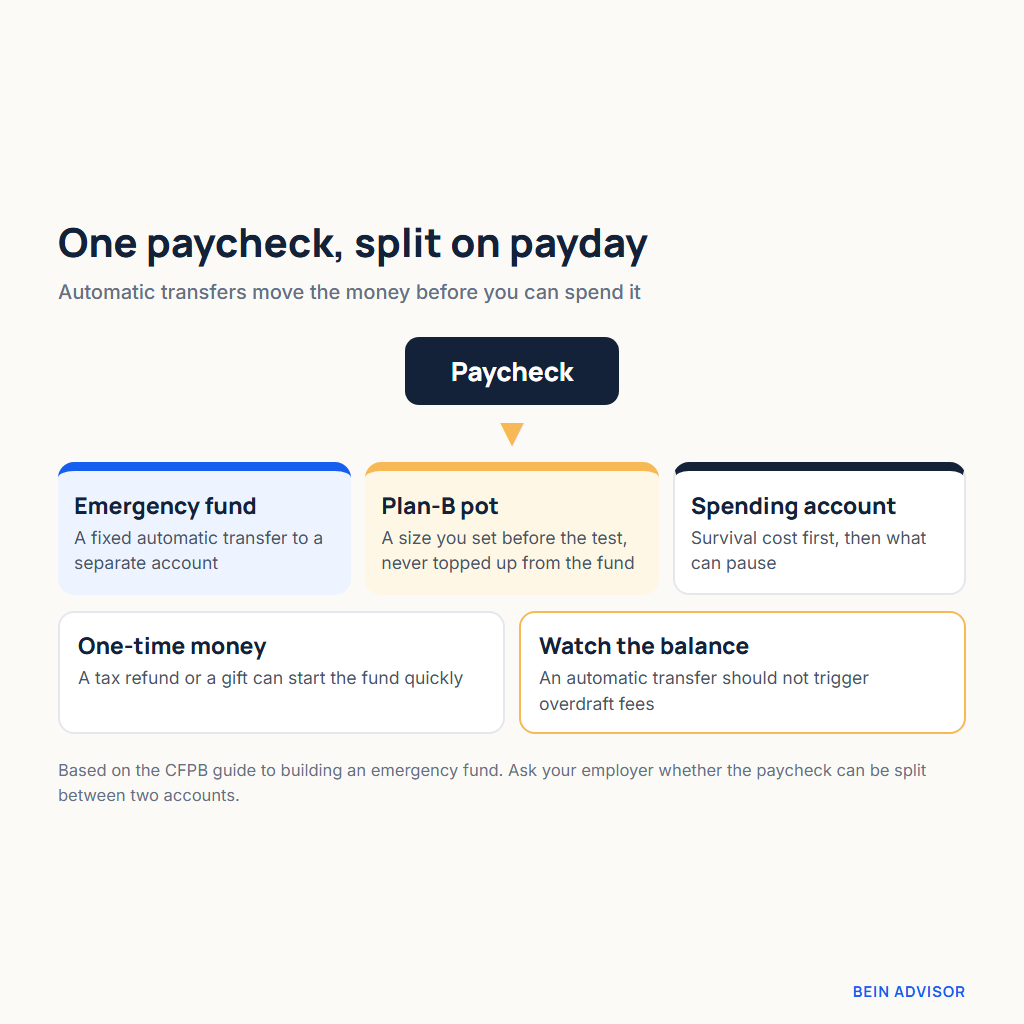
The Plan-B budget holds only money you can afford to spend and lose. You fix its size before the test starts, and you never top it up from the emergency fund. The emergency fund, in contrast, is meant to be boring. The CFPB advises keeping it safe, accessible, and somewhere you will not be tempted to spend it on non-emergencies. It also warns that cash can be stolen, lost, or destroyed. Therefore, a separate savings account with no card attached suits this pot. Write down what counts as an emergency as well: job loss, an urgent medical bill, or a repair you need to keep working.
According to the CFPB guide, automatic recurring transfers are one of the easiest ways to save consistently. The guide also suggests asking your employer whether a paycheck can be split between two accounts. One-time money, such as a tax refund or a gift, can start a fund quickly. However, keep an eye on the main account, because the same guide warns about overdraft fees. Couples who pool money can use a guide to splitting finances as a couple to agree who funds which pot. The investing pot, meanwhile, sits outside this guide, because investing is a separate decision with its own risks. Ultimately, none of the three pots should quietly pay for another.
A Worked Plan-B Example
Consider a hypothetical payroll clerk who offers small shops a fixed-price monthly cleanup of their sales records. The buyers are 20 nearby shop owners. For this test, the Plan-B pot holds $300 for a simple one-page site and printed cards. One shop pays by day 30. By day 90, three shops, including that first one, have ordered twice each: six orders at $120. Altogether, the clerk has earned $720 over 48 hours of work: $15 an hour before costs, or about $8.75 after the $300.
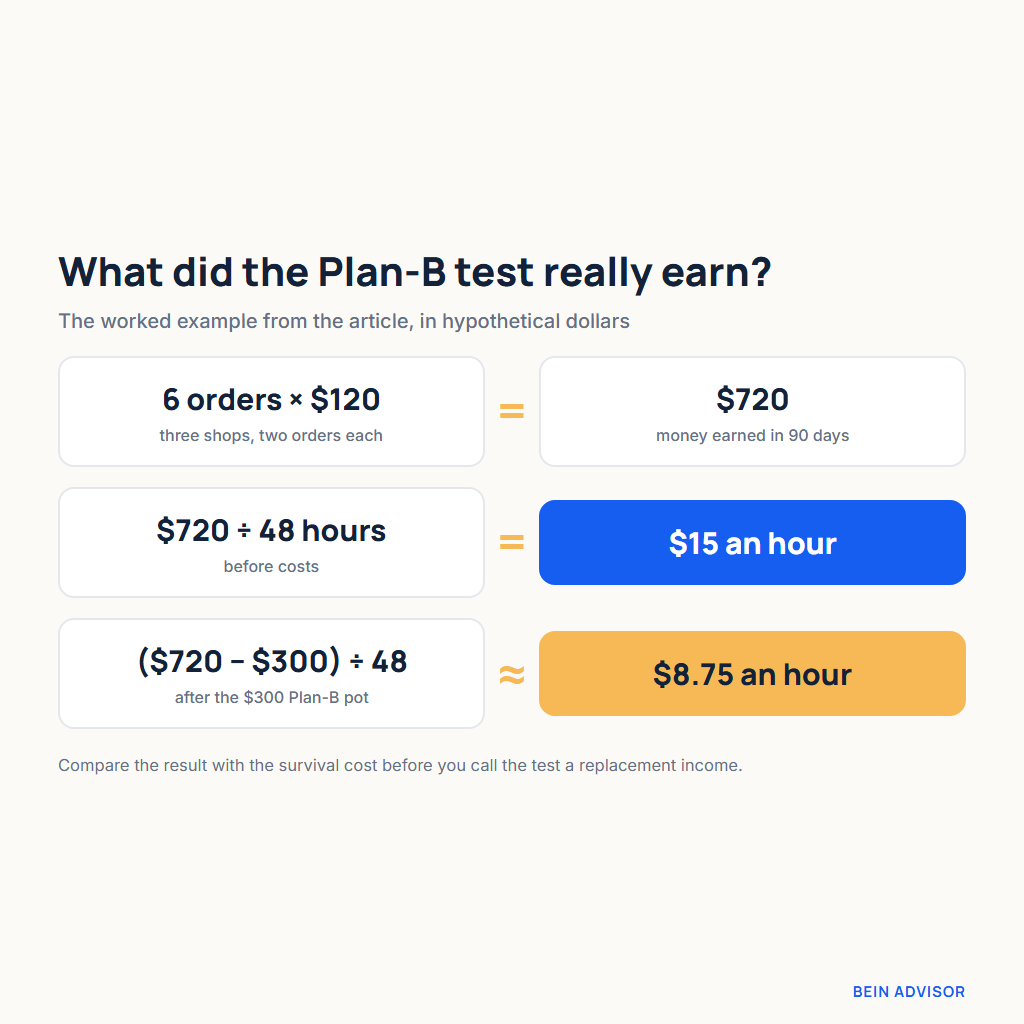
That last figure is the real result. Money per hour shows whether the work could grow into an income or would only fill evenings. For instance, $8.75 an hour may justify a second round at a higher price. On the other hand, a result of $3 an hour points to a different offer or a different skill. Either way, the salary keeps paying survival cost, and the emergency fund stays untouched.
Write the result down in one line, with dates and figures, and record what failed, such as a buyer group that never replied. In fact, a failed test still teaches something specific. Its only cost to your financial security is money that was set aside to be lost.
Number Five: Your Quit Threshold for Financial Security
Leaving a salary is the biggest single bet on your financial security, so it deserves a checklist. A bad week at work makes the decision feel urgent. A written threshold, however, keeps it tied to evidence. Therefore, set the threshold while you are calm, and read it again whenever the urge to quit arrives.
| Readiness check | Threshold example (hypothetical) | Met? |
|---|---|---|
| Runway at survival cost | At least 9–12 months in the emergency fund | Yes / No |
| Plan-B income | Covers survival cost for 3–6 months in a row | Yes / No |
| Debts | All payments current; no new card balances | Yes / No |
| Household agreement | Everyone affected agrees to the plan and date | Yes / No |
| Health coverage | Replacement coverage arranged before the salary ends | Yes / No |
Each line answers a separate fear. Runway answers how long the household can last. Plan-B income answers whether money will keep coming in. The debt line keeps missed payments from following you into the new venture. Health coverage guards against a costly surprise, and agreement matters because the risk falls on everyone at the table.
Five yes answers make leaving a measured step. In contrast, a single no moves the date. For instance, three shops at $120 a month bring in $360, far short of the $2,240 survival cost in the single-employee example. Consequently, the clerk keeps the job, raises the price, and runs another 90 days. That outcome still counts as progress toward financial security, because the gap now has a size.

A Quarterly Financial Security Review
Five numbers protect your financial security only if someone looks at them. Therefore, pick one evening every three months and update a small dashboard.
| Number | Example reading (hypothetical) | Warning sign |
|---|---|---|
| Survival cost | $2,240 a month | Rises faster than income |
| Months of runway (reserve ÷ survival cost) | 3.0 months | Falls for two quarters in a row |
| Target runway | 6 months = $13,440 | Not re-measured within the year |
| Plan-B test result | $8.75 an hour after costs | No test running and none planned |
| Quit threshold | 2 of 5 met | Talk of quitting without the checklist |

Compare each reading with the last one. For example, a runway that grew from 3.0 to 3.4 months shows the system working, even while the target is still far off. A rising survival cost, on the other hand, is an early signal worth acting on before it shrinks the runway.
Once a year, let one review start from fresh statements. The IMF’s explainer on inflation defines inflation as the rate of increase in prices over a given period. When incomes grow more slowly than prices, buying power falls. As a result, a cash target set once covers fewer months of survival cost later. For instance, if groceries and rent have risen, the money target rises with them, even when the months stay the same. Ultimately, four reviews a year turn your financial security into a set of trends you can steer.
Take the first step in a single evening at the table. Open the last three months of bank and card statements, mark each line E or P, and add up the E lines. Divide that total by three, then add one twelfth of any annual essentials, such as registration or school fees, that the statements do not show. That single figure is your survival cost, and every other number in this guide starts from it.