
Ask a few people what they need to live on each month, and the answers tend to be either too harsh or too soft. Both errors start in the same place: nobody has written down their essential expenses. The harsh number leaves out the dentist, the school trip and the car registration, so the plan breaks in the first month. The soft number quietly includes takeout, streaming and new clothes, so every safety target built on it is bigger than it needs to be.
Your essential expenses are the costs you would still have to pay if your income stopped tomorrow. That single figure sits underneath almost every money decision a household makes. It sets the size of an emergency fund, the number of months you can last between jobs, and the income a side business must reach before it can replace a salary. When the figure is wrong, every one of those plans inherits the error.
This guide shows how to calculate essential expenses from real statements in one sitting. It covers which costs belong in the figure and which do not, how to handle annual and irregular bills, and how family obligations change the count. It then shows how to keep the number current and how to turn it into months of runway. Every amount below is an illustration; your own records supply the real figures.
Gather Three Months of Spending Before You Count Essential Expenses
Memory is a poor accountant. People remember rent and the phone bill, but they forget the pharmacy run, the school supplies and the cash handed out for small things. So start with records, not guesses. Pull three months of bank and card statements, plus receipts for anything you paid in cash. Three months is long enough to catch most monthly patterns and short enough to finish in an evening.
The Consumer Financial Protection Bureau (CFPB) publishes a free Your Money, Your Goals toolkit that includes a spending tracker and a bill calendar. The tracker sorts a month of spending into categories, and the calendar shows when each bill falls due. Either one works as a starting sheet. A plain notebook or spreadsheet works just as well, as long as every payment lands somewhere.

Mark each line with one of two colors as you go. One color means the cost continues in a crisis. The other means it could pause. Do not argue with yourself yet; the next section gives a test for the hard cases. The goal of this first pass is simply that nothing stays unsorted.
One Question That Separates Essential Expenses From the Rest
For each line, ask: if my income stopped for two months, would skipping this cost put my job, my home or my health at risk, or break a legal duty? If the answer is yes, it belongs in your essential expenses. If the answer is no, it is flexible, even when you enjoy it every week. The question works because it ties the decision to consequences rather than to feelings.
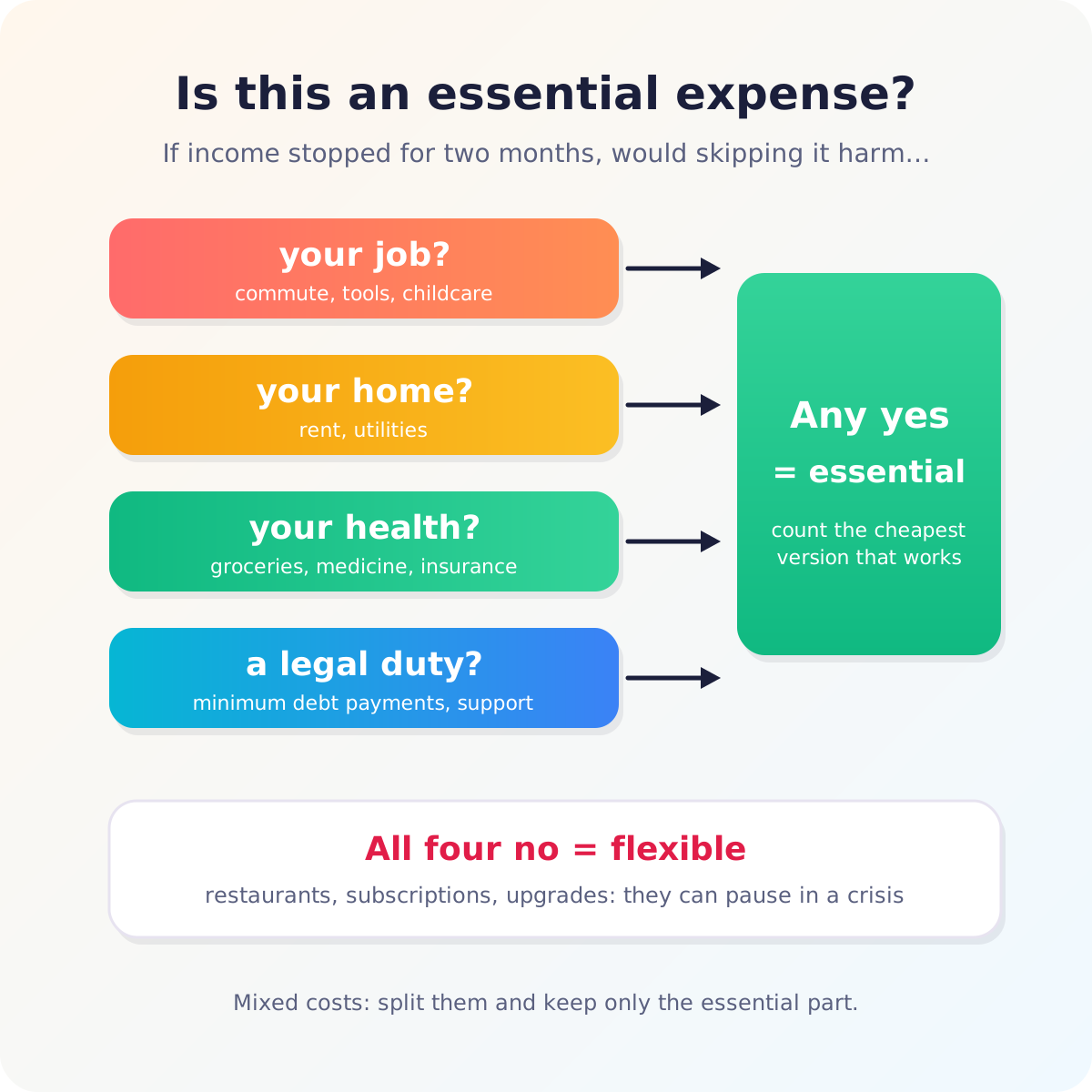
The CFPB uses the same order of priorities in its checklist for when cash is short. It lists protecting your income first, then your shelter, then essential insurance and other assets, then legal obligations such as child support and taxes. It also warns that payments you miss now will have to be made up later. That warning is why minimum debt payments belong in the essential figure.
| Expense | Essential? | Why |
|---|---|---|
| Rent or mortgage | Yes | Protects shelter |
| Electricity, water, heating | Yes | Protects the home and health; disconnection adds fees |
| Basic groceries | Yes | Health |
| Commute to work | Yes | Protects the income itself |
| Health insurance and regular medicine | Yes | Health and assets |
| Minimum debt payments | Yes | Missed payments return later with added costs |
| Restaurants and takeout | No | Can pause without harm |
| Streaming and app subscriptions | No | Can pause without harm |
| Phone plan | Partly | A basic plan is essential; the premium tier is not |
Split the mixed costs instead of choosing a side
Some costs are partly essential. A phone is necessary for most job searches, but an unlimited premium plan is not. Groceries are essential, but the specialty items in the cart are not. For these, write down the cheapest version that still does the job and count only that part. Splitting mixed costs removes the premium part of a bill while keeping the service you rely on.

Annual Bills in Your Essential Expenses: Divide by Twelve
An essential expenses figure often fails because it counts only what arrives every month. Car insurance, school fees, property tax, license renewals and the yearly boiler service all arrive on their own schedule. When one of them lands, it feels like an emergency, even though it was on the calendar all along.
The fix is simple arithmetic. List every bill that comes once, twice or four times a year. Add up the yearly total, then divide by twelve and add that monthly share to your essential expenses. For example, $900 of car insurance, $600 of school fees and $300 of renewals make $1,800 a year, which is $150 a month. That $150 belongs in the figure even in months when nothing is due.
Then open a separate savings pot for those bills and move the monthly share into it automatically. When the insurance renewal arrives, the money is already waiting. As a result, the emergency fund stays reserved for real surprises instead of predictable invoices.
Family Obligations That Cannot Pause
Families carry costs that a one-person budget does not show. Childcare that lets a parent keep working is essential, because it protects the income. So are school fees that cannot be deferred, regular medicine for a child or a parent, and money you send to a relative who depends on it. If someone would be harmed by a two-month pause, the cost belongs in the figure.
Couples should agree on the list together. Two people often sort the same cost differently, and a disagreement found during a crisis is far harder to settle than one found at the kitchen table. The guide to splitting finances as a couple covers how to divide shared costs once the list is agreed.

A Worked Example of Essential Expenses
Here is how the pieces combine for an illustrative household of two adults and one child. The figures are examples only, chosen to show the method rather than to suggest what any household should spend.
| Category | Monthly amount | Note |
|---|---|---|
| Rent | $1,200 | Shelter |
| Utilities | $180 | Electricity, water, heating |
| Groceries (basic) | $450 | Specialty items removed |
| Transport to work | $160 | Fuel and parking or a transit pass |
| Health insurance and medicine | $210 | Regular prescriptions included |
| Minimum debt payments | $140 | Minimums only, not extra payments |
| Basic phone and internet | $70 | Cheapest plan that works |
| Annual bills ÷ 12 | $150 | Insurance, school fees, renewals |
| Essential expenses | $2,560 |
In a normal month, that household might spend $3,600 once restaurants, subscriptions, clothes and gifts are added. The gap of $1,040 is the room it has to cut in a crisis. Knowing both numbers matters: the essential figure sets your safety targets, and the full figure shows your everyday cost of living.
Mistakes That Make Essential Expenses Too Harsh or Too Soft
A harsh figure feels virtuous but fails in practice. A soft figure feels comfortable but inflates every target. These are the patterns that push the number off course in either direction.
- Too harsh: leaving out medicine bought every second month, school trips, or the car registration.
- Too harsh: assuming groceries can drop to a level the household has never actually lived on.
- Too soft: counting the full premium phone plan or every subscription as essential.
- Too soft: including extra debt payments instead of minimums only.
- Either way: using one unusual month instead of an average of three.
A useful check is to read the final list aloud to someone in the household. If a line makes them laugh, it is probably flexible. If they point out a missing cost, it was probably essential.
Keep the Essential Expenses Figure Current
Prices do not stand still. The International Monetary Fund describes inflation as the rate at which prices rise over time, and notes that a fixed amount of money loses purchasing power. In practice, an essential expenses figure measured a while ago will understate today’s cost, and every target built on it will be too small.
Recalculate the figure once a year from fresh statements, and again after any big change: a move, a new child, a new car, or a change in health costs. Then update the targets that depend on it. The emergency fund target, for example, is simply the new essential figure multiplied by the number of months you chose.

Turn Essential Expenses Into Months of Runway
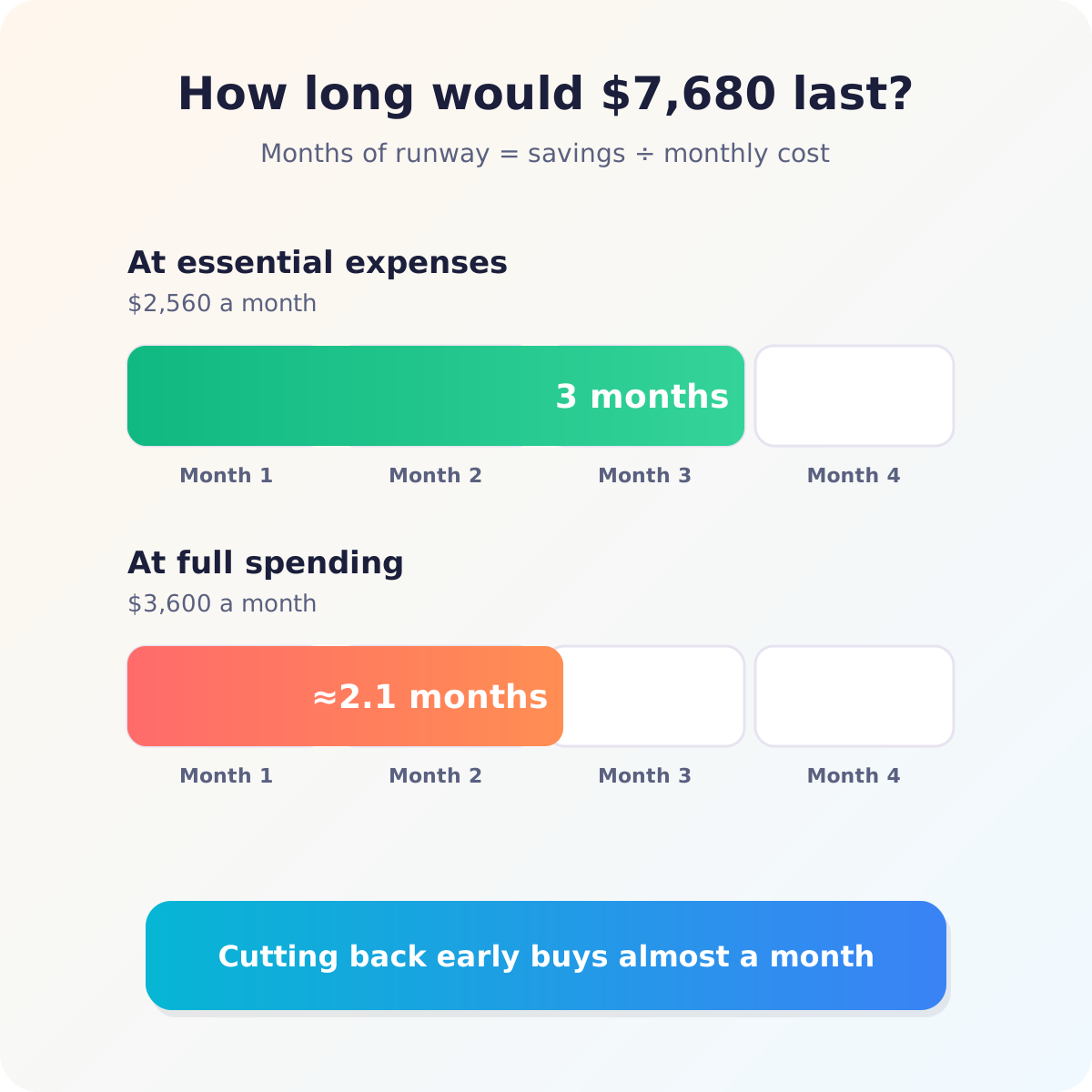
Once you trust the number, it answers a question that matters more than any budget: how long could you last without income? Divide the money you can reach quickly by your essential expenses. The result is your runway in months. In the example, $7,680 of savings divided by $2,560 gives three months of runway.

Run the same sum with full monthly spending, and the picture changes. The same $7,680 divided by $3,600 lasts a little over two months. That difference is why the essential figure matters so much: the cuts you are willing to make in a crisis add almost a full month of time to look for work.
Write both runway numbers down. The first shows how long your savings last if you cut back at once, and the second shows how quickly they drain if you change nothing. Both are honest, and both help you plan the next step.
Frequently Asked Questions
Should I count a partner’s income when I calculate runway?
Count it only if it would continue when your income stops. A second salary that stays in place shortens the gap you need to cover. Even so, calculate essential expenses for the whole household, because the bills do not split themselves when one income disappears.
Should savings contributions count as essential expenses?
No. Savings stop when income stops, so they are not part of the figure you need to survive. Count them in your normal budget instead.
What if my essential expenses are higher than my income?
Then your essential expenses figure has done its job by showing the problem early. Start with the largest essential lines, such as housing and debt, and look for cheaper versions. The CFPB toolkit includes a worksheet for cutting expenses that can help structure that review.
How precise does the number need to be?
Round to the nearest ten or twenty. The aim is a figure you trust, not one accurate to the cent. Precision matters less than including every category.
Conclusion: One Evening, One Reliable Number
Calculating essential expenses takes one evening with three months of statements, two highlighter colors and a calculator. Sort every line with the two-month test, split the mixed costs, and add a twelfth of each annual bill. The result is your essential expenses figure, the number your whole safety plan stands on.
Next, use it. Multiply it by the number of months that fits your situation to set your emergency fund target. The financial security guide shows how the figure connects to the rest of the plan.