
Staying with one booking site only pays if the site hands something back. Travel loyalty programs promise that return in three forms: a lower price today, a credit for a later trip, or a perk such as a free breakfast. The useful question is how much comes back on every $1,000 you spend, and when you can use it.
This guide runs that arithmetic for four travel loyalty programs: Booking.com Genius, Expedia One Key, Trip.com Rewards and AgodaVIP. Every figure comes from the platform’s own published terms. However, platforms revise those terms, so confirm each rate on the official page before you book. The later sections match the numbers to four kinds of traveller. In fact, a rate that rewards a frequent hotel guest can return almost nothing to someone who books once a year.
What Travel Loyalty Programs Return on $1,000
The four schemes pay in different currencies, so a fair comparison needs one yardstick. Take $1,000 of bookings and ask what each published rate gives back. Booking.com Genius answers with a price cut. Level 1 starts when you create an account and lists a 10% discount on stays. As a result, a $1,000 stay at a participating property costs $100 less at the moment you book. Level 2 lists 10–15% and Level 3 lists 10–20%, and the percentage varies by property.

Expedia One Key combines two mechanisms. The first is Member Prices on select hotels: “10% or more” for Blue members, “15% or more” for Silver, and “20% or more” for Gold and Platinum. The second is OneKeyCash, a credit earned on eligible bookings. Blue members earn 1%, Silver and Gold earn 2%, and Platinum earns 3%. Therefore, $1,000 of eligible spend returns $10, $20 or $30 in OneKeyCash. The rate rises at stays that Expedia labels VIP Access. For example, Silver earns 3% there, Gold 4% and Platinum 6%.
Trip.com Rewards pays in Trip Coins, and 100 coins are worth roughly $1. Hotels and cruises earn 50 coins per $100 spent. In contrast, flights and trains earn 20 coins, and a flight-plus-hotel package earns 35. Consequently, $1,000 of hotel bookings returns about $5, while $1,000 of flights returns about $2. Those sums are small beside a 10% discount. That said, Trip.com attaches its stronger benefits to tier status, which a later section covers.
AgodaVIP is the hardest of the four travel loyalty programs to convert into a single number. Agoda describes its tiers through VIP deals of “up to 12%”, “up to 18%” and “up to 25%” off as the level rises. An “up to” figure is a ceiling, so it does not tell you what a typical booking saves. In addition, Agoda’s pages show no per-tier points currency. The table therefore gives no dollar figure for Agoda.
The $1,000 Worked Example in One Table
The table below is a worked example for the four travel loyalty programs. It applies each published rate to $1,000 and assumes the booking qualifies. However, it cannot show which site charges the lowest final price, because none of the published terms compare final prices.
| Program and level | Published rate | Worked example on $1,000 | When you get it | Conditions |
|---|---|---|---|---|
| Genius, Level 1 | 10% off stays | $100 off | At booking | Participating properties and select stays only |
| Genius, Level 3 | 10–20% off stays | $100 to $200 off | At booking | Percentage varies by property |
| One Key, Blue | 1% OneKeyCash | $10 credit | Later eligible booking | Taxes and fees excluded; United States figures |
| One Key, Silver or Gold | 2% OneKeyCash | $20 credit | Later eligible booking | 3% (Silver) or 4% (Gold) at VIP Access stays |
| One Key, Platinum | 3% OneKeyCash | $30 credit | Later eligible booking | 6% at VIP Access stays |
| Trip.com, hotels | 50 Trip Coins per $100 | 500 coins, about $5 | Later booking | Booking coins expire 18 months after crediting |
| Trip.com, flights | 20 Trip Coins per $100 | 200 coins, about $2 | Later booking | Same 18-month expiry |
| AgodaVIP | VIP deals “up to” 12%, 18% or 25% | No fixed figure; no points rate published | At booking, where a VIP deal applies | Ceiling figures; status lasts six months |
A Discount Today and a Credit for Later Are Different Money
The table mixes two kinds of return, and they should not be added together as equals. A discount lowers the price you pay today, and no later trip is required. A credit, on the other hand, has value only if you book again on the same platform before the credit lapses. Most travel loyalty programs lean on one of these two models, and the model decides who benefits.
Among these travel loyalty programs, OneKeyCash shows most clearly how a credit works. One dollar of OneKeyCash takes one dollar off a later eligible booking. However, the credit cannot be redeemed for cash, and it works only on Expedia and its participating brands, Hotels.com and Vrbo. Consequently, a traveller who earns $20 and then books the next trip on another site has earned nothing usable. The credit, in turn, nudges the next booking toward the same group even when another site lists a lower price.
Trip Coins add a clock to the same idea. Coins earned from bookings expire 18 months after they are credited. Meanwhile, coins earned from reviews expire after six months. A traveller who books every two years would therefore lose booking coins before the next trip. The practical test for any credit is to name the trip on which you will spend it. If you cannot name one inside the expiry window, count the credit as zero.

How Travel Loyalty Programs Award Status and How Long It Lasts
Rates depend on tier, so the next question is how much booking each tier demands. These four travel loyalty programs count different things over different periods. Genius and Agoda count bookings over two years. One Key, in contrast, counts “trip elements” inside a calendar year, and each element must be worth $25 or more before taxes and fees. Trip.com counts bookings and, at the upper tiers, dollars spent within 12 months.
How long a tier lasts matters as much as how it is earned. Booking.com states that once you unlock a Genius level, its rewards “are yours for life”. Similarly, Trip.com makes Silver and Gold permanent. AgodaVIP status, in contrast, lasts six months and renews only when the required bookings are made in that time.
| Program | How each tier is earned | How long the tier lasts |
|---|---|---|
| Booking.com Genius | Level 1 on account creation; Level 2 after 5 bookings in 2 years; Level 3 after 15 bookings in 2 years | For life once unlocked, according to Booking.com |
| Expedia One Key | Trip elements in a calendar year: Blue 0–4, Silver 5–14, Gold 15–29, Platinum 30 or more | Counted per calendar year; confirm the renewal rule on the official page |
| Trip.com Rewards | Silver on registration; Gold after 1 eligible booking; Platinum after 3 eligible bookings within 12 months of reaching Gold; Diamond after 8 eligible bookings and $1,000 of spend within 12 months; Diamond+ after $10,000 of spend within 12 months of reaching Diamond; Black Diamond by invitation only | Silver and Gold permanent; Platinum and above last 12 calendar months; a tier never drops below Gold |
| AgodaVIP | Silver after two bookings within two years; further bookings lead to Gold, Platinum and Diamond | Six months, renewed when the required bookings are made in that time |
Two details in the table change the arithmetic. First, cancelled bookings on Trip.com raise the remaining requirement, so a cancelled trip sets your progress back. Second, One Key resets its count with the calendar, while Genius looks back over two years. Consequently, a traveller with one busy year followed by a quiet one keeps Genius rewards more easily than a calendar-year tier. Travel loyalty programs with short validity therefore suit steady bookers and penalise irregular ones.
If You Book Once or Twice a Year
An occasional traveller should ignore the upper tiers of travel loyalty programs and look only at what arrives on day one. Genius Level 1 does the most at that stage, because the 10% discount on stays begins with the account itself. One Key Blue offers a comparable entry point. Its Member Prices of “10% or more” apply to select hotels, and 1% in OneKeyCash is added on eligible bookings. Meanwhile, registration on Trip.com gives Silver, and a single eligible booking gives Gold for good.
Higher levels sit just out of reach at this pace. Genius Level 2 needs five bookings in two years. Two bookings a year produce four in that period, which is one short. Similarly, One Key Silver needs five trip elements in a single calendar year. AgodaVIP is more reachable on paper, since Silver starts after two bookings within two years. That said, Agoda status is valid for six months, so widely spaced trips make it hard to keep.
Credits are the weak point for this profile. A $10 OneKeyCash balance or 500 Trip Coins helps only if the next booking lands on the same platform. For instance, a traveller who takes one trip a year still fits inside Trip.com’s 18-month coin window. Someone who travels every second year, on the other hand, does not. Ultimately, an occasional traveller gains most from immediate discounts and should treat any credit as a bonus. Travel loyalty programs reward repetition, and one or two bookings a year give them little to reward.
Travel Loyalty Programs for Frequent Hotel Bookers
Frequent hotel stays are where concentration starts to pay, because several tiers are counted in bookings. Fifteen bookings in two years unlock Genius Level 3. That level lists 10–20% discounts on stays, free breakfasts and room upgrades on select options, and priority support for stays. An unlocked level is kept for life, according to Booking.com. Therefore, under Booking.com’s present terms, a busy two-year stretch keeps those rewards even if your travel slows afterwards. Booking.com can still change the programme.

One Key asks for more activity in less time. Gold requires 15 trip elements in one calendar year, and Platinum requires 30. The step from Silver to Gold deserves a close look. Member Prices move from “15% or more” to “20% or more” on select hotels. However, the base OneKeyCash rate stays at 2% for both tiers. Gold improves the cash rate only at VIP Access stays, where it rises from 3% to 4%. In addition, Gold brings One Key Price Drop Protection, which issues the price difference as OneKeyCash.
Trip.com sets a mixed target for hotel regulars. Diamond needs at least eight eligible bookings and $1,000 of spend within 12 months. Hotels earn the top coin rate on the platform, at 50 coins per $100. That rate equals about 0.5%, however, so the coins are a minor part of the return. The tier perks carry more weight. For example, Platinum members and above receive a free global eSIM data package.
AgodaVIP offers the largest headline figure for hotel bookers, with VIP deals of “up to 25%” at the top of the range. Platinum members qualify for free breakfast at many accommodations. Furthermore, higher tiers unlock room upgrades and flexible cancellation at select properties. Status expires after six months unless the required bookings are made. As a result, AgodaVIP suits travellers who stay in hotels throughout the year.
One caution applies to every hotel-focused traveller. Travel loyalty programs tie these discounts to properties that take part, and the hotel you want may not be among them. Suppose you have already chosen a specific property, such as one of the hotels overlooking the Kaaba. Check whether the member rate appears on that listing before you count on a tier discount. Hotel chains, meanwhile, run their own points schemes. Whether a platform booking earns those points depends on the chain, so read the chain’s terms.
If Most of Your Spend Is Flights
Flight-heavy travellers get the thinnest published returns from these travel loyalty programs. Trip.com is the only platform here with a stated flight rate, and it is 20 coins per $100. Consequently, $1,000 of airfare returns about $2, less than half of what the same sum earns on hotels. A flight-plus-hotel package sits between the two, at 35 coins per $100. Bundling a room with the fare therefore lifts the rate on that purchase, although the gain is only a few dollars.
One Key gives no separate figure for flights on its present page. The programme lists a single OneKeyCash rate for “eligible bookings”, so check whether a given fare qualifies before assuming 1–3% back. That said, the tiers do add flight-related extras, and Blue members get free price tracking for flights. In addition, Gold and Platinum members get free lounge access when an eligible flight is delayed 90 minutes or more.
Genius focuses its discounts on stays and select rental cars. For flights, Level 1 lists price alerts, which help with timing but do not reduce a fare. Similarly, the benefits Agoda describes for AgodaVIP concern accommodation: deals, breakfast, upgrades and flexible cancellation. A traveller who mainly buys airfare should therefore expect little cash back from any of these travel loyalty programs.
Status perks are the stronger argument for this profile. Trip.com’s Platinum tier needs three eligible bookings within 12 months of reaching Gold, and it includes free airport VIP lounge access. Moreover, Diamond+ and Black Diamond members receive a flight-hotel cancellation guarantee. For a frequent flyer, a lounge visit or a protected cancellation may be worth more than $2 per $1,000.
Which Travel Loyalty Programs Deliver Breakfast, Lounges and Upgrades
Some travellers care less about cash and more about how the trip feels. Perks in travel loyalty programs need the same scrutiny as percentages, because almost every one carries a qualifier. The words to look for are “select”, “when available” and “many”. Each of them means the perk is possible on a given booking but not promised.
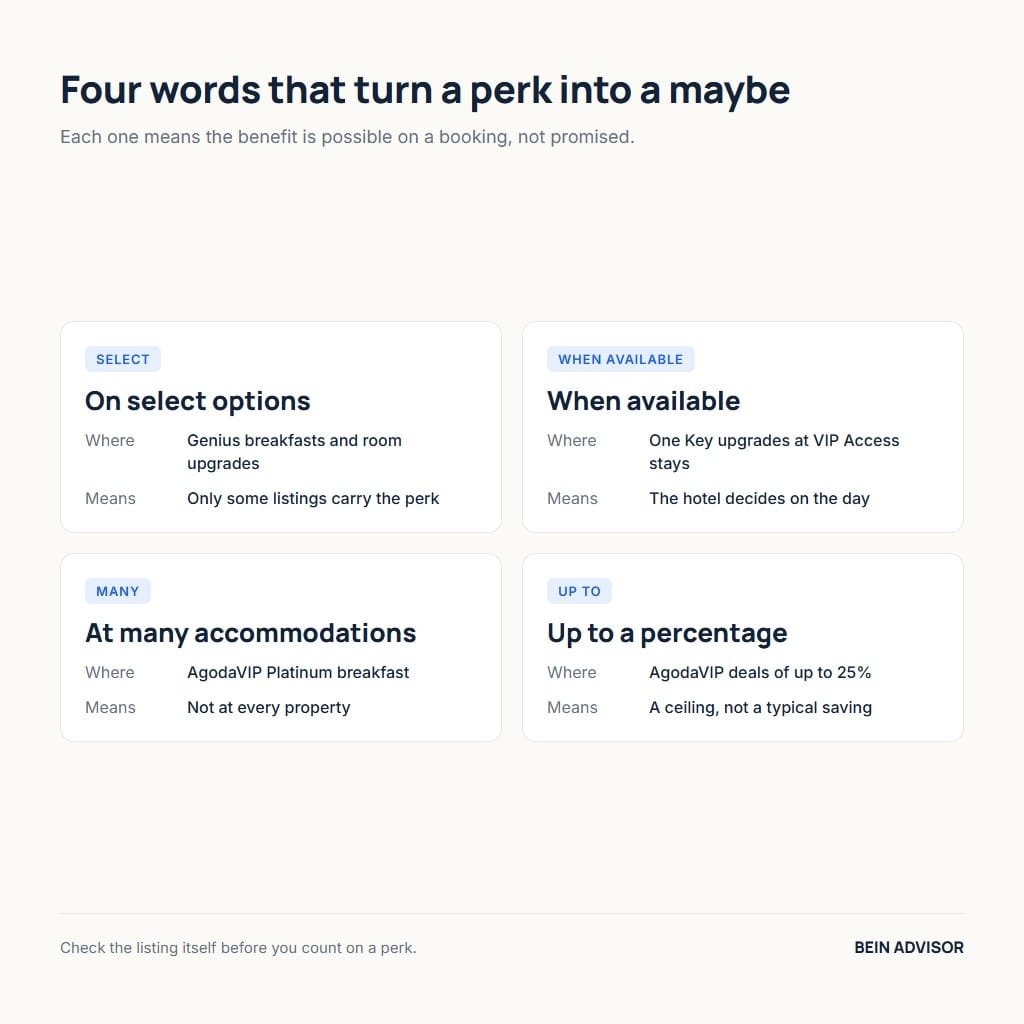
Free breakfast arrives earliest on Genius. Level 2 lists free breakfasts on select options, and Level 2 needs five bookings in two years. AgodaVIP places breakfast at Platinum, where members qualify at many accommodations. However, Agoda status has to be renewed every six months through further bookings, so the breakfast perk lapses if the bookings stop.
Room upgrades appear in three of the four schemes. Genius lists them from Level 2 on select options. One Key offers them to Gold members when available at VIP Access stays. Additionally, Agoda’s higher tiers unlock upgrades at select properties. One Key adds a restriction that is easy to miss: VIP Access perks are unavailable on third-party supplied rates at those properties. As a result, a Gold member can book a VIP Access hotel and still receive no upgrade if a third party supplies the rate.
Lounge access separates two of these travel loyalty programs clearly. Trip.com lists free airport VIP lounge access for Platinum members and above, with no delay condition in its tier description. One Key’s version, Flight Delay Access, is narrower. It applies to Gold and Platinum members only when an eligible flight is delayed 90 minutes or more. Therefore, a traveller who wants a lounge on ordinary travel days should look at Trip.com’s Platinum requirement first.

Priority support matters most when a booking goes wrong. One Key offers it from Silver, and Genius offers it at Level 3 for stays. AgodaVIP, on the other hand, reserves priority customer support for Diamond, along with early access to limited-time coupons. Ultimately, perk seekers should choose the single perk they would use on most trips. Travel loyalty programs spread their extras widely, and chasing all of them across four sites earns none.
What Travel Loyalty Programs Do Not Tell You Up Front
Headline rates leave out the conditions that decide whether you receive them. The first is participation. Genius discounts apply only at participating properties and on select stays and rental cars. In addition, Booking.com neither counts nor discounts cruises, insurance, public transportation, ride hail and free options. Add-ons such as room upgrades do not qualify either. A traveller can therefore be a member, book on the platform, and still see no discount on a particular purchase.
The second condition is the base on which a reward is calculated. One Key excludes taxes and fees from both Member Prices and OneKeyCash. Consequently, the amount that earns credit is smaller than the total you pay. Some charges are collected by the property itself after you arrive. For instance, our guide to avoiding pet-friendly hotel fees at check-in covers one such cost. Compare final totals, because travel loyalty programs can apply their percentages to only part of the bill, as One Key does.
Geography is the third condition, and it affects One Key directly. The One Key rates in this article come from the United States site. Furthermore, the programme’s own FAQ treats use in other regions as a separate question. A reader outside the United States should therefore open the One Key page for their country. Two things need confirming there: that One Key operates in that country, and which rates apply.
Price-match promises have limits of their own. Booking.com’s “We Price Match” refunds the difference when the same booking is cheaper elsewhere, within set criteria. However, several cases fall outside it. The exclusions include opaque websites, where the hotel name stays hidden until after payment. They also include loyalty-programme prices on other sites, Partner Offers and cancelled bookings. Moreover, Booking.com alone decides whether a claim is eligible. In fact, a cheaper member rate on a rival site is exactly the case the promise does not cover.
The last point is that none of these terms is fixed. Booking.com’s terms state that it may change any feature of Genius, including the levels and which bookings count. Other travel loyalty programs revise their terms as well, which is why every figure here needs confirming on the official page. Furthermore, no published rate says which platform is cheapest overall. Only a like-for-like price check on your own dates can answer that question.
Choosing Among Travel Loyalty Programs
The arithmetic points to a clear order of priorities. A discount at booking is worth its face value, so Genius Level 1 and One Key Member Prices help even a once-a-year traveller. A credit, in contrast, is worth less than its face value unless a second booking is already planned on the same platform. Frequent hotel guests gain most from concentrating bookings, since Genius Level 3 needs 15 bookings and One Key Gold needs 15 trip elements. Flight buyers, on the other hand, should judge travel loyalty programs by status perks such as lounge access, because the cash return on airfare is small.
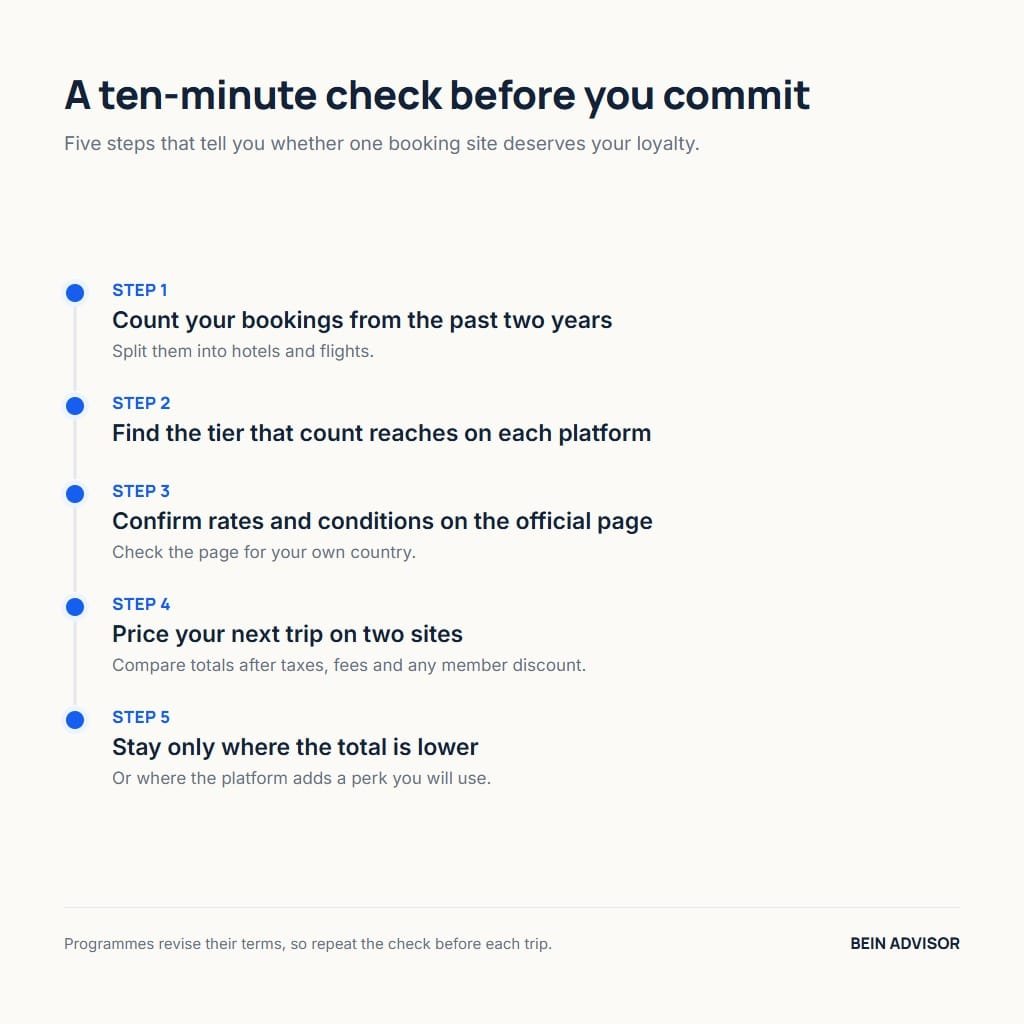
Your next step takes about ten minutes. Count the bookings you made over the past two years and split them into hotels and flights. Then find each platform in the tier table and note which level that count reaches. Open the official page for each of those travel loyalty programs and confirm the present rates and conditions for your country. Finally, price your next trip on two sites and compare the totals after taxes, fees and any member discount. Stay with one platform only if the total is lower there, or if it adds a perk you will use.