

Choosing a first digital-marketing course can feel harder than learning the first skill. In fact, course pages use similar promises. They differ in scope, practice, pace, provider, and the kind of learner they serve. This guide compares five beginner options on Coursera so you can choose by goal instead of by the loudest description. It explains what each course covers, where each option fits, what the official course information does not prove, and how to build a practical study decision. As a result, you will leave with a short list of questions that protects your time and budget before enrollment. In fact, the best digital marketing courses for beginners are not identical, even when they share words such as SEO, social media, content, analytics, and campaigns.
For example, one course may be a quick orientation, while another gives a broader map of marketing and e-commerce. Similarly, a third may emphasize campaign planning, and a fourth may explain how digital tools changed traditional marketing decisions. Therefore, the right choice depends on what you need to do after the lessons: understand the field, test a channel, plan a campaign, or build a structured foundation for further study.
This comparison of digital marketing courses uses information listed on official Coursera course pages, including level, module structure, estimated schedule, provider, and stated learning outcomes. However, these details can change, so check access, language, assessment format, price, financial-aid terms, and certificate conditions on the course page before paying. In addition, a certificate can document completed learning. It cannot guarantee a job, a client, a salary, or a particular marketing result. Ultimately, the goal is a better enrollment decision, not a promise that one course will fit every beginner.
1. How to choose among digital marketing courses
Start with the decision you want the course to support. For example, a learner who wants a broad introduction needs a different first step from someone who already understands marketing and wants campaign practice. Write one sentence before comparing digital marketing courses: “I want to learn digital marketing so I can…” The ending might be understand the funnel, manage social campaigns, connect marketing with e-commerce, interpret audience data, or decide whether a marketing career deserves more study. As a result, this sentence prevents a familiar brand name from making the decision for you.

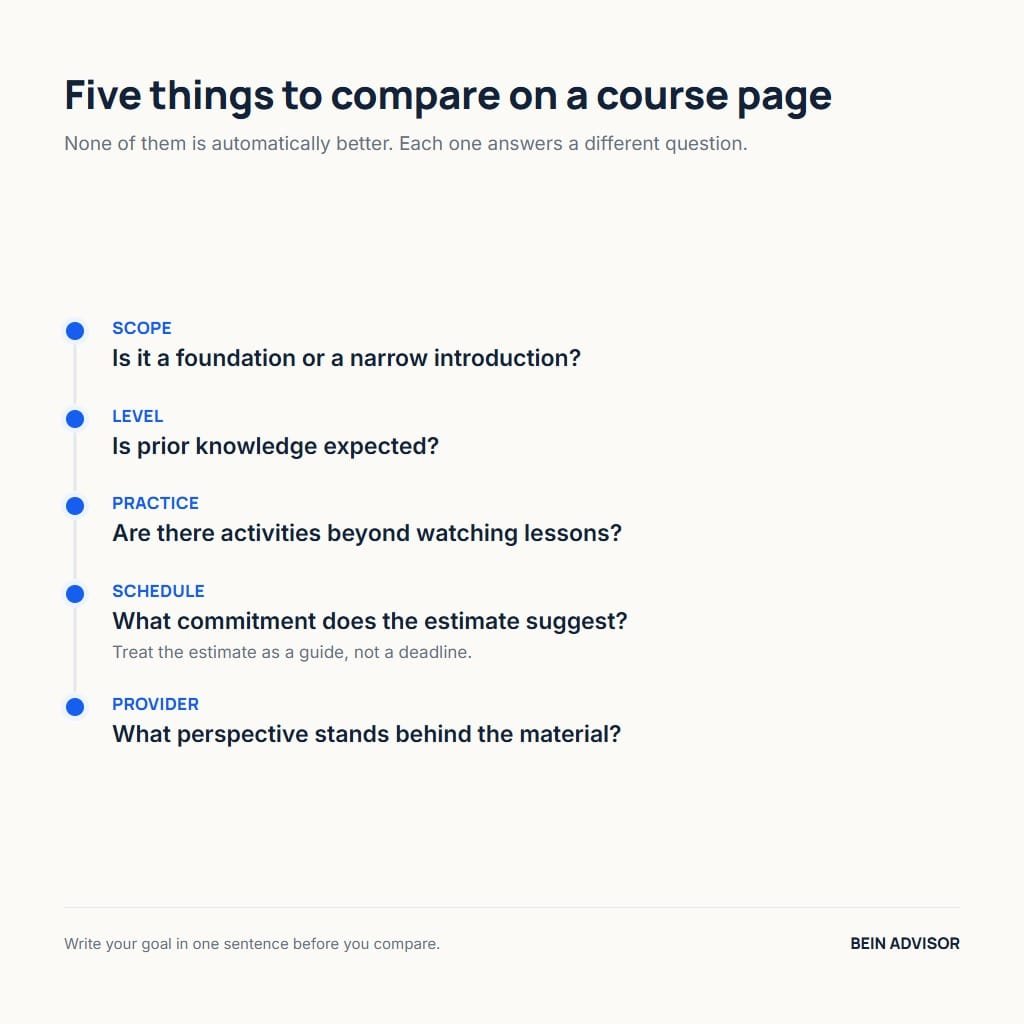
Then compare five practical dimensions. Scope tells you whether the course is a foundation or a narrow introduction. Similarly, level tells you whether prior knowledge is expected. In addition, practice shows whether the page describes activities beyond watching lessons. Schedule helps you estimate the commitment without treating an estimate as a deadline. Provider context explains the perspective behind the material. However, none of these dimensions is automatically superior. For example, a short course can be useful for testing the subject, while a broader program can be better for building a map of related skills.
| Decision question. | What to inspect. | Why it matters. |
|---|---|---|
| Do I need a broad foundation? | Marketing concepts, funnel, channels, and e-commerce context. | Prevents choosing a channel course too early. |
| Do I want campaign skills? | Planning, audience segments, measurable outcomes, and channel examples. | Connects lessons with work-like decisions. |
| Do I need a short trial? | Module count, official time estimate, and stated beginner level. | Limits the cost of testing interest. |
| Do I need a certificate? | Certificate type, issuer, access conditions, and intended use. | Keeps credentials in proportion to their purpose. |
2. The five digital marketing courses on Coursera
The table below is a decision map, not a permanent ranking. In fact, each option is presented as the strongest fit for a specific beginner need. These digital marketing courses are labeled beginner options on their official pages, but “beginner” does not mean effortless. Therefore, you still need time to read, take notes, complete activities when available, and test ideas outside the lesson interface. Use the table to create a shortlist of digital marketing courses, then read the individual course page before enrollment.
| Course. | Best fit. | Distinctive emphasis. | Main caution. |
|---|---|---|---|
| Google Foundations of Digital Marketing and E-commerce. | A learner who wants a broad starting map. | Digital marketing, e-commerce, funnel, and entry-level context. | May feel introductory if you already work in marketing. |
| IBM Introduction to Digital Marketing. | A learner comparing several channels. | Social media, email, PPC, content, audience analysis, and analytics. | Wide coverage requires extra practice to build depth. |
| Adobe Digital Marketing. | A learner interested in planning measurable campaigns. | Campaign planning, outcomes, audience segments, and B2B context. | Campaign concepts still need real data and a practice project. |
| Marketing in a Digital World. | A learner who wants marketing context before tools. | Marketing foundations, digital tools, activities, and critical thinking. | It may not be a complete channel-by-channel toolkit. |
| Digital Marketing Fundamentals. | A learner who wants a compact overview. | Planning, audience, SEO, social, content, paid leads, automation, and measurement. | Many subjects in a short path require follow-up study. |
3. Google Foundations among the best digital marketing courses
Google Foundations of Digital Marketing and E-commerce is a sensible starting point for a reader who does not yet know how the main parts of digital marketing fit together. In addition, the official page labels it beginner, states that no prior experience is required, and presents four modules with a flexible schedule estimate. Its stated outcomes include defining digital marketing and e-commerce, describing entry-level roles, and explaining the marketing funnel. As a result, that combination makes it useful when your first problem is orientation rather than specialization, which is why it leads this comparison of digital marketing courses.
Choose this option when you want a vocabulary and a map before deciding whether to study SEO, social media, paid advertising, or e-commerce in more depth. However, the value is not that it makes you job-ready by itself. In fact, the value is that it can help you recognize how customer needs, channels, messages, and conversion steps relate to one another. After each module, write one example from a real business and identify the audience, channel, action, and measurement you would examine. In turn, that small exercise turns orientation into usable understanding and gives digital marketing courses a practical purpose.

The limitation is equally important. For instance, a broad foundation cannot give equal depth to every channel. The official description also does not guarantee a specific practical outcome. Therefore, if you already manage campaigns or understand funnels, you may prefer a course with a narrower project or stronger channel focus. Read the module list and preview material instead of choosing by the provider name alone. Ultimately, Google Foundations is best treated as a clear first map, not as proof of professional readiness.
4. IBM Introduction among multi-channel digital marketing courses
IBM Introduction to Digital Marketing fits beginners who want to compare several marketing channels before choosing a specialization. The official page labels the course beginner and describes coverage that includes social media, email, PPC, content, audience analysis, campaign strategy, and analytics. As a result, that range helps a learner see that digital marketing is a connected system rather than a collection of unrelated posting tactics. In addition, it can support a reader who wants to understand how a campaign moves from audience definition to measurement.
The practical way to use a broad course is to choose one channel for a small project while studying the others as context. For example, create a simple campaign brief for a fictional service, define one audience segment, write one message, select a channel, and state the event you would measure. However, do not confuse a completed brief with a validated campaign. In fact, the exercise shows whether you can connect concepts. Real performance would require data, testing, budget control, and a clear business objective. Ultimately, that is how digital marketing courses become practice instead of passive viewing.

IBM Introduction may be less suitable if you want one deep technical skill immediately. In fact, wide coverage creates a useful survey, but depth must come from follow-up projects and targeted study. Therefore, before enrolling, check the current module order, activity format, language options, and access terms. The best digital marketing courses for beginners are often the ones whose limitations match the learner’s next step, not the ones with the longest feature list.
5. Adobe Digital Marketing: campaign planning
Adobe Digital Marketing is a strong fit for a beginner who is more interested in planning and measuring campaigns than in collecting definitions. In addition, the official page labels it beginner, lists four modules, and describes outcomes related to defining digital marketing, planning and launching a campaign with measurable outcomes, and applying B2B tactics to audience segments. As a result, those themes make the course useful for readers who want to think in objectives, audiences, messages, and results.
A good study exercise is to build a one-page campaign plan without pretending that the plan has been tested. For example, state the business objective, audience, problem, offer, channel, message, conversion event, and measurement method. Then list the assumption that could be wrong. In fact, this last step matters because a campaign can be well organized and still fail when the audience, offer, or landing page does not match the problem. Therefore, the course can improve how you plan a campaign, but it cannot replace market evidence. Use that standard when judging digital marketing courses.

Choose Adobe when the campaign lens matches your purpose. In fact, it is one of the digital marketing courses worth inspecting when measurable planning matters more than a general survey. In contrast, choose Google Foundations when you still need the broad map. Choose IBM when you want a wider channel survey. However, the provider name should not be treated as a guarantee of access to Adobe software, a job, or a preferred hiring outcome. Therefore, confirm the exact syllabus and the tools required before purchase. This matters most when your goal depends on practicing inside a particular platform.
6. Marketing in a Digital World: principles before channels
Marketing in a Digital World from the University of Illinois Urbana-Champaign suits learners who want to understand the relationship between marketing decisions and digital tools. In addition, the official page labels it beginner, says no prior experience is required, and describes a four-module structure with a flexible schedule estimate. Its stated outcomes cover marketing foundations, digital tools, marketing activities, and critical thinking about how digital tools affect firms and consumers.
This option can be valuable when you are tempted to start with software before understanding the decision the software is meant to support. For example, ask what customer problem the channel addresses, what behavior the message requests, and what evidence would change your decision. In fact, that habit transfers across platforms. In addition, it helps you read later courses more critically because you can distinguish a marketing principle from a temporary tool interface.
The trade-off is focus. For instance, a concepts-first course may not give you a complete checklist for launching an SEO, email, or paid-social campaign. Therefore, pair it with one small practical project or a channel-specific course after you understand the framework. It is a good choice among digital marketing courses for a learner who wants to reduce confusion before spending time on tools, not for someone searching for an immediate collection of platform tutorials. In turn, that distinction keeps the course choice tied to a real learning task.
7. Digital Marketing Fundamentals: a compact course
Digital Marketing Fundamentals by Madecraft is suited to a learner who wants a compact overview before deciding where to specialize. In addition, the official page lists it as beginner, describes nine modules, and gives a short estimated completion time. The stated coverage includes a digital marketing plan, audience definition, brand credibility, SEO, social media, content, paid lead generation, automation, measurement, and A/B testing. As a result, the range is broad enough to expose the main vocabulary without requiring a long first commitment.
The strength of a compact course is speed of orientation. For example, you can use it to identify the two topics that deserve deeper study, then create a follow-up plan instead of trying to master every channel at once. However, the risk is mistaking exposure for competence. After each module, write one sentence describing what you would need to test in the real world. Therefore, if you cannot name the audience, action, and measurement, revisit the concept before moving on. This makes digital marketing courses a starting point for practice, not a substitute for it.

Pick this course when time is your main constraint and you want a structured first pass. In contrast, pick a longer or more specialized option when you already know the channel you need. However, short schedules can change and do not measure your personal pace. Verify the course page before relying on the estimate. The best digital marketing courses for beginners should make the next decision clearer. A compact overview can do that when its limits are visible.
8. Which course fits your beginner goal?
Use your goal to narrow the list, then use the official syllabus to confirm the match. If you want a broad map, start with Google Foundations or Marketing in a Digital World. Similarly, if you want to survey channels, inspect IBM Introduction. In contrast, if campaign planning and measurable outcomes are your priority, Adobe may fit better. If you need a fast overview before committing to a longer path, Digital Marketing Fundamentals is a reasonable candidate. However, these fit recommendations help you compare digital marketing courses. They are not promises that one provider will produce a particular result.
A practical study routine can make the choice more useful. For example, if you need help remembering the material, see BeIN ADVISOR’s guide to memory retention exercises. Similarly, if you want to connect learning with a work system, review the guide to Notion AI productivity.
| Your situation. | First option to inspect. | What to do next. |
|---|---|---|
| You are completely new and need a map. | Google Foundations. | Write a funnel example for one business. |
| You want to compare channels. | IBM Introduction. | Build one campaign brief and choose one channel. |
| You want measurable campaign planning. | Adobe Digital Marketing. | Define an objective, event, audience, and assumption. |
| You want principles before software. | Marketing in a Digital World. | Explain the customer problem before naming a tool. |
| You need a short first pass. | Digital Marketing Fundamentals. | Choose one follow-up skill for deeper practice. |
Do not enroll in several overlapping courses merely because each one sounds useful. Therefore, select one starting point, define a small output, and set a review date for your own progress. For example, a useful output could be a campaign brief, an audience profile, a content test, or a measurement plan. In turn, the output gives the lessons a purpose and reveals what you still do not understand. If you later need a specialized course, you will choose it with better evidence instead of starting from a vague feeling that you should learn “more marketing.” In addition, this approach separates useful digital marketing courses from passive certificate collecting.
9. What to check before enrolling
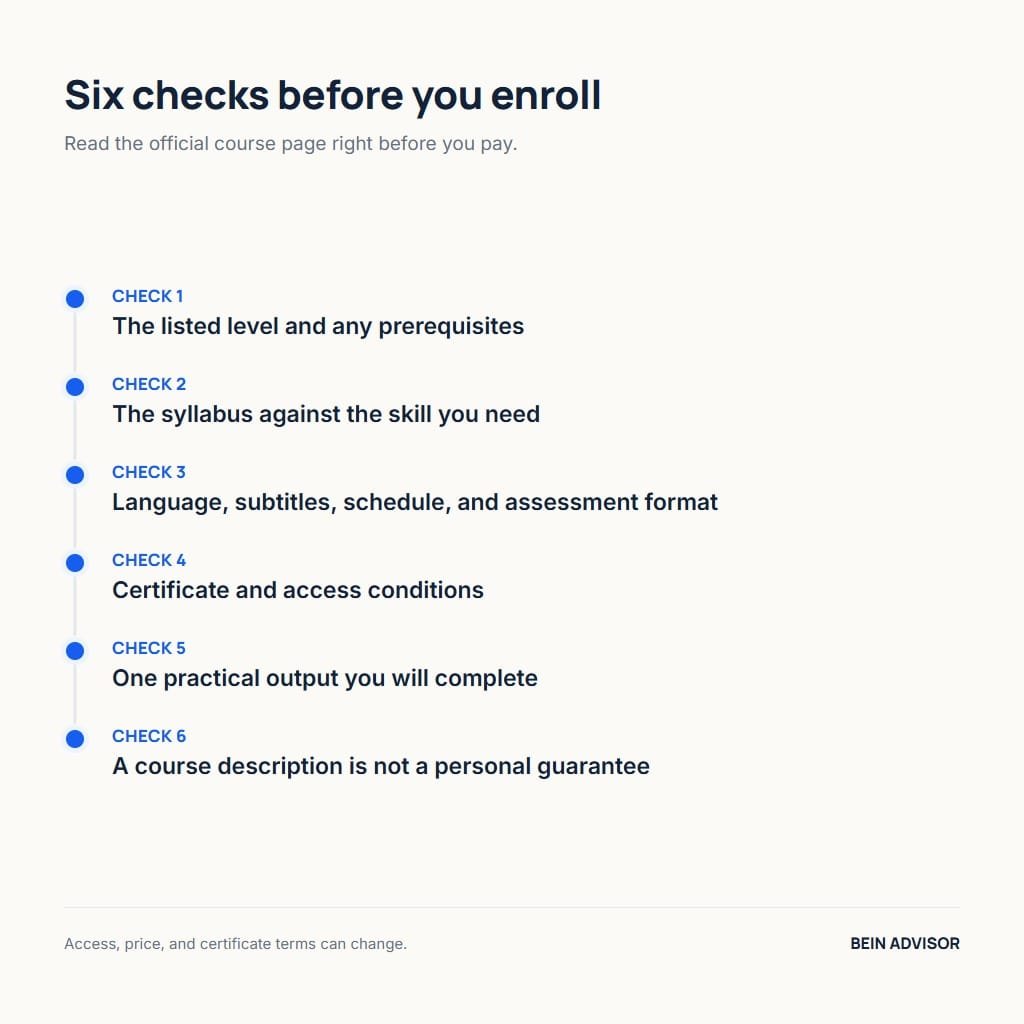
Read the official course page immediately before enrollment because access, price, language, assessment format, and certificate terms can change. In addition, confirm whether the course is an individual class, a Specialization component, or part of a Professional Certificate. Check whether the estimated schedule matches your available time, but do not treat it as a personal guarantee. Similarly, if you need a particular software tool, verify whether the course expects you to supply it or simply discusses the concept. As a result, this final check protects a decision among digital marketing courses from outdated assumptions.
Also decide what evidence will tell you that the course helped. For example, a certificate may be useful as a record of completion, but it does not replace a portfolio, an experiment, a campaign brief, or the ability to explain a decision. If you are studying for a career change, compare the course with the skills requested in the roles you want. In contrast, if you are learning for a current business, connect every module to a real customer question and one measurable action. As a result, this keeps your investment tied to a defined outcome. In addition, it helps you compare digital marketing courses by the work they enable, not by the badge alone.
- Check the listed level and any stated prerequisites.
- Compare the syllabus with the skill you actually need.
- Confirm language, subtitles, schedule estimate, and assessment format.
- Read the certificate and access conditions on the official page.
- Plan one practical output before you enroll.
- Separate a course provider’s description from a personal guarantee.
10. Coursera course cards for a faster choice
These cards summarize the job each of the five digital marketing courses can do and take you to the official Coursera page for the current syllabus and enrollment details. Use the same check for every option. Match the fit, verify the conditions, and choose the output you will complete after studying.
Google Foundations of Digital Marketing and E-commerce
Best for: Beginners who need a broad map of digital marketing, the funnel, and e-commerce.
Suggested output: Map one customer journey and define its channel, action, and measurement signal.
IBM Introduction to Digital Marketing
Best for: Beginners comparing content, email, paid advertising, audience analysis, and analytics.
Suggested output: Write a short campaign brief linking an audience, message, channel, and measurement method.
Adobe Digital Marketing
Best for: Learners focused on campaign planning, audience segments, and measurable outcomes.
Suggested output: Build a one-page campaign brief with a goal, audience, assumption, and metric.
Marketing in a Digital World by the University of Illinois
Best for: Learners who want marketing principles before they focus on a software interface.
Suggested output: Explain the customer problem and marketing decision before naming a tool.
Digital Marketing Fundamentals by Madecraft
Best for: Learners who want a compact pass through planning, audience, SEO, content, and measurement.
Suggested output: Choose one skill from the overview and deepen it through a small follow-up project.
11. Final recommendation on digital marketing courses
For most complete beginners, Google Foundations is the clearest first option to inspect because it connects digital marketing with e-commerce, the funnel, and entry-level context. In contrast, choose IBM Introduction when you want a multi-channel survey, Adobe when campaign planning and measurable outcomes matter most, Marketing in a Digital World when you want concepts before tools, and Digital Marketing Fundamentals when you need a compact overview. Ultimately, your decision among digital marketing courses should follow the learning job you need the course to perform, not a general claim that one platform is best for everyone. The recommendation is a fit judgment, not a guarantee.
Before you enroll, open the official page for your finalist and verify the details that can change. Then choose one practical output and schedule time to complete it. In fact, a course becomes more valuable when it changes what you can explain, plan, measure, or test. Therefore, if this comparison reduced your shortlist of digital marketing courses, use the official Coursera page to confirm the final fit. This is a practical way to begin among digital marketing courses rather than collecting certificates without practice.